




The screen on which the images of the object we see are formed is called as
(A) Cornea
(B) Conjunctiva
(C) Optic nerve
(D) Retina
Answer
 Verified
526.8k+ views
Hint: An image is the exact duplicate of the object that we see from our eyes. The light from this object converts to neural signals and sends these signals to the eye for recognition. All the above-mentioned parts of the eye contribute to the formation of an image, however, it is formed in only one of these parts.
Complete answer:
The eye is a very delicate structure. The orbits, bony sockets in the skull, protect the eyes from physical damage, and a pad of fat behind the eyeball helps to cushion it from shocks. Each eye weighs roughly 7 grams only.
Let’s analyze the given options:
A) Cornea: The anterior portion of the sclera is called the cornea and it lies over the coloured part of the eye, the iris. It is transparent while the rest of the sclera is white and opaque. Due to this characteristic of the sclera, it is also known as the ‘white’ of the eye. No blood vessels are found in the cornea. The cornea is the site that allows light to pass.
B) Conjunctiva: Cornea is covered externally by a thin, transparent membrane called the conjunctiva. The inflammation of this layer causes a disease called conjunctivitis, which is contagious and may spread to other people through the secretion of an infected person. The light rays enter the lens after crossing the conjunctiva.
C) Optic nerve: The axons of the ganglion cells extend across the surface of the retina and unite to form the optic nerve. The area where the optic nerve passes out the eyeball is known as the blind spot, as it lacks rods and cones, images falling on it cannot be perceived.
D) Retina: It is the incomplete innermost coat of the eyeball, incomplete as it has no anterior portion. Three layers of neurons make up the major portion of the retina. The light from the cornea passes through the aqueous humor, lens and vitreous humor and finally forms an image on the screen of the retina.
The structure of a human eye is shown below:
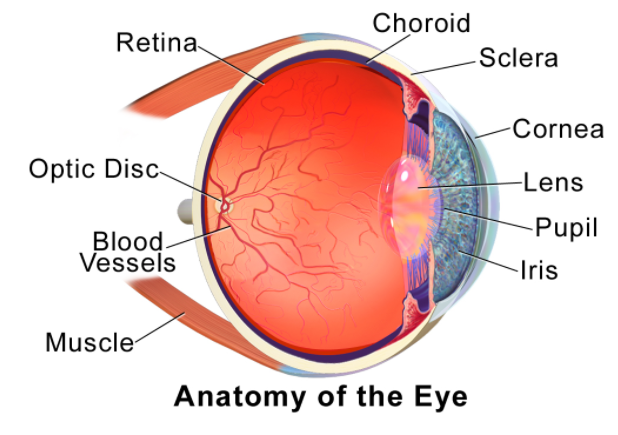
Therefore, The screen on which the images of the object we see are formed is called Retina. So, option (D) is the correct answer.
Note:
- The retina consists of five main types of neurons- photoreceptors, bipolar cells, ganglion cells, horizontal cells and amacrine cells.
- A tiny circular area, about 6 mm in diameter in the retina is the yellow spot or macula lutea, where the vision is sharpest.
Complete answer:
The eye is a very delicate structure. The orbits, bony sockets in the skull, protect the eyes from physical damage, and a pad of fat behind the eyeball helps to cushion it from shocks. Each eye weighs roughly 7 grams only.
Let’s analyze the given options:
A) Cornea: The anterior portion of the sclera is called the cornea and it lies over the coloured part of the eye, the iris. It is transparent while the rest of the sclera is white and opaque. Due to this characteristic of the sclera, it is also known as the ‘white’ of the eye. No blood vessels are found in the cornea. The cornea is the site that allows light to pass.
B) Conjunctiva: Cornea is covered externally by a thin, transparent membrane called the conjunctiva. The inflammation of this layer causes a disease called conjunctivitis, which is contagious and may spread to other people through the secretion of an infected person. The light rays enter the lens after crossing the conjunctiva.
C) Optic nerve: The axons of the ganglion cells extend across the surface of the retina and unite to form the optic nerve. The area where the optic nerve passes out the eyeball is known as the blind spot, as it lacks rods and cones, images falling on it cannot be perceived.
D) Retina: It is the incomplete innermost coat of the eyeball, incomplete as it has no anterior portion. Three layers of neurons make up the major portion of the retina. The light from the cornea passes through the aqueous humor, lens and vitreous humor and finally forms an image on the screen of the retina.
The structure of a human eye is shown below:
Therefore, The screen on which the images of the object we see are formed is called Retina. So, option (D) is the correct answer.
Note:
- The retina consists of five main types of neurons- photoreceptors, bipolar cells, ganglion cells, horizontal cells and amacrine cells.
- A tiny circular area, about 6 mm in diameter in the retina is the yellow spot or macula lutea, where the vision is sharpest.
Recently Updated Pages
Master Class 11 Social Science: Engaging Questions & Answers for Success

Master Class 11 English: Engaging Questions & Answers for Success
Master Class 11 Maths: Engaging Questions & Answers for Success
Master Class 11 Chemistry: Engaging Questions & Answers for Success
Master Class 11 Biology: Engaging Questions & Answers for Success
Master Class 11 Physics: Engaging Questions & Answers for Success
Trending doubts
Differentiate between an exothermic and an endothermic class 11 chemistry CBSE
One Metric ton is equal to kg A 10000 B 1000 C 100 class 11 physics CBSE
Difference Between Prokaryotic Cells and Eukaryotic Cells
There are 720 permutations of the digits 1 2 3 4 5 class 11 maths CBSE
Draw a diagram of a plant cell and label at least eight class 11 biology CBSE
Two of the body parts which do not appear in MRI are class 11 biology CBSE