




The root cells of wheat have $6n= 42$ chromosomes. Which one of the following is the basic chromosome number of wheat?
a. 42
b. 21
c. 7
d. 14
Answer
 Verified
626.4k+ views
Hint: As you know the ploidy level of an organism shows the number of complete chromosome sets present in that organism. The ploidy level is denoted by $n$. For example in this question ploidy level of wheat is 6 i.e. wheat is hexaploid.
Complete answer:
According to the question, wheat is hexaploid, having $6n=42$ chromosomes i.e. it has 6 chromosomes of a single set. Therefore if we solve the equation, the answer comes out to be
$6n=42$ and
$n=7$
Therefore, in wheat there are basically seven chromosomes which have 6 copies of each of the chromosomes.
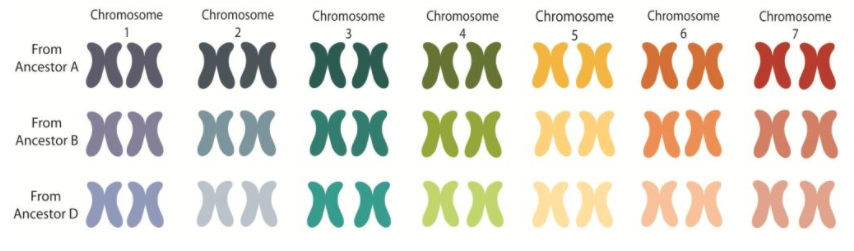
Hence, The correct answer is option (C).
Additional information:
As we already know wheat has seven basic chromosomes that have 6 copies of each, it means it has 21 chromosomes that can be mapped during gene mapping. It is estimated that wheat has almost 164,000 to 334,000 genes present in its genome which is far away from 20,000 to 25,000 genes of a human being. Wheat has the largest genome among commonly grown agricultural crops.
Numerous forms of wheat and many of their hybrids are developed by artificial and natural selection. As like in many grasses, polyploidy is also common in wheat. These can be hexaploid $(6n=42)$ or tetraploid $(4n=28)$. The common wheat is hexaploid otherwise no wild form of hexaploid wheat is found. It is believed that hexaploid wheat is produced by crossing tetraploid wheat and a diploid one.
Note: The polyploidy in wheat is necessary as it influences some of the plant features and also, wheat with one ploidy level will be more closely related to each other, consequently no new genes will be introduced into the species.
Complete answer:
According to the question, wheat is hexaploid, having $6n=42$ chromosomes i.e. it has 6 chromosomes of a single set. Therefore if we solve the equation, the answer comes out to be
$6n=42$ and
$n=7$
Therefore, in wheat there are basically seven chromosomes which have 6 copies of each of the chromosomes.
Hence, The correct answer is option (C).
Additional information:
As we already know wheat has seven basic chromosomes that have 6 copies of each, it means it has 21 chromosomes that can be mapped during gene mapping. It is estimated that wheat has almost 164,000 to 334,000 genes present in its genome which is far away from 20,000 to 25,000 genes of a human being. Wheat has the largest genome among commonly grown agricultural crops.
Numerous forms of wheat and many of their hybrids are developed by artificial and natural selection. As like in many grasses, polyploidy is also common in wheat. These can be hexaploid $(6n=42)$ or tetraploid $(4n=28)$. The common wheat is hexaploid otherwise no wild form of hexaploid wheat is found. It is believed that hexaploid wheat is produced by crossing tetraploid wheat and a diploid one.
Note: The polyploidy in wheat is necessary as it influences some of the plant features and also, wheat with one ploidy level will be more closely related to each other, consequently no new genes will be introduced into the species.
Recently Updated Pages
Master Class 12 Business Studies: Engaging Questions & Answers for Success

Master Class 12 Biology: Engaging Questions & Answers for Success
Master Class 12 Chemistry: Engaging Questions & Answers for Success
Class 12 Question and Answer - Your Ultimate Solutions Guide
Master Class 11 English: Engaging Questions & Answers for Success
Master Class 11 Social Science: Engaging Questions & Answers for Success
Trending doubts
Sulphuric acid is known as the king of acids State class 12 chemistry CBSE
Derive an expression for the electric field intensity class 12 physics CBSE
The electric field due to a uniformly charged nonconducting class 12 physics CBSE
In a halfwave rectifier the rms value of the ac component class 12 physics CBSE
What is apomixis and what is its importance class 12 biology CBSE
One megawatt is equal to how many units of electri class 12 physics CBSE