



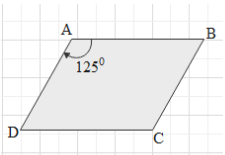
The rhombus is not drawn to scale. Find the other three angles of the given rhombus.
Answer
 Verified
589.5k+ views
Hint:A rhombus is a special type of quadrilateral, whose both pairs of opposite sides are parallel and all the four sides are equal in lengths. The opposites angles of a rhombus are equal and the both the diagonals bisect each other.
Complete step by step answer:
Let us first understand what a rhombus is. A four sided convex polygon is called quadrilateral. A rhombus is a special type of quadrilateral, whose both pairs of opposite sides are parallel and all the four sides are equal in lengths. We can observe these properties in the figure given in the question.
Let us discuss the other properties of a rhombus.The opposites angles of a rhombus are equal and the both the diagonals bisect each other. We now know that the opposite angles of a rhombus are equal. Therefore, the angle C is equal to angle A and angle B is equal to angle D.
i.e. $\angle A=\angle C$ and $\angle B=\angle D$.
It is given that $\angle A={{125}^{\circ }}$.
This means that $\angle C=\angle A={{125}^{\circ }}$.
To find the other two angles of the rhombus, we shall use the property of a quadrilateral that the sum of all (four) the interior angles is equal ${{360}^{\circ }}$.
This means that $\angle A+\angle B+\angle C+\angle D={{360}^{\circ }}$.
Substitute the values of the angles A and C.
$\Rightarrow {{125}^{\circ }}+\angle B+{{125}^{\circ }}+\angle D={{360}^{\circ }}$
$\Rightarrow \angle B+\angle D={{360}^{\circ }}-{{250}^{\circ }}={{110}^{\circ }}$
But we know that $\angle B=\angle D$. Therefore, substitute $\angle B=\angle D$ on the above equation.
$\Rightarrow \angle D+\angle D={{110}^{\circ }}$
$\Rightarrow \angle D={{55}^{\circ }}$
$\therefore \angle B={{55}^{\circ }}$.
Therefore, the other three angles of the rhombus are ${{55}^{\circ }}$, ${{125}^{\circ }}$ and ${{55}^{\circ }}$.
Note:Actually, a rhombus is a special type of parallelogram. A parallelogram is a quadrilateral whose both pairs of opposite sides are parallel and equal in lengths.A rhombus becomes a square when all the four angles of the rhombus are equal to ${{90}^{\circ }}$.Note that a square is a rhombus but a rhombus is not a square.
Complete step by step answer:
Let us first understand what a rhombus is. A four sided convex polygon is called quadrilateral. A rhombus is a special type of quadrilateral, whose both pairs of opposite sides are parallel and all the four sides are equal in lengths. We can observe these properties in the figure given in the question.
Let us discuss the other properties of a rhombus.The opposites angles of a rhombus are equal and the both the diagonals bisect each other. We now know that the opposite angles of a rhombus are equal. Therefore, the angle C is equal to angle A and angle B is equal to angle D.
i.e. $\angle A=\angle C$ and $\angle B=\angle D$.
It is given that $\angle A={{125}^{\circ }}$.
This means that $\angle C=\angle A={{125}^{\circ }}$.
To find the other two angles of the rhombus, we shall use the property of a quadrilateral that the sum of all (four) the interior angles is equal ${{360}^{\circ }}$.
This means that $\angle A+\angle B+\angle C+\angle D={{360}^{\circ }}$.
Substitute the values of the angles A and C.
$\Rightarrow {{125}^{\circ }}+\angle B+{{125}^{\circ }}+\angle D={{360}^{\circ }}$
$\Rightarrow \angle B+\angle D={{360}^{\circ }}-{{250}^{\circ }}={{110}^{\circ }}$
But we know that $\angle B=\angle D$. Therefore, substitute $\angle B=\angle D$ on the above equation.
$\Rightarrow \angle D+\angle D={{110}^{\circ }}$
$\Rightarrow \angle D={{55}^{\circ }}$
$\therefore \angle B={{55}^{\circ }}$.
Therefore, the other three angles of the rhombus are ${{55}^{\circ }}$, ${{125}^{\circ }}$ and ${{55}^{\circ }}$.
Note:Actually, a rhombus is a special type of parallelogram. A parallelogram is a quadrilateral whose both pairs of opposite sides are parallel and equal in lengths.A rhombus becomes a square when all the four angles of the rhombus are equal to ${{90}^{\circ }}$.Note that a square is a rhombus but a rhombus is not a square.
Recently Updated Pages
Master Class 11 English: Engaging Questions & Answers for Success

Master Class 11 Social Science: Engaging Questions & Answers for Success
Master Class 11 Maths: Engaging Questions & Answers for Success
Master Class 11 Biology: Engaging Questions & Answers for Success
Master Class 11 Physics: Engaging Questions & Answers for Success
Master Class 11 Chemistry: Engaging Questions & Answers for Success
Trending doubts
Difference Between Plant Cell and Animal Cell
Fill the blanks with the suitable prepositions 1 The class 9 english CBSE
What is pollution? How many types of pollution? Define it
Name 10 Living and Non living things class 9 biology CBSE
What is the full form of pH?
On an outline map of India show its neighbouring c class 9 social science CBSE