




The resultant of two vectors A and B is perpendicular to the vector A and its magnitude is equal to half the magnitude of B. What is the angle between A and B?
Answer
 Verified
548k+ views
- Hint: Use vector law $\overrightarrow{R}=\overrightarrow{A}+\overrightarrow{B}$, where $\overrightarrow{R}$ is the resultant vector of the vectors $\overrightarrow{A}$ and $\overrightarrow{B}$. ${{\left| \overrightarrow{R} \right|}^{2}}={{\left| \overrightarrow{A} \right|}^{2}}+{{\left| \overrightarrow{B} \right|}^{2}}+2\left| \overrightarrow{A} \right|\left| \overrightarrow{B} \right|\cos (\theta )$, where $\left| \overrightarrow{R} \right|$, $\left| \overrightarrow{A} \right|$, $\left| \overrightarrow{B} \right|$ are the magnitudes of the vectors and $\theta $ is the angle between $\overrightarrow{A}$ and $\overrightarrow{B}$.
Complete step-by-step solution -
The given case can be shown as:
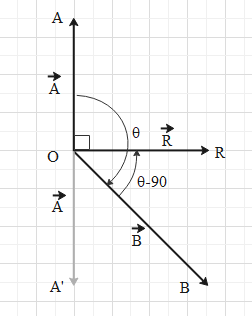
Vector OA is perpendicular to vector OR and OA’ is a vector equal in magnitude with OA but opposite in direction of OA.
Here, $\overrightarrow{A}+\overrightarrow{B}=\overrightarrow{R}$ ………..(i). But we can also write it as $\overrightarrow{R}+\left( -\overrightarrow{A} \right)=\overrightarrow{B}$ …………(1)
Let magnitude of vector OA be ‘a’, magnitude of vector OB be ‘b’, magnitude of vector OR be ‘r’ and since vector OA’ is equal in magnitude with OA, magnitude of vector OA’ will be ‘a’.
Now, by using the resultant formula for (1) we get, ${{\left| \overrightarrow{B} \right|}^{2}}={{\left| \overrightarrow{A} \right|}^{2}}+{{\left| \overrightarrow{R} \right|}^{2}}+2\left| \overrightarrow{A} \right|\left| \overrightarrow{R} \right|\cos (\theta )$.
$\Rightarrow {{b}^{2}}={{a}^{2}}+{{r}^{2}}+2ar\cos ({{90}^{\circ }})$ .………(2)
But, it is said that the magnitude of vector OR is half of the magnitude of vector OB. Therefore, $r=\dfrac{1}{2}b\Rightarrow 2r=b$ ……….(3). Substitute this value of b in (2).
So, we get,
$\Rightarrow {{(2r)}^{2}}={{a}^{2}}+{{r}^{2}}+0$ (Since cos(90) = 0).
$\Rightarrow 3{{r}^{2}}={{a}^{2}}$ .……….(4)
Now, use the resultant formula for (i).
Therefore, ${{r}^{2}}={{a}^{2}}+{{b}^{2}}+2abcos\theta $ ……….(ii). Substitute the values of a and b from equations (4) and (3) respectively in equation (ii).
$\Rightarrow {{r}^{2}}=3{{r}^{2}}+{{(2r)}^{2}}+2\sqrt{3{{r}^{2}}}.2rcos\theta $
Now, solve for theta.
$\Rightarrow 1=3+4+2\sqrt{3}\cos \theta $
$\Rightarrow \cos \theta =-\dfrac{\sqrt{3}}{2}$
Since the value is negative, the angle will be an obtuse angle and the value that angle will equal to 180 - 30 = 150. Therefore, the angle between the vectors A and B is ${{150}^{o}}$.
Note: The problem can also be solved by resolving the vector B. If you complete the triangle ROB, you will get a right-angled triangle with OB as the hypotenuse. Now, use the trigonometric ratio, cos.
Therefore,
$\cos (\theta -90)=\dfrac{r}{b}\Rightarrow r=b\cos (\theta -90)$ But we also know that $r=\dfrac{1}{2}b$.
$\Rightarrow \dfrac{1}{2}b=b\cos (\theta -90)$
$\Rightarrow \dfrac{1}{2}=\cos (\theta -90)$
$\Rightarrow \theta -90=60\Rightarrow \theta ={{150}^{o}}$
Therefore, the angle between the vectors A and B is ${{150}^{o}}$.
Complete step-by-step solution -
The given case can be shown as:
Vector OA is perpendicular to vector OR and OA’ is a vector equal in magnitude with OA but opposite in direction of OA.
Here, $\overrightarrow{A}+\overrightarrow{B}=\overrightarrow{R}$ ………..(i). But we can also write it as $\overrightarrow{R}+\left( -\overrightarrow{A} \right)=\overrightarrow{B}$ …………(1)
Let magnitude of vector OA be ‘a’, magnitude of vector OB be ‘b’, magnitude of vector OR be ‘r’ and since vector OA’ is equal in magnitude with OA, magnitude of vector OA’ will be ‘a’.
Now, by using the resultant formula for (1) we get, ${{\left| \overrightarrow{B} \right|}^{2}}={{\left| \overrightarrow{A} \right|}^{2}}+{{\left| \overrightarrow{R} \right|}^{2}}+2\left| \overrightarrow{A} \right|\left| \overrightarrow{R} \right|\cos (\theta )$.
$\Rightarrow {{b}^{2}}={{a}^{2}}+{{r}^{2}}+2ar\cos ({{90}^{\circ }})$ .………(2)
But, it is said that the magnitude of vector OR is half of the magnitude of vector OB. Therefore, $r=\dfrac{1}{2}b\Rightarrow 2r=b$ ……….(3). Substitute this value of b in (2).
So, we get,
$\Rightarrow {{(2r)}^{2}}={{a}^{2}}+{{r}^{2}}+0$ (Since cos(90) = 0).
$\Rightarrow 3{{r}^{2}}={{a}^{2}}$ .……….(4)
Now, use the resultant formula for (i).
Therefore, ${{r}^{2}}={{a}^{2}}+{{b}^{2}}+2abcos\theta $ ……….(ii). Substitute the values of a and b from equations (4) and (3) respectively in equation (ii).
$\Rightarrow {{r}^{2}}=3{{r}^{2}}+{{(2r)}^{2}}+2\sqrt{3{{r}^{2}}}.2rcos\theta $
Now, solve for theta.
$\Rightarrow 1=3+4+2\sqrt{3}\cos \theta $
$\Rightarrow \cos \theta =-\dfrac{\sqrt{3}}{2}$
Since the value is negative, the angle will be an obtuse angle and the value that angle will equal to 180 - 30 = 150. Therefore, the angle between the vectors A and B is ${{150}^{o}}$.
Note: The problem can also be solved by resolving the vector B. If you complete the triangle ROB, you will get a right-angled triangle with OB as the hypotenuse. Now, use the trigonometric ratio, cos.
Therefore,
$\cos (\theta -90)=\dfrac{r}{b}\Rightarrow r=b\cos (\theta -90)$ But we also know that $r=\dfrac{1}{2}b$.
$\Rightarrow \dfrac{1}{2}b=b\cos (\theta -90)$
$\Rightarrow \dfrac{1}{2}=\cos (\theta -90)$
$\Rightarrow \theta -90=60\Rightarrow \theta ={{150}^{o}}$
Therefore, the angle between the vectors A and B is ${{150}^{o}}$.
Recently Updated Pages
Master Class 12 Business Studies: Engaging Questions & Answers for Success

Master Class 12 Biology: Engaging Questions & Answers for Success
Master Class 12 Chemistry: Engaging Questions & Answers for Success
Class 12 Question and Answer - Your Ultimate Solutions Guide
Master Class 11 Social Science: Engaging Questions & Answers for Success
Master Class 11 English: Engaging Questions & Answers for Success
Trending doubts
Which is more stable and why class 12 chemistry CBSE
Which are the Top 10 Largest Countries of the World?
Draw a labelled sketch of the human eye class 12 physics CBSE
Differentiate between homogeneous and heterogeneous class 12 chemistry CBSE
What are the major means of transport Explain each class 12 social science CBSE
Sulphuric acid is known as the king of acids State class 12 chemistry CBSE