




The resultant magnetic moment for the following arrangement is:
A. M
B. 2M
C. 3M
D. 4M
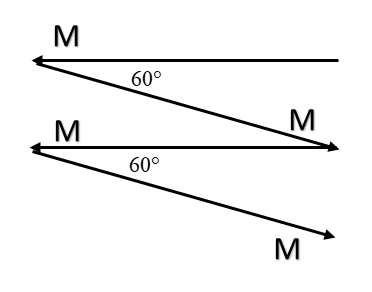
Answer
 Verified
621k+ views
Hint: Magnetic field is the space around the magnet where the effect of magnet can be felt by another magnet or iron piece. Magnetic fields can also be produced by a moving charge whose intensity can be determined by the velocity and magnitude of charge or using a magnet having definite pole strength. The S.I unit of magnetic field is Tesla (T) whereas the C.G.S unit is Gauss (G).
Formula used:
$R = \sqrt{A^2+B^2+2ABcos\theta}$
Complete answer:
In physics, moment means the torque, if it is associated with some force. Hence magnetic moment is the measure of torque that a bar magnet will experience when placed in an external magnetic field. It is a vector quantity. Hence to get its resultant, we have to add it by vector addition.
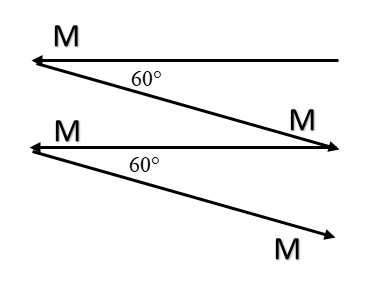
Now, using the property of vectors, we can displace the vector anywhere in the space by keeping its direction and magnitude the same. Now, the vectors which are present in the same direction could be simply added up. Thus we can redraw the diagram as:
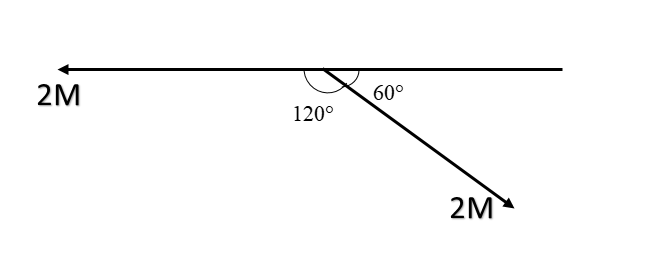
Here, by linear pair axiom, we can say the angles between two vectors as $180^{\circ} - 60^{\circ} = 120^{\circ}$
Now, let the resultant of the moments be ‘R’ (as shown in the figure), hence we can use formula$R = \sqrt{A^2+B^2+2ABcos\theta}$, we get:
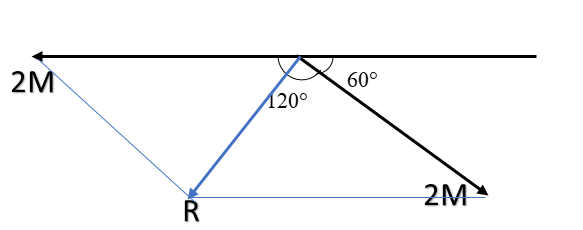
$R = \sqrt{(2M)^2 + (2M)^2 + 2(2M)(2M)cos120\circ}$
$R = \sqrt{4M^2+4M^2 + 8M^2 (\dfrac{-1}{2})}$
$R = \sqrt{8M^2- 4M^2 }$
$R = \sqrt{4M^2} = 2M$
Hence, the resultant equals 2M.
So, the correct answer is “Option B”.
Note:
In the above expression, we have the magnitude $R = \sqrt{A^2+B^2+2ABcos\theta}$, which has nothing to do with the direction of $\vec R$ i.e. resultant whereas in expression, $\alpha =tan^{-1}{ \dfrac{\vec B sin \theta}{\vec B cos \theta + A}}$. The vector quantities can’t be expressed without its direction. Hence we can represent the resultant as 2M, making $60^{\circ}$ with the horizontal.
Formula used:
$R = \sqrt{A^2+B^2+2ABcos\theta}$
Complete answer:
In physics, moment means the torque, if it is associated with some force. Hence magnetic moment is the measure of torque that a bar magnet will experience when placed in an external magnetic field. It is a vector quantity. Hence to get its resultant, we have to add it by vector addition.
Now, using the property of vectors, we can displace the vector anywhere in the space by keeping its direction and magnitude the same. Now, the vectors which are present in the same direction could be simply added up. Thus we can redraw the diagram as:
Here, by linear pair axiom, we can say the angles between two vectors as $180^{\circ} - 60^{\circ} = 120^{\circ}$
Now, let the resultant of the moments be ‘R’ (as shown in the figure), hence we can use formula$R = \sqrt{A^2+B^2+2ABcos\theta}$, we get:
$R = \sqrt{(2M)^2 + (2M)^2 + 2(2M)(2M)cos120\circ}$
$R = \sqrt{4M^2+4M^2 + 8M^2 (\dfrac{-1}{2})}$
$R = \sqrt{8M^2- 4M^2 }$
$R = \sqrt{4M^2} = 2M$
Hence, the resultant equals 2M.
So, the correct answer is “Option B”.
Note:
In the above expression, we have the magnitude $R = \sqrt{A^2+B^2+2ABcos\theta}$, which has nothing to do with the direction of $\vec R$ i.e. resultant whereas in expression, $\alpha =tan^{-1}{ \dfrac{\vec B sin \theta}{\vec B cos \theta + A}}$. The vector quantities can’t be expressed without its direction. Hence we can represent the resultant as 2M, making $60^{\circ}$ with the horizontal.
Recently Updated Pages
Master Class 12 Business Studies: Engaging Questions & Answers for Success

Master Class 12 Chemistry: Engaging Questions & Answers for Success
Master Class 12 Biology: Engaging Questions & Answers for Success
Class 12 Question and Answer - Your Ultimate Solutions Guide
Master Class 11 English: Engaging Questions & Answers for Success
Master Class 11 Social Science: Engaging Questions & Answers for Success
Trending doubts
Which are the Top 10 Largest Countries of the World?
Draw a labelled sketch of the human eye class 12 physics CBSE
Differentiate between homogeneous and heterogeneous class 12 chemistry CBSE
Why is the cell called the structural and functional class 12 biology CBSE
Draw ray diagrams each showing i myopic eye and ii class 12 physics CBSE
Which is the correct genotypic ratio of mendel dihybrid class 12 biology CBSE