




The resistance of an ammeter is given as $13\Omega $ and its scale is graduated for a current up to $100A$. After an additional shunt has been connected to the ammeter it becomes possible to measure currents up to $750A$ by this meter. The value of shunt resistance is
$\begin{align}
& A.20\Omega \\
& B.2\Omega \\
& C.0.2\Omega \\
& D.2K\Omega \\
\end{align}$
Answer
 Verified
594.9k+ views
Hint: Current flowing through ${{R}_{A}}$ should be found first of all and then current through shunt resistance is found out. Using this the potential difference between two points should be taken.
From this we can calculate the shunt resistance.
Complete step by step answer:
First of all let us take a look at what the shunt resistance means. A shunt resistor is a resistor having a very small value of resistance. The shunt resistor is primarily made of the substances having the low-temperature coefficient of resistance. It is usually used to convert a galvanometer into either an ammeter or to a voltmeter. It is to be connected in parallel with the ammeter which is chosen to extend the range. Here it is given that
${{R}_{A}}=13\Omega $
Let us take the shunt resistance to be ${{R}_{S}}$and also the current flowing through ${{R}_{A}}$is${{I}_{1}}$.
\[{{R}_{s}}=2\Omega \]
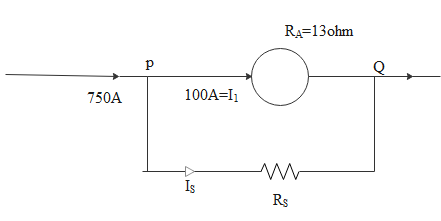
${{I}_{1}}=100A$
Therefore the current flowing in the shunt resistance is,
${{I}_{2}}=750-{{I}_{1}}=750-100=650A$
As we observe the figure we will get to know that potential difference across P and Q is similar.
Therefore,
${{I}_{2}}\times {{R}_{S}}={{I}_{1}}\times {{R}_{A}}$
Substituting the values,
$650\times {{R}_{s}}=100\times 13$
Therefore the shunt resistance is given as
\[{{R}_{s}}=2\Omega \]
Therefore the correct answer is option is option B.
Note:
A shunt resistance is a low resistance resistor that is used to measure current. The total current flows through the shunt and develops a voltage drop, which is then calculated. By the use of Ohm's law and the value of the known resistance, these calculations can then be used to calculate the current also.
From this we can calculate the shunt resistance.
Complete step by step answer:
First of all let us take a look at what the shunt resistance means. A shunt resistor is a resistor having a very small value of resistance. The shunt resistor is primarily made of the substances having the low-temperature coefficient of resistance. It is usually used to convert a galvanometer into either an ammeter or to a voltmeter. It is to be connected in parallel with the ammeter which is chosen to extend the range. Here it is given that
${{R}_{A}}=13\Omega $
Let us take the shunt resistance to be ${{R}_{S}}$and also the current flowing through ${{R}_{A}}$is${{I}_{1}}$.
\[{{R}_{s}}=2\Omega \]
${{I}_{1}}=100A$
Therefore the current flowing in the shunt resistance is,
${{I}_{2}}=750-{{I}_{1}}=750-100=650A$
As we observe the figure we will get to know that potential difference across P and Q is similar.
Therefore,
${{I}_{2}}\times {{R}_{S}}={{I}_{1}}\times {{R}_{A}}$
Substituting the values,
$650\times {{R}_{s}}=100\times 13$
Therefore the shunt resistance is given as
\[{{R}_{s}}=2\Omega \]
Therefore the correct answer is option is option B.
Note:
A shunt resistance is a low resistance resistor that is used to measure current. The total current flows through the shunt and develops a voltage drop, which is then calculated. By the use of Ohm's law and the value of the known resistance, these calculations can then be used to calculate the current also.
Recently Updated Pages
Master Class 12 Economics: Engaging Questions & Answers for Success

Master Class 12 Physics: Engaging Questions & Answers for Success
Master Class 12 English: Engaging Questions & Answers for Success
Master Class 12 Social Science: Engaging Questions & Answers for Success
Master Class 12 Maths: Engaging Questions & Answers for Success
Master Class 12 Business Studies: Engaging Questions & Answers for Success
Trending doubts
Which are the Top 10 Largest Countries of the World?
What are the major means of transport Explain each class 12 social science CBSE
Draw a labelled sketch of the human eye class 12 physics CBSE
Why cannot DNA pass through cell membranes class 12 biology CBSE
Differentiate between insitu conservation and exsitu class 12 biology CBSE
Draw a neat and well labeled diagram of TS of ovary class 12 biology CBSE