




The relation between magnetic field and current is given by Biot-Savart law. Illustrate Biot-Savart law with necessary figures.
Answer
 Verified
623.1k+ views
Hint
The Biot-Savart law states that a small current-carrying conductor of length $ dl $ and carrying a current $ I $ is an elementary source of the magnetic field. Therefore this law can be used to calculate the magnetic field of certain distributions.
Complete step by step answer
The Biot-Savart law gives us the magnetic field that is associated with a current-carrying conductor. According to this law, the magnetic field at any point due to a current element $ Idl $ is given by,
$\Rightarrow d\vec B = \dfrac{{{\mu _o}}}{{4\pi }}\dfrac{{Id\vec l \times \vec R}}{{{R^3}}} $
$\vec R $ is the distance of the current-carrying conductor from the point of observation and $ {\mu _o} $ is the permeability of free space which has a value of $ {\mu _o} = 4\pi \times {10^{ - 7}}N/{A^2} $ .
To derive this mathematical expression we consider a wire carrying current $ I $ in a specific direction as in the figure,
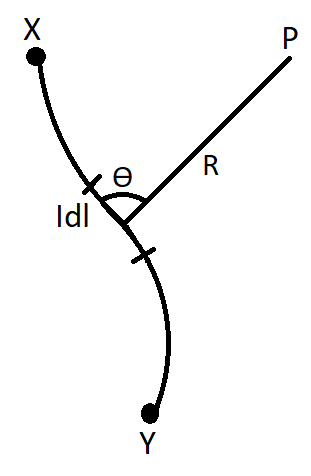
Let us consider a small element of wire $ dl $ . The direction of this element is along the direction of the current in the wire. Now by using the Biot-Savart law we can calculate the magnetic field at the point P due to this current element.
The magnetic field at point P due to the element $ dl $ is found to be proportional to the current in the wire, and the length of $ dl $ and is inversely proportional to the square of the distance $ R $ .
So we can write,
$\Rightarrow d\vec B \propto \dfrac{{Id\vec l \times \vec R}}{{{R^3}}} $
and removing the proportionality we get,
$\Rightarrow d\vec B = \dfrac{{{\mu _o}}}{{4\pi }}\dfrac{{Id\vec l \times \vec R}}{{{R^3}}} $
The magnitude of this field is given by,
$\Rightarrow \left| {d\vec B} \right| = \dfrac{{{\mu _o}}}{{4\pi }}\dfrac{{Idl\sin \theta }}{{{R^2}}} $.
Note
The Biot-Savart law is similar to Coulomb's law in a way as both of them are inversely proportional to the square of the distance between the source and the point. Using the Biot-Savart law we can calculate the magnetic fields of various current-carrying elements.
The Biot-Savart law states that a small current-carrying conductor of length $ dl $ and carrying a current $ I $ is an elementary source of the magnetic field. Therefore this law can be used to calculate the magnetic field of certain distributions.
Complete step by step answer
The Biot-Savart law gives us the magnetic field that is associated with a current-carrying conductor. According to this law, the magnetic field at any point due to a current element $ Idl $ is given by,
$\Rightarrow d\vec B = \dfrac{{{\mu _o}}}{{4\pi }}\dfrac{{Id\vec l \times \vec R}}{{{R^3}}} $
$\vec R $ is the distance of the current-carrying conductor from the point of observation and $ {\mu _o} $ is the permeability of free space which has a value of $ {\mu _o} = 4\pi \times {10^{ - 7}}N/{A^2} $ .
To derive this mathematical expression we consider a wire carrying current $ I $ in a specific direction as in the figure,
Let us consider a small element of wire $ dl $ . The direction of this element is along the direction of the current in the wire. Now by using the Biot-Savart law we can calculate the magnetic field at the point P due to this current element.
The magnetic field at point P due to the element $ dl $ is found to be proportional to the current in the wire, and the length of $ dl $ and is inversely proportional to the square of the distance $ R $ .
So we can write,
$\Rightarrow d\vec B \propto \dfrac{{Id\vec l \times \vec R}}{{{R^3}}} $
and removing the proportionality we get,
$\Rightarrow d\vec B = \dfrac{{{\mu _o}}}{{4\pi }}\dfrac{{Id\vec l \times \vec R}}{{{R^3}}} $
The magnitude of this field is given by,
$\Rightarrow \left| {d\vec B} \right| = \dfrac{{{\mu _o}}}{{4\pi }}\dfrac{{Idl\sin \theta }}{{{R^2}}} $.
Note
The Biot-Savart law is similar to Coulomb's law in a way as both of them are inversely proportional to the square of the distance between the source and the point. Using the Biot-Savart law we can calculate the magnetic fields of various current-carrying elements.
Recently Updated Pages
Master Class 12 Business Studies: Engaging Questions & Answers for Success

Master Class 12 Chemistry: Engaging Questions & Answers for Success
Master Class 12 Biology: Engaging Questions & Answers for Success
Class 12 Question and Answer - Your Ultimate Solutions Guide
Master Class 11 English: Engaging Questions & Answers for Success
Master Class 11 Social Science: Engaging Questions & Answers for Success
Trending doubts
Which are the Top 10 Largest Countries of the World?
Draw a labelled sketch of the human eye class 12 physics CBSE
Differentiate between homogeneous and heterogeneous class 12 chemistry CBSE
Differentiate between Pyramid of energy and pyramid class 12 biology CBSE
Why is the cell called the structural and functional class 12 biology CBSE
Draw the diagram of the pyramid of energy Explain In class 12 biology CBSE