




The relation between enol content x, y and z should be
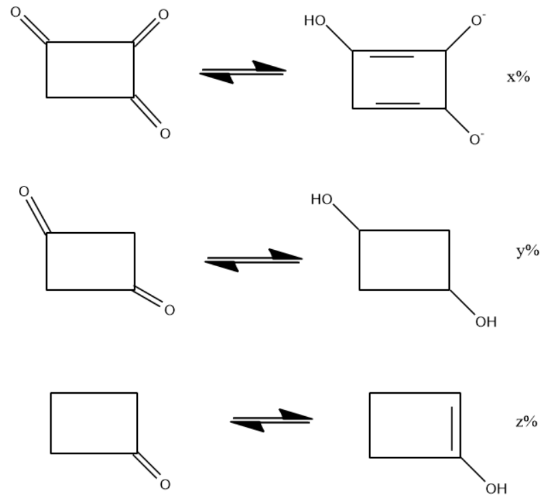
(A) x > y > z
(B) z > y > x
(C) x > z > y
(D) y > x > z
Answer
 Verified
507.9k+ views
Hint :To find the relation between these enol content one must know the stability order of aromatic, non-aromatic and anti-aromatic enols. Also one should know how to identify these properties in a compound.
Complete Step By Step Answer:
Enol or also known as the alkenols are a type of reactive structure or intermediate in organic chemistry that is represented as an alkene with a hydroxyl group attached to one end of the alkene double bond.
Now let’s find out whether the given enols are aromatic, anti-aromatic or non-aromatic. Also the order of stability of enol is aromatic > non-aromatic > anti-aromatic.
A molecule is aromatic if it is cyclic, planar and completely conjugated with $ (4n + 2)\pi $
For the first option, it exists as a resonance structure where the enol ring has a double bond inside it. Therefore the system has two pi electrons. This means that it follows all the rules of aromaticity. Thus it is an aromatic compound. As discussed earlier aromatic enol has the highest order of stability, therefore it is the most stable compound.
A molecule or compound is non-aromatic if the factors like cyclic, planar or fully conjugated are not followed, therefore called to be a non-aromatic compound. This is true for the third option. Therefore it is a non-aromatic compound. It will occupy the second position in enol stability order.
The anti-aromatic compound is very close to the aromatic compound, but instead of $ (4n + 2)\pi $ it should have $ 4n $ system. The second option is an antiaromatic compound as there is no pi-electron system therefore it is $ 4n $ system. Therefore it is the least stable compound.
On account of all these reasons, our answer is option C which is x > z > y.
Note :
Generation of enols often involves removal of a hydrogen adjacent to the carbonyl group i.e. deprotonation. When this proton is not returned at the end of the stepwise process, the result is an anion termed enolate. Generation of enol is accompanied by masking of hydroxyl group as an ether.
Complete Step By Step Answer:
Enol or also known as the alkenols are a type of reactive structure or intermediate in organic chemistry that is represented as an alkene with a hydroxyl group attached to one end of the alkene double bond.
Now let’s find out whether the given enols are aromatic, anti-aromatic or non-aromatic. Also the order of stability of enol is aromatic > non-aromatic > anti-aromatic.
A molecule is aromatic if it is cyclic, planar and completely conjugated with $ (4n + 2)\pi $
For the first option, it exists as a resonance structure where the enol ring has a double bond inside it. Therefore the system has two pi electrons. This means that it follows all the rules of aromaticity. Thus it is an aromatic compound. As discussed earlier aromatic enol has the highest order of stability, therefore it is the most stable compound.
A molecule or compound is non-aromatic if the factors like cyclic, planar or fully conjugated are not followed, therefore called to be a non-aromatic compound. This is true for the third option. Therefore it is a non-aromatic compound. It will occupy the second position in enol stability order.
The anti-aromatic compound is very close to the aromatic compound, but instead of $ (4n + 2)\pi $ it should have $ 4n $ system. The second option is an antiaromatic compound as there is no pi-electron system therefore it is $ 4n $ system. Therefore it is the least stable compound.
On account of all these reasons, our answer is option C which is x > z > y.
Note :
Generation of enols often involves removal of a hydrogen adjacent to the carbonyl group i.e. deprotonation. When this proton is not returned at the end of the stepwise process, the result is an anion termed enolate. Generation of enol is accompanied by masking of hydroxyl group as an ether.
Recently Updated Pages
Master Class 12 Economics: Engaging Questions & Answers for Success

Master Class 12 Physics: Engaging Questions & Answers for Success
Master Class 12 English: Engaging Questions & Answers for Success
Master Class 12 Social Science: Engaging Questions & Answers for Success
Master Class 12 Maths: Engaging Questions & Answers for Success
Master Class 12 Business Studies: Engaging Questions & Answers for Success
Trending doubts
Which are the Top 10 Largest Countries of the World?
What are the major means of transport Explain each class 12 social science CBSE
Draw a labelled sketch of the human eye class 12 physics CBSE
Why cannot DNA pass through cell membranes class 12 biology CBSE
Differentiate between insitu conservation and exsitu class 12 biology CBSE
Draw a neat and well labeled diagram of TS of ovary class 12 biology CBSE