




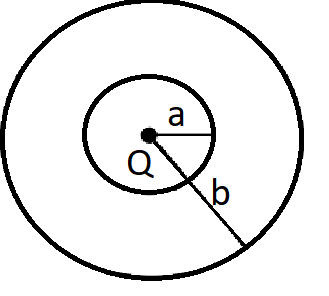
The region between two concentric spheres of radii ‘a’ and ‘b’, respectively, has a volume charge density of $\rho =\dfrac{A}{r}$, where A is constant and r is the distance from the centre. At the centre of the sphere is a point charge Q. The value of A such that the electric field in the region between the spheres will be constant, is:
A. $\dfrac{Q}{2\pi {{a}^{2}}}$
B. $\dfrac{Q}{2\pi ({{b}^{2}}-{{a}^{2}})}$
C. $\dfrac{Q}{2\pi ({{a}^{2}}-{{b}^{2}})}$
D. $\dfrac{Q}{\pi {{a}^{2}}}$
Answer
 Verified
556.7k+ views
Hint: This question is an application of the concept of Flux that was given by Gauss. We can easily find the formula using Gauss's Theorem. Take a small element dr and then integrate. While integrating, set a and b as lower limit and upper limit respectively.
Complete answer:
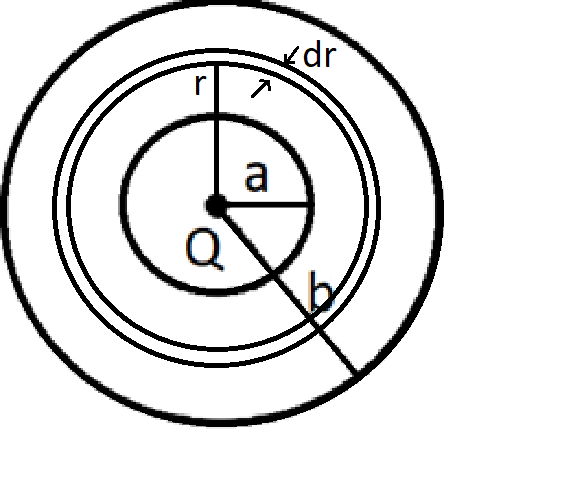
Let us consider a sphere between two concentric spheres lying in the area of radius r and thickness dr. Charging within alone leads to electric field / flux according to Gauss' theorem.
So,
We have
\[\Rightarrow \dfrac{kQ}{{{a}^{2}}}=\dfrac{k[Q+\int\limits_{a}^{b}{4\pi r2drAr}]}{{{b}^{2}}}\]
Where, k is coulomb’s constant, and a, r, and b are the radii of the three concentric circles respectively.
Now,
On integrating, ‘rdr’
In accordance with the power rule of integration, i.e.,
$\int{{{x}^{a}}dx=\dfrac{{{x}^{a+1}}}{a+1}}$
So,
We have
\[\Rightarrow Q\dfrac{{{b}^{2}}}{{{a}^{2}}}=Q+4\pi A[\dfrac{{{r}^{2}}}{2}]_{a}^{b}\]
\[=Q+4\pi A\dfrac{({{b}^{2}}-{{a}^{2}})}{2}\]
\[\Rightarrow \dfrac{Q\left( {{b}^{2}}-{{a}^{2}} \right)}{{{a}^{2}}}=2\pi A\left( {{b}^{2}}-{{a}^{2}} \right)\]
So, now
We have
\[A=\dfrac{Q}{2\pi {{a}^{2}}}\]
So, the value of A such that the electric field in the region between the spheres will be constant, is \[\dfrac{Q}{2\pi {{a}^{2}}}\]
So, the correct answer is “Option A”.
Note:
The law of Gauss, also known as the flux theorem of Gauss, is a law of physics relating to the propagation of electric charges to the resulting electric field. A closed one enclosing a volume such as a spherical surface might be the surface under consideration.
Complete answer:
Let us consider a sphere between two concentric spheres lying in the area of radius r and thickness dr. Charging within alone leads to electric field / flux according to Gauss' theorem.
So,
We have
\[\Rightarrow \dfrac{kQ}{{{a}^{2}}}=\dfrac{k[Q+\int\limits_{a}^{b}{4\pi r2drAr}]}{{{b}^{2}}}\]
Where, k is coulomb’s constant, and a, r, and b are the radii of the three concentric circles respectively.
Now,
On integrating, ‘rdr’
In accordance with the power rule of integration, i.e.,
$\int{{{x}^{a}}dx=\dfrac{{{x}^{a+1}}}{a+1}}$
So,
We have
\[\Rightarrow Q\dfrac{{{b}^{2}}}{{{a}^{2}}}=Q+4\pi A[\dfrac{{{r}^{2}}}{2}]_{a}^{b}\]
\[=Q+4\pi A\dfrac{({{b}^{2}}-{{a}^{2}})}{2}\]
\[\Rightarrow \dfrac{Q\left( {{b}^{2}}-{{a}^{2}} \right)}{{{a}^{2}}}=2\pi A\left( {{b}^{2}}-{{a}^{2}} \right)\]
So, now
We have
\[A=\dfrac{Q}{2\pi {{a}^{2}}}\]
So, the value of A such that the electric field in the region between the spheres will be constant, is \[\dfrac{Q}{2\pi {{a}^{2}}}\]
So, the correct answer is “Option A”.
Note:
The law of Gauss, also known as the flux theorem of Gauss, is a law of physics relating to the propagation of electric charges to the resulting electric field. A closed one enclosing a volume such as a spherical surface might be the surface under consideration.
Recently Updated Pages
Master Class 12 Economics: Engaging Questions & Answers for Success

Master Class 12 English: Engaging Questions & Answers for Success
Master Class 12 Social Science: Engaging Questions & Answers for Success
Master Class 12 Maths: Engaging Questions & Answers for Success
Master Class 12 Physics: Engaging Questions & Answers for Success
Master Class 9 General Knowledge: Engaging Questions & Answers for Success
Trending doubts
Which are the Top 10 Largest Countries of the World?
Draw a labelled sketch of the human eye class 12 physics CBSE
Differentiate between homogeneous and heterogeneous class 12 chemistry CBSE
Sulphuric acid is known as the king of acids State class 12 chemistry CBSE
Why is the cell called the structural and functional class 12 biology CBSE
A dentist uses a small mirror that gives a magnification class 12 physics CBSE