




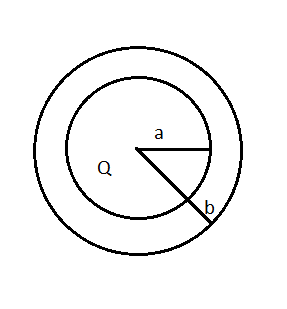
The region between two concentric circle spheres of radius and , respectively (in figure), has volume charge density $ \rho = \dfrac{A}{r} $ , where $ A $ is a constant and $ r $ is the distance from the centre. At the centre of the sphere is a point charge $ Q $ . The value of $ A $ such that the electric field in the region between the spheres will be constant, is:
(A) $ \dfrac{Q}{{2\pi {a^2}}} $
(B) $ \dfrac{Q}{{2\pi \left( {{b^2} - {a^2}} \right)}} $
(C) $ \dfrac{Q}{{2\pi \left( {{a^2} - {b^2}} \right)}} $
(D) $ \dfrac{{2Q}}{{\pi {a^2}}} $
Answer
 Verified
569.1k+ views
Hint: to solve this problem we should know about the Gauss’s theorem and force exerted by electric charge.
Electrostatic force:
$ F = \dfrac{{k{q_1}{q_2}}}{{{r^2}}} $ , here $ k $ is constant.
Gauss’s theorem: it states that the net flux through any hypothetical closed surface will equal to $ \dfrac{1}{{{\varepsilon _0}}} $ times the total charge inside the closed surface.
$ \oint {E.ds = \dfrac{1}{{{\varepsilon _0}}}q} $
Complete step by step solution:
Let’s assume that a sphere of radius $ r $ and it has thickness $ dr $ lying in the region between two concentric spheres.
From Gauss's theorem, charge inside alone will contribute to the electric field. We get,
So, $ \dfrac{{kQ}}{{{a^2}}} = \dfrac{{k\left[ {Q + \int\limits_a^b {4\pi {r^2}dr\dfrac{A}{r}} } \right]}}{{{b^2}}} $
$ \Rightarrow Q\dfrac{{{b^2}}}{{{a^2}}} = Q + A\int\limits_a^b {4\pi rdr} $
By integrating the given equation. We get,
$ \Rightarrow Q\left( {\dfrac{{{b^2}}}{{{a^2}}} - 1} \right) = 2\pi A({b^2} - {a^2}) $
$ \Rightarrow Q\left( {\dfrac{{{b^2} - {a^2}}}{{{a^2}}}} \right) = 2\pi A({b^2} - {a^2}) $
$ \Rightarrow A = \dfrac{Q}{{2\pi {a^2}}} $
So, we can conclude from the above solution, option (a) is the right answer.
Note:
Gauss’s law is used to solve complex problems. As we have to only find the charge inside the given surface then we can easily calculate the electric field due to these charges. We can find complex problems like electric fields due to infinite long charge carrying wire, electric field due to charge plate, electric field due to charged cylinder. Electric field is a force experienced by a charged particle in the periphery of another charged particle.
Electrostatic force:
$ F = \dfrac{{k{q_1}{q_2}}}{{{r^2}}} $ , here $ k $ is constant.
Gauss’s theorem: it states that the net flux through any hypothetical closed surface will equal to $ \dfrac{1}{{{\varepsilon _0}}} $ times the total charge inside the closed surface.
$ \oint {E.ds = \dfrac{1}{{{\varepsilon _0}}}q} $
Complete step by step solution:
Let’s assume that a sphere of radius $ r $ and it has thickness $ dr $ lying in the region between two concentric spheres.
From Gauss's theorem, charge inside alone will contribute to the electric field. We get,
So, $ \dfrac{{kQ}}{{{a^2}}} = \dfrac{{k\left[ {Q + \int\limits_a^b {4\pi {r^2}dr\dfrac{A}{r}} } \right]}}{{{b^2}}} $
$ \Rightarrow Q\dfrac{{{b^2}}}{{{a^2}}} = Q + A\int\limits_a^b {4\pi rdr} $
By integrating the given equation. We get,
$ \Rightarrow Q\left( {\dfrac{{{b^2}}}{{{a^2}}} - 1} \right) = 2\pi A({b^2} - {a^2}) $
$ \Rightarrow Q\left( {\dfrac{{{b^2} - {a^2}}}{{{a^2}}}} \right) = 2\pi A({b^2} - {a^2}) $
$ \Rightarrow A = \dfrac{Q}{{2\pi {a^2}}} $
So, we can conclude from the above solution, option (a) is the right answer.
Note:
Gauss’s law is used to solve complex problems. As we have to only find the charge inside the given surface then we can easily calculate the electric field due to these charges. We can find complex problems like electric fields due to infinite long charge carrying wire, electric field due to charge plate, electric field due to charged cylinder. Electric field is a force experienced by a charged particle in the periphery of another charged particle.
Recently Updated Pages
Master Class 12 Business Studies: Engaging Questions & Answers for Success

Master Class 12 Chemistry: Engaging Questions & Answers for Success
Master Class 12 Biology: Engaging Questions & Answers for Success
Class 12 Question and Answer - Your Ultimate Solutions Guide
Master Class 9 General Knowledge: Engaging Questions & Answers for Success
Master Class 9 Maths: Engaging Questions & Answers for Success
Trending doubts
Which are the Top 10 Largest Countries of the World?
Draw a labelled sketch of the human eye class 12 physics CBSE
Name the crygenes that control cotton bollworm and class 12 biology CBSE
Differentiate between homogeneous and heterogeneous class 12 chemistry CBSE
In a transcription unit the promoter is said to be class 12 biology CBSE
Sulphuric acid is known as the king of acids State class 12 chemistry CBSE