




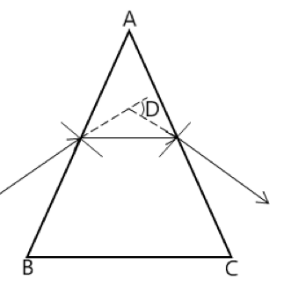
The refraction of light by a prism is shown in the following figure. Then angle D is-
A. Angle of prism
B. Angle of refraction
C. Angle of emergent
D. Angle of deviation
Answer
 Verified
575.7k+ views
Hint:A ray of light that strikes a surface is called an incident ray. The angle between the incident ray and the normal to the surface is called the angle of incidence.When an incident light ray passes through the second medium its direction changes, the ray is said to be a refracted ray and the angle between the refracted ray and the normal is called the angle of refraction.
Complete answer:
The incident ray of light gets refracted towards the normal when it enters the prism. On striking the other face of the prism, the refracted ray further deviates away from the normal and leaves the glass prism; it enters the air i.e. from one medium to the other. Thus a ray that emerges from the other side of prism is called the emergent ray. The angle made by the emergent ray with the normal at the surface is known as angle of emergence.
In the figure see that the emergent ray is extended backward and the incident ray is produced forward, so the angle between these two rays shows the amount of deviation of the incident ray and is thus called the angle of deviation.Therefore the angel mentioned in the question i.e. angle D is angle of deviation.
Hence, option D is the correct answer.
Note: When a ray travels from rarer medium to a denser medium it bends towards the normal and when a ray travels from denser to a rarer medium it bends away from the normal. At an angle of minimum deviation of the prism the refracted ray becomes parallel to the base of the prism.
Complete answer:
The incident ray of light gets refracted towards the normal when it enters the prism. On striking the other face of the prism, the refracted ray further deviates away from the normal and leaves the glass prism; it enters the air i.e. from one medium to the other. Thus a ray that emerges from the other side of prism is called the emergent ray. The angle made by the emergent ray with the normal at the surface is known as angle of emergence.
In the figure see that the emergent ray is extended backward and the incident ray is produced forward, so the angle between these two rays shows the amount of deviation of the incident ray and is thus called the angle of deviation.Therefore the angel mentioned in the question i.e. angle D is angle of deviation.
Hence, option D is the correct answer.
Note: When a ray travels from rarer medium to a denser medium it bends towards the normal and when a ray travels from denser to a rarer medium it bends away from the normal. At an angle of minimum deviation of the prism the refracted ray becomes parallel to the base of the prism.
Recently Updated Pages
Basicity of sulphurous acid and sulphuric acid are

Master Class 12 English: Engaging Questions & Answers for Success
Master Class 12 Social Science: Engaging Questions & Answers for Success
Master Class 12 Maths: Engaging Questions & Answers for Success
Master Class 12 Economics: Engaging Questions & Answers for Success
Master Class 12 Physics: Engaging Questions & Answers for Success
Trending doubts
Which are the Top 10 Largest Countries of the World?
Draw a labelled sketch of the human eye class 12 physics CBSE
Which country did Danny Casey play for class 12 english CBSE
Give 10 examples of unisexual and bisexual flowers
Coming together federation is practiced in A India class 12 social science CBSE
Write the formula to find the shortest distance between class 12 maths CBSE