




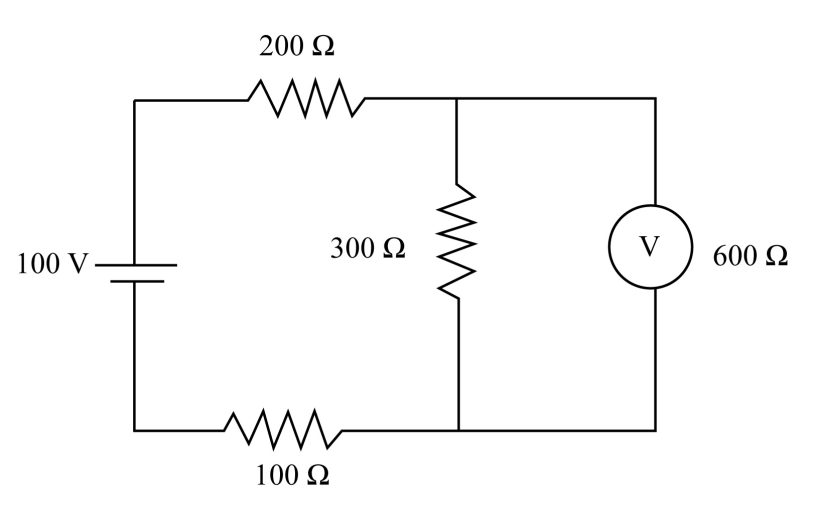
The reading of the voltmeter is
Answer
 Verified
618.3k+ views
Hint: As we know when the resistors are connected into series, the same current flows through them, but when the resistors are connected into parallel, different values of current flow through them as the potential drop across each resistor is same when the resistors are connected in parallel.
Complete step by step answer:
We all have studied to know that if two resistors $R_1$ and $R_2$ are connected in parallel, then the net resistance $R_p$ is given by the formula:
$ \Rightarrow {R_p} = \dfrac{{{R_1}{R_2}}}{{{R_1} + {R_2}}}$
As we can see in the given problem, here 300 ohms and 600-ohm voltmeter are connected in parallel, so the net resistance can be found out by substituting $R_1=600$ ohm and $R_2=300$ ohm to find $R_p$. Therefore, it becomes,
$ \Rightarrow {R_p} = \dfrac{{600\Omega \times 300\Omega }}{{600\Omega + 300\Omega }}$
$ \Rightarrow {R_p} = \dfrac{{300 \times 6}}{9}$
As we will simplify the above equation, then it will become,
$\therefore {R_p} = 200\Omega $
We all have studied to know that if three resistors $R_1$ and $R_2$ and $R_p$ are connected in series, then the net resistance $R_s$ is given by the formula:
${R_s} = {R_1} + {R_2} + {R_p}$ …… (I)
We will now substitute${R_p} = 200\Omega $, ${R_1} = 200\Omega $ and ${R_2} = 100\Omega $ in equation (I) to find $R_s$.
$ \Rightarrow {R_s} = \left( {100 + 200 + 200} \right)\Omega $
$ \Rightarrow {R_s} = 500\Omega $
Now we can calculate the current through the whole circuit by applying ohm’s law. We know that,
$I = \dfrac{V}{{{R_s}}}$
We will now substitute ${R_s} = 500\Omega $ and $V = 100V$ to find the current I.
$I = \dfrac{{100V}}{{500\Omega }}$
$I = 0.2A$
This is the current through the whole circuit. Now the voltage reading of the voltmeter can be calculated by the formula,
${V_R} = I{R_V}$
In this equation, we can see that ${V_R}$ it is the voltmeter reading, and ${R_V}$ is the voltmeter resistance. We will now substitute ${R_V} = 200\Omega $ and $I = 0.2A$ to find the value of ${V_R}$.
$ \Rightarrow {V_R} = 0.2A \times 200\Omega $
$ \Rightarrow {V_R} = 40V$
Therefore the voltmeter reading is 40 V.
Note:
We can see that in the given problem as the resistors are connected into a series along a single path, so the equal current flows through all of the resistors. The current passing through every component is the same, so the net voltage in the whole circuit is the sum of the entire voltage drop across these components. In a parallel circuit, the total current is the sum of all the current in each of these components. Since the voltmeter has a resistance, hence it is also considered as a separate resistor.
Complete step by step answer:
We all have studied to know that if two resistors $R_1$ and $R_2$ are connected in parallel, then the net resistance $R_p$ is given by the formula:
$ \Rightarrow {R_p} = \dfrac{{{R_1}{R_2}}}{{{R_1} + {R_2}}}$
As we can see in the given problem, here 300 ohms and 600-ohm voltmeter are connected in parallel, so the net resistance can be found out by substituting $R_1=600$ ohm and $R_2=300$ ohm to find $R_p$. Therefore, it becomes,
$ \Rightarrow {R_p} = \dfrac{{600\Omega \times 300\Omega }}{{600\Omega + 300\Omega }}$
$ \Rightarrow {R_p} = \dfrac{{300 \times 6}}{9}$
As we will simplify the above equation, then it will become,
$\therefore {R_p} = 200\Omega $
We all have studied to know that if three resistors $R_1$ and $R_2$ and $R_p$ are connected in series, then the net resistance $R_s$ is given by the formula:
${R_s} = {R_1} + {R_2} + {R_p}$ …… (I)
We will now substitute${R_p} = 200\Omega $, ${R_1} = 200\Omega $ and ${R_2} = 100\Omega $ in equation (I) to find $R_s$.
$ \Rightarrow {R_s} = \left( {100 + 200 + 200} \right)\Omega $
$ \Rightarrow {R_s} = 500\Omega $
Now we can calculate the current through the whole circuit by applying ohm’s law. We know that,
$I = \dfrac{V}{{{R_s}}}$
We will now substitute ${R_s} = 500\Omega $ and $V = 100V$ to find the current I.
$I = \dfrac{{100V}}{{500\Omega }}$
$I = 0.2A$
This is the current through the whole circuit. Now the voltage reading of the voltmeter can be calculated by the formula,
${V_R} = I{R_V}$
In this equation, we can see that ${V_R}$ it is the voltmeter reading, and ${R_V}$ is the voltmeter resistance. We will now substitute ${R_V} = 200\Omega $ and $I = 0.2A$ to find the value of ${V_R}$.
$ \Rightarrow {V_R} = 0.2A \times 200\Omega $
$ \Rightarrow {V_R} = 40V$
Therefore the voltmeter reading is 40 V.
Note:
We can see that in the given problem as the resistors are connected into a series along a single path, so the equal current flows through all of the resistors. The current passing through every component is the same, so the net voltage in the whole circuit is the sum of the entire voltage drop across these components. In a parallel circuit, the total current is the sum of all the current in each of these components. Since the voltmeter has a resistance, hence it is also considered as a separate resistor.
Recently Updated Pages
Master Class 12 Economics: Engaging Questions & Answers for Success

Master Class 12 English: Engaging Questions & Answers for Success
Master Class 12 Social Science: Engaging Questions & Answers for Success
Master Class 12 Maths: Engaging Questions & Answers for Success
Master Class 12 Physics: Engaging Questions & Answers for Success
Master Class 9 General Knowledge: Engaging Questions & Answers for Success
Trending doubts
Which are the Top 10 Largest Countries of the World?
Draw a labelled sketch of the human eye class 12 physics CBSE
Differentiate between homogeneous and heterogeneous class 12 chemistry CBSE
Sulphuric acid is known as the king of acids State class 12 chemistry CBSE
Why is the cell called the structural and functional class 12 biology CBSE
Draw ray diagrams each showing i myopic eye and ii class 12 physics CBSE