




What would be the reading of ammeter & voltmeter in the given circuit for Emf of battery 3V?
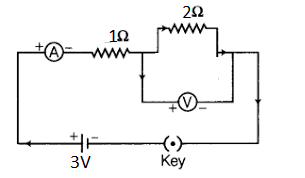
A) 1 and 2
B) 2 and 1
C) 1 and 1
D) 2 and 2
Answer
 Verified
617.1k+ views
Hint: For solving this problem we will use KVL ( Kirchhoff’s Voltage law ).
We will revolve around the circuit in a closed loop and keep on finding the voltage source and voltage drops.
Ohm’s Law is also used in this problem: $V=IR$
Where $V$ is the voltage, $I$ is current, $R$ is the resistance.
Complete step by step answer:
Now let’s apply the KVL in the circuit, which states that:
“Sum of all the voltage drops in the circuit is equal to zero “.
Let the unknown current flowing in the circuit is $i$, which we have to find out :
Before proceeding with the problem, we must learn about sign conventions of KVL law :
If we move from positive to negative sign then the voltage is dropped then we will use negative sign while applying KVL, If we move from negative to positive sign then the voltage is grained then we will use the positive sign in the equation.
Our equation is as follows :
Moving from 3V voltage source,
$
\Rightarrow 3 - 1i - 2i = 0 \\
\Rightarrow 3 - 3i = 0 \\
\Rightarrow i = \dfrac{3}{3} = 1 \\
\Rightarrow i = 1A \\
$ ( simple addition and subtraction calculation)
Value of current is 1A, which means ammeter reading is 1.
The voltmeter is connected across the 2-ohm resistor then the voltage across the 2-ohm resistor is calculated as 1-ampere current is flowing through the 2-ohm resistor then,
Voltage=$2 \times 1= 2V$.
Thus, the reading of the voltmeter is $2$.
$\therefore$ The reading of Ammeter is 1. The reading of Voltmeter is 2. Hence, Option A is correct.
Note:
An ammeter measures the magnitude of the current flowing in the circuit and always connected in series in the circuit. A voltmeter measures the magnitude of the voltage drop across the connected circuit and is always connected in parallel in the circuit.
When resistors are connected in series, the given magnitudes are added directly without taking reciprocal value to find an equivalent resistor in the circuit.
We will revolve around the circuit in a closed loop and keep on finding the voltage source and voltage drops.
Ohm’s Law is also used in this problem: $V=IR$
Where $V$ is the voltage, $I$ is current, $R$ is the resistance.
Complete step by step answer:
Now let’s apply the KVL in the circuit, which states that:
“Sum of all the voltage drops in the circuit is equal to zero “.
Let the unknown current flowing in the circuit is $i$, which we have to find out :
Before proceeding with the problem, we must learn about sign conventions of KVL law :
If we move from positive to negative sign then the voltage is dropped then we will use negative sign while applying KVL, If we move from negative to positive sign then the voltage is grained then we will use the positive sign in the equation.
Our equation is as follows :
Moving from 3V voltage source,
$
\Rightarrow 3 - 1i - 2i = 0 \\
\Rightarrow 3 - 3i = 0 \\
\Rightarrow i = \dfrac{3}{3} = 1 \\
\Rightarrow i = 1A \\
$ ( simple addition and subtraction calculation)
Value of current is 1A, which means ammeter reading is 1.
The voltmeter is connected across the 2-ohm resistor then the voltage across the 2-ohm resistor is calculated as 1-ampere current is flowing through the 2-ohm resistor then,
Voltage=$2 \times 1= 2V$.
Thus, the reading of the voltmeter is $2$.
$\therefore$ The reading of Ammeter is 1. The reading of Voltmeter is 2. Hence, Option A is correct.
Note:
An ammeter measures the magnitude of the current flowing in the circuit and always connected in series in the circuit. A voltmeter measures the magnitude of the voltage drop across the connected circuit and is always connected in parallel in the circuit.
When resistors are connected in series, the given magnitudes are added directly without taking reciprocal value to find an equivalent resistor in the circuit.
Recently Updated Pages
Master Class 12 Business Studies: Engaging Questions & Answers for Success

Master Class 12 Biology: Engaging Questions & Answers for Success
Master Class 12 Chemistry: Engaging Questions & Answers for Success
Class 12 Question and Answer - Your Ultimate Solutions Guide
Master Class 11 English: Engaging Questions & Answers for Success
Master Class 11 Social Science: Engaging Questions & Answers for Success
Trending doubts
Which are the Top 10 Largest Countries of the World?
Draw a labelled sketch of the human eye class 12 physics CBSE
Differentiate between homogeneous and heterogeneous class 12 chemistry CBSE
Why is the cell called the structural and functional class 12 biology CBSE
Draw ray diagrams each showing i myopic eye and ii class 12 physics CBSE
Which is the correct genotypic ratio of mendel dihybrid class 12 biology CBSE