




The ratio in which the yz plane divides the line segment joining the (-3,4,2) and (2,1,3) is
[a] -4:1
[b] 3:2
[c] -2:3
[d] 1:4
Answer
 Verified
640.2k+ views
Hint: Assume that the ratio in which the yz plane divides the line segment is k:1. Hence find the coordinates of the point using section formula. Use the fact that any point in the yz plane will have x-coordinate as 0. Hence form an equation in k. Solve for k. The value of k gives the ratio in which the point in the yz plane divides the given line segment.
Complete step by step solution:
Let the ratio in which the yz plane divides the line segment joining the points A(-3,4,2) and B(2,1,3) be k:1 at Point C
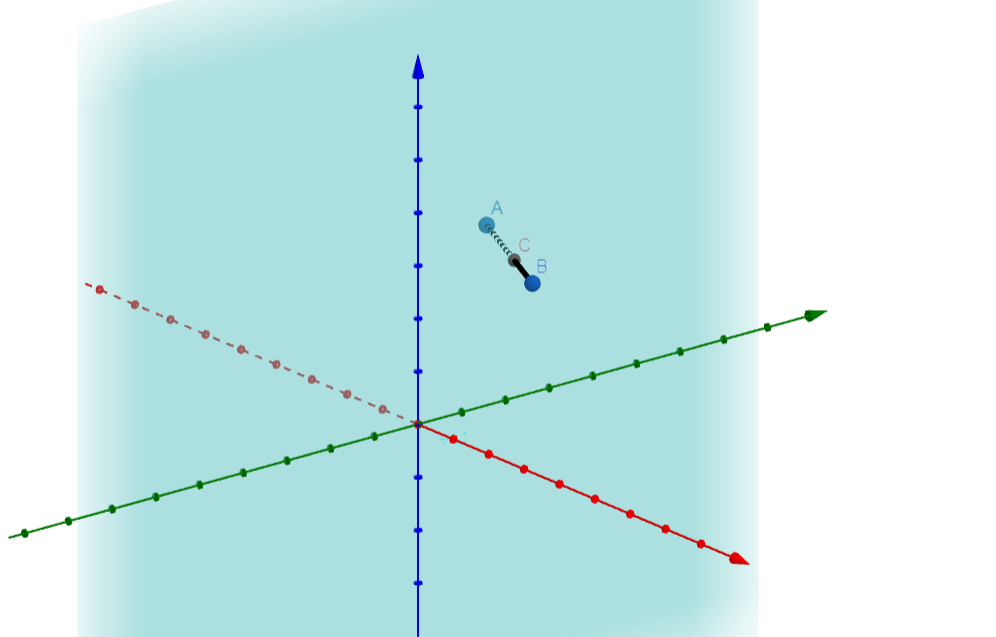
We know that if point C divides a line segment joining $A\left( {{x}_{1}},{{y}_{1}},{{z}_{1}} \right)$ and $B\left( {{x}_{2}},{{y}_{2}},{{z}_{2}} \right)$ in the ratio of m:n, then $C\equiv \left( \dfrac{m{{x}_{2}}+n{{x}_{1}}}{m+n},\dfrac{m{{y}_{2}}+n{{y}_{1}}}{m+n},\dfrac{m{{z}_{2}}+n{{z}_{1}}}{m+n} \right)$
Hence, $C\equiv \left( \dfrac{2k-3}{k+1},\dfrac{k+4}{k+1},\dfrac{3k+2}{k+1} \right)$
Since C lies on the yz plane, x-coordinate of C is 0
Hence, we have
$\dfrac{2k-3}{k+1}=0$
Multiplying both sides by k+1, we get
2k-3=0
Adding 3 on both sides, we get
2k = 3
Dividing both sides by 2, we get
$k=\dfrac{3}{2}$
Hence, the ratio in which the yz plane divides the line segment joining (-3,4,2) and (2,1,3) is 3:2
Hence option [b] is correct
Note: Verification:
We can verify our solution by checking that the point which divides the line segment AB in the ratio 3:2 lies on the yz plane.
By section formula, we have
$C\equiv \left( \dfrac{3\times 2-3\times 2}{3+2},\dfrac{3\times 1+4\times 2}{3+2},\dfrac{3\times 3+2\times 2}{3+2} \right)=\left( 0,\dfrac{11}{5},\dfrac{13}{5} \right)$
Since x-coordinate of C is 0, C lies on the yz plane.
Hence our solution is verified to be correct.
Complete step by step solution:
Let the ratio in which the yz plane divides the line segment joining the points A(-3,4,2) and B(2,1,3) be k:1 at Point C
We know that if point C divides a line segment joining $A\left( {{x}_{1}},{{y}_{1}},{{z}_{1}} \right)$ and $B\left( {{x}_{2}},{{y}_{2}},{{z}_{2}} \right)$ in the ratio of m:n, then $C\equiv \left( \dfrac{m{{x}_{2}}+n{{x}_{1}}}{m+n},\dfrac{m{{y}_{2}}+n{{y}_{1}}}{m+n},\dfrac{m{{z}_{2}}+n{{z}_{1}}}{m+n} \right)$
Hence, $C\equiv \left( \dfrac{2k-3}{k+1},\dfrac{k+4}{k+1},\dfrac{3k+2}{k+1} \right)$
Since C lies on the yz plane, x-coordinate of C is 0
Hence, we have
$\dfrac{2k-3}{k+1}=0$
Multiplying both sides by k+1, we get
2k-3=0
Adding 3 on both sides, we get
2k = 3
Dividing both sides by 2, we get
$k=\dfrac{3}{2}$
Hence, the ratio in which the yz plane divides the line segment joining (-3,4,2) and (2,1,3) is 3:2
Hence option [b] is correct
Note: Verification:
We can verify our solution by checking that the point which divides the line segment AB in the ratio 3:2 lies on the yz plane.
By section formula, we have
$C\equiv \left( \dfrac{3\times 2-3\times 2}{3+2},\dfrac{3\times 1+4\times 2}{3+2},\dfrac{3\times 3+2\times 2}{3+2} \right)=\left( 0,\dfrac{11}{5},\dfrac{13}{5} \right)$
Since x-coordinate of C is 0, C lies on the yz plane.
Hence our solution is verified to be correct.
Recently Updated Pages
Master Class 12 Business Studies: Engaging Questions & Answers for Success

Master Class 12 Biology: Engaging Questions & Answers for Success
Master Class 12 Chemistry: Engaging Questions & Answers for Success
Class 12 Question and Answer - Your Ultimate Solutions Guide
Master Class 11 English: Engaging Questions & Answers for Success
Master Class 11 Social Science: Engaging Questions & Answers for Success
Trending doubts
Which are the Top 10 Largest Countries of the World?
Draw a labelled sketch of the human eye class 12 physics CBSE
Differentiate between homogeneous and heterogeneous class 12 chemistry CBSE
Why is the cell called the structural and functional class 12 biology CBSE
Draw ray diagrams each showing i myopic eye and ii class 12 physics CBSE
Which is the correct genotypic ratio of mendel dihybrid class 12 biology CBSE