




The ratio in which the plane $r\cdot \left( \overline{i}-2\overline{j}+3\overline{k} \right)=17$ divides the line joining the points $-2\hat{i}+4\hat{j}+7\hat{k}$ and $3\hat{i}-5\hat{j}+8\hat{k}$ is
(a) $1:5$
(b) $1:10$
(c) $3:5$
(d) $3:10$
Answer
 Verified
635.4k+ views
Hint: First, we will find midpoint using the section formula given as $\dfrac{m{{x}_{2}}+n{{x}_{1}}}{m+n}$ where we will assume $m:n$ to be $\lambda :1$ . Here, for finding point i, we will use respective values of i from point $-2\hat{i}+4\hat{j}+7\hat{k}$ and $3\hat{i}-5\hat{j}+8\hat{k}$ which is $\left( -2,3 \right)$ . Similarly for point j, point will be $\left( 4,-5 \right)$ and for point k it is $\left( 7,8 \right)$ . The, we will place those values in the plane equation i.e. $r\cdot \left( \overline{i}-2\overline{j}+3\overline{k} \right)=17$ and then on solving we will get a value of $\lambda $ which will be the answer.
Complete step by step answer:
Here, we will draw a figure to understand clearly.
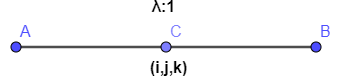
We have assumed the ratio which divides the plane to be $\lambda :1$ which is the same to be $m:n$ . Also, point A is $-2\hat{i}+4\hat{j}+7\hat{k}$ and point B is $3\hat{i}-5\hat{j}+8\hat{k}$ .
Here, for finding point i, we will use respective values of i from point $-2\hat{i}+4\hat{j}+7\hat{k}$ and $3\hat{i}-5\hat{j}+8\hat{k}$ which is $\left( -2,3 \right)$ . Similarly for point j, point will be $\left( 4,-5 \right)$ and for point k it is $\left( 7,8 \right)$ .
Now, we will use section formula to find midpoints of the line which is given as $\dfrac{m{{x}_{2}}+n{{x}_{1}}}{m+n}$ . So, here we get i as
$i=\dfrac{m{{x}_{2}}+n{{x}_{1}}}{m+n}$
On substituting the values i.e. $\left( -2,3 \right)$ where ${{x}_{2}}=3,{{x}_{1}}=-2$ , we get as
$i=\dfrac{\lambda 3+1\left( -2 \right)}{\lambda +1}=\dfrac{3\lambda -2}{\lambda +1}$ …………………………….(1)
Similarly, we will find point j as $\left( 4,-5 \right)$ i.e. ${{x}_{2}}=-5,{{x}_{1}}=3$ we will get
$j=\dfrac{m{{x}_{2}}+n{{x}_{1}}}{m+n}$
On putting values, we get
$j=\dfrac{-5\lambda +1\left( 4 \right)}{\lambda +1}=\dfrac{-5\lambda +4}{\lambda +1}$ ………………………………(2)
Similarly, point k i.e. $\left( 7,8 \right)$ i.e. ${{x}_{2}}=8,{{x}_{1}}=7$ we will find as
$k=\dfrac{m{{x}_{2}}+n{{x}_{1}}}{m+n}$
On putting values, we will get
$k=\dfrac{8\lambda +1\left( 7 \right)}{\lambda +1}=\dfrac{8\lambda +7}{\lambda +1}$ …………………………….(3)
Now, all the three points i.e. i, j, k lies in the plane given as $r\cdot \left( \overline{i}-2\overline{j}+3\overline{k} \right)=17$ . So, we will substitute values of equation (1), (2), (3) in the given plane. So, we will get as
$\Rightarrow \dfrac{3\lambda -2}{\lambda +1}-2\left( \dfrac{-5\lambda +4}{\lambda +1} \right)+3\left( \dfrac{8\lambda +7}{\lambda +1} \right)=17$
On further solving, we will get as
$\Rightarrow \dfrac{3\lambda -2}{\lambda +1}+\dfrac{10\lambda -8}{\lambda +1}+\dfrac{24\lambda +21}{\lambda +1}=17$
$\Rightarrow 3\lambda -2+10\lambda -8+24\lambda +21=17\left( \lambda +1 \right)$
On simplification, we get equation as
$\Rightarrow 37\lambda +11=17\lambda +17$
Now, taking constant term on RHS and variable term on LHS, we will get
$\Rightarrow 37\lambda -17\lambda =17-11=6$
$\Rightarrow 20\lambda =6$
On dividing both sides by 20, we will get
$\Rightarrow \lambda =\dfrac{6}{20}=\dfrac{3}{10}$
Thus, the ratio in which the plane is divided is $3:10$ .
Hence, option (d) is the correct answer.
Note: Students should know the section formula which has to be used here in this problem. Students sometimes take the ratio as $1:\lambda $ and by doing this, we will get the same answer. We will get on solving, equation as $\dfrac{3-2\lambda }{\lambda +1}+\dfrac{10-8\lambda }{\lambda +1}+\dfrac{24+21\lambda }{\lambda +1}=17$ . On solving this we will get value as $\lambda =10:3$ . But remember that we have taken the ratio as $1:\lambda $ so, it will be $\dfrac{1}{\lambda }=\dfrac{10}{3}$ . Thus, we will get the same answer $3:10$ as $\lambda $ is in the denominator, so the ratio will be inverse. Do not write answers as $\lambda =10:3$ which will be wrong.
Complete step by step answer:
Here, we will draw a figure to understand clearly.
We have assumed the ratio which divides the plane to be $\lambda :1$ which is the same to be $m:n$ . Also, point A is $-2\hat{i}+4\hat{j}+7\hat{k}$ and point B is $3\hat{i}-5\hat{j}+8\hat{k}$ .
Here, for finding point i, we will use respective values of i from point $-2\hat{i}+4\hat{j}+7\hat{k}$ and $3\hat{i}-5\hat{j}+8\hat{k}$ which is $\left( -2,3 \right)$ . Similarly for point j, point will be $\left( 4,-5 \right)$ and for point k it is $\left( 7,8 \right)$ .
Now, we will use section formula to find midpoints of the line which is given as $\dfrac{m{{x}_{2}}+n{{x}_{1}}}{m+n}$ . So, here we get i as
$i=\dfrac{m{{x}_{2}}+n{{x}_{1}}}{m+n}$
On substituting the values i.e. $\left( -2,3 \right)$ where ${{x}_{2}}=3,{{x}_{1}}=-2$ , we get as
$i=\dfrac{\lambda 3+1\left( -2 \right)}{\lambda +1}=\dfrac{3\lambda -2}{\lambda +1}$ …………………………….(1)
Similarly, we will find point j as $\left( 4,-5 \right)$ i.e. ${{x}_{2}}=-5,{{x}_{1}}=3$ we will get
$j=\dfrac{m{{x}_{2}}+n{{x}_{1}}}{m+n}$
On putting values, we get
$j=\dfrac{-5\lambda +1\left( 4 \right)}{\lambda +1}=\dfrac{-5\lambda +4}{\lambda +1}$ ………………………………(2)
Similarly, point k i.e. $\left( 7,8 \right)$ i.e. ${{x}_{2}}=8,{{x}_{1}}=7$ we will find as
$k=\dfrac{m{{x}_{2}}+n{{x}_{1}}}{m+n}$
On putting values, we will get
$k=\dfrac{8\lambda +1\left( 7 \right)}{\lambda +1}=\dfrac{8\lambda +7}{\lambda +1}$ …………………………….(3)
Now, all the three points i.e. i, j, k lies in the plane given as $r\cdot \left( \overline{i}-2\overline{j}+3\overline{k} \right)=17$ . So, we will substitute values of equation (1), (2), (3) in the given plane. So, we will get as
$\Rightarrow \dfrac{3\lambda -2}{\lambda +1}-2\left( \dfrac{-5\lambda +4}{\lambda +1} \right)+3\left( \dfrac{8\lambda +7}{\lambda +1} \right)=17$
On further solving, we will get as
$\Rightarrow \dfrac{3\lambda -2}{\lambda +1}+\dfrac{10\lambda -8}{\lambda +1}+\dfrac{24\lambda +21}{\lambda +1}=17$
$\Rightarrow 3\lambda -2+10\lambda -8+24\lambda +21=17\left( \lambda +1 \right)$
On simplification, we get equation as
$\Rightarrow 37\lambda +11=17\lambda +17$
Now, taking constant term on RHS and variable term on LHS, we will get
$\Rightarrow 37\lambda -17\lambda =17-11=6$
$\Rightarrow 20\lambda =6$
On dividing both sides by 20, we will get
$\Rightarrow \lambda =\dfrac{6}{20}=\dfrac{3}{10}$
Thus, the ratio in which the plane is divided is $3:10$ .
Hence, option (d) is the correct answer.
Note: Students should know the section formula which has to be used here in this problem. Students sometimes take the ratio as $1:\lambda $ and by doing this, we will get the same answer. We will get on solving, equation as $\dfrac{3-2\lambda }{\lambda +1}+\dfrac{10-8\lambda }{\lambda +1}+\dfrac{24+21\lambda }{\lambda +1}=17$ . On solving this we will get value as $\lambda =10:3$ . But remember that we have taken the ratio as $1:\lambda $ so, it will be $\dfrac{1}{\lambda }=\dfrac{10}{3}$ . Thus, we will get the same answer $3:10$ as $\lambda $ is in the denominator, so the ratio will be inverse. Do not write answers as $\lambda =10:3$ which will be wrong.
Recently Updated Pages
Master Class 12 Business Studies: Engaging Questions & Answers for Success

Master Class 12 Chemistry: Engaging Questions & Answers for Success
Master Class 12 Biology: Engaging Questions & Answers for Success
Class 12 Question and Answer - Your Ultimate Solutions Guide
Master Class 11 English: Engaging Questions & Answers for Success
Master Class 11 Social Science: Engaging Questions & Answers for Success
Trending doubts
Which are the Top 10 Largest Countries of the World?
Draw a labelled sketch of the human eye class 12 physics CBSE
The end of compass needle which points towards north class 12 physics CBSE
Differentiate between homogeneous and heterogeneous class 12 chemistry CBSE
In order to find out the different types of gametes class 12 biology NEET_UG
Why is the cell called the structural and functional class 12 biology CBSE