




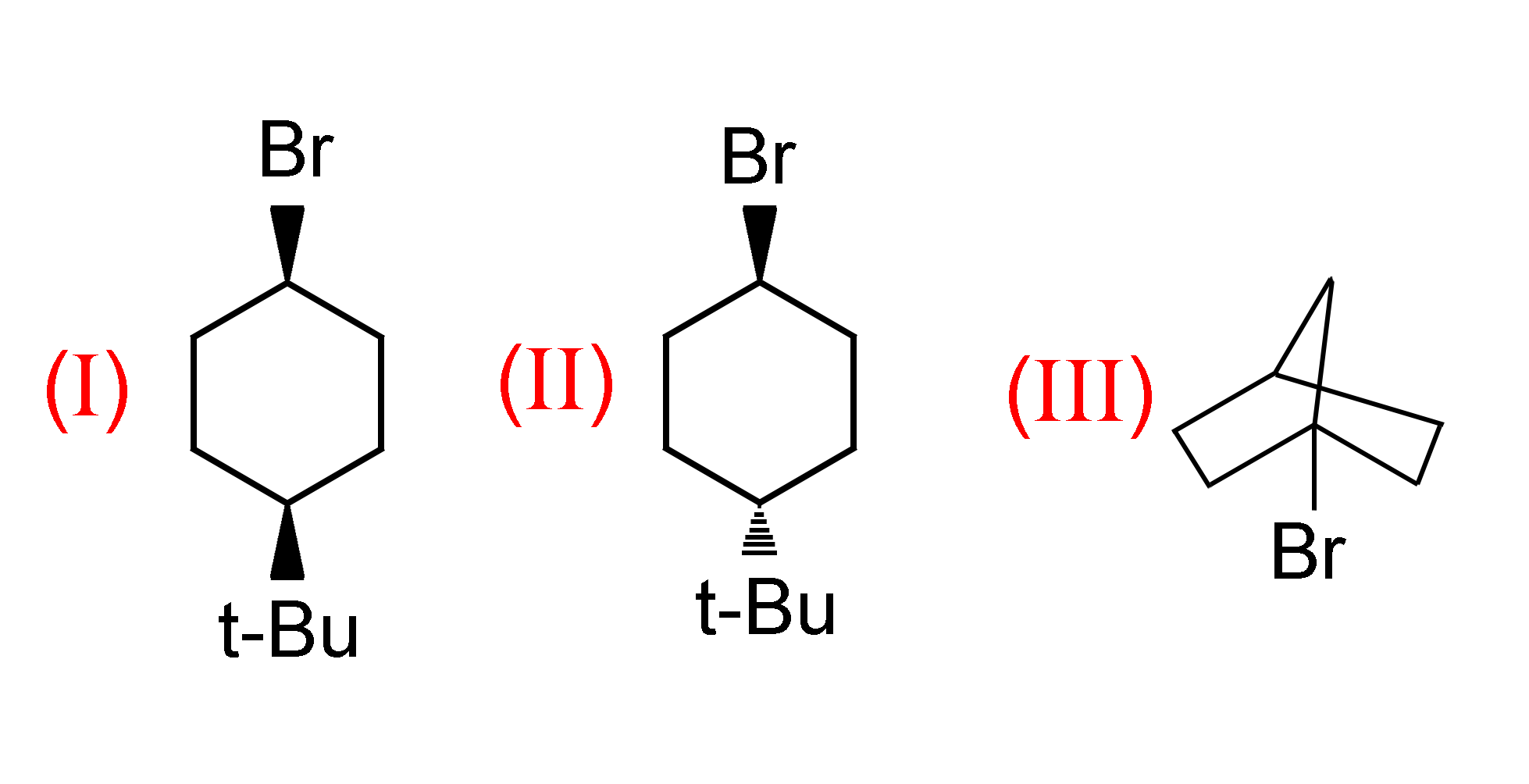
The rate of elimination (using EtONa) is in the order:
a.) $I > II > III$
b.) $I > III > II$
c.) $II > I > III$
d.) $III > I > II$
Answer
 Verified
584.4k+ views
Hint: The $C - Br$ bond will be more strained in the $I$ compound and will be less strained in the $II$ compound. In the case of the $III$ compound the $C - Br$ bond is present in a compact structure, so breaking the $C - Br$ bond will be the hardest to break. So the order of elimination is $I > II > III$
Complete step by step answer:
The reaction of all the above compounds with sodium ethoxide $\left( {{C_2}{H_5}ONa} \right)$ are examples of elimination reactions where $Br$ is eliminated by the action of sodium ethoxide.
You may have noticed solid black lines and the line containing dashes in compounds $I$ and $II$ . These lines are used to represent the 3-dimensional structure of any compound, the solid black lines represent that the bond is in a direction away from the viewer and the dashed line which are called wedges represent that the direction of the bond is towards the viewer.
Now let’s consider the reaction of the $I$ compound.
In this reaction $Br$ is to be removed from the benzene ring. $Br$ and $t - Bu$ (Tertiary butyl) groups are present on the same side (i.e. on the side away from the viewer represented by black solid lines). Now since both these groups are on the same side, the bond between the $C$ atom and $Br$ atom will be more strained and thus $Br$ atoms will be removed easily.
Now for the reaction of $II$ compound.
In this compound $Br$ and $t - Bu$ groups are not present on the same side (i.e. $t - Bu$ is represented by a dashed line and $Br$ is represented by a solid line), so the bond between the $C$ atom and $Br$ atom will be less strained and thus $Br$ atoms will be more difficult to remove.
Now for the reaction of the $III$ compound.
Here $Br$ is surrounded by three carbon atoms and is a compact structure, so here we can easily conclude that removing $Br$ will be relatively difficult.
So, the order of rate of elimination using sodium ethoxide on the given compounds is $I > II > III$
So, the correct answer is “Option A”.
Note: In the solution above we discussed how the presence of groups around the $C - Br$ bond affects the removal of $Br$ from the compounds, this effect is called the steric effect (Steric effects are nonbonding interactions that affect the shape or conformation and reactivity of ions and molecules).
Complete step by step answer:
The reaction of all the above compounds with sodium ethoxide $\left( {{C_2}{H_5}ONa} \right)$ are examples of elimination reactions where $Br$ is eliminated by the action of sodium ethoxide.
You may have noticed solid black lines and the line containing dashes in compounds $I$ and $II$ . These lines are used to represent the 3-dimensional structure of any compound, the solid black lines represent that the bond is in a direction away from the viewer and the dashed line which are called wedges represent that the direction of the bond is towards the viewer.
Now let’s consider the reaction of the $I$ compound.
In this reaction $Br$ is to be removed from the benzene ring. $Br$ and $t - Bu$ (Tertiary butyl) groups are present on the same side (i.e. on the side away from the viewer represented by black solid lines). Now since both these groups are on the same side, the bond between the $C$ atom and $Br$ atom will be more strained and thus $Br$ atoms will be removed easily.
Now for the reaction of $II$ compound.
In this compound $Br$ and $t - Bu$ groups are not present on the same side (i.e. $t - Bu$ is represented by a dashed line and $Br$ is represented by a solid line), so the bond between the $C$ atom and $Br$ atom will be less strained and thus $Br$ atoms will be more difficult to remove.
Now for the reaction of the $III$ compound.
Here $Br$ is surrounded by three carbon atoms and is a compact structure, so here we can easily conclude that removing $Br$ will be relatively difficult.
So, the order of rate of elimination using sodium ethoxide on the given compounds is $I > II > III$
So, the correct answer is “Option A”.
Note: In the solution above we discussed how the presence of groups around the $C - Br$ bond affects the removal of $Br$ from the compounds, this effect is called the steric effect (Steric effects are nonbonding interactions that affect the shape or conformation and reactivity of ions and molecules).
Recently Updated Pages
Master Class 12 Economics: Engaging Questions & Answers for Success

Master Class 12 Physics: Engaging Questions & Answers for Success
Master Class 12 English: Engaging Questions & Answers for Success
Master Class 12 Social Science: Engaging Questions & Answers for Success
Master Class 12 Maths: Engaging Questions & Answers for Success
Master Class 12 Business Studies: Engaging Questions & Answers for Success
Trending doubts
Which are the Top 10 Largest Countries of the World?
What are the major means of transport Explain each class 12 social science CBSE
Draw a labelled sketch of the human eye class 12 physics CBSE
Why cannot DNA pass through cell membranes class 12 biology CBSE
Differentiate between insitu conservation and exsitu class 12 biology CBSE
Draw a neat and well labeled diagram of TS of ovary class 12 biology CBSE