




The rate of diffusion of liquids is ________.
A) Higher than gases.
B) Lower than solids.
C) Higher than solids.
D) Equal to gases.
Answer
 Verified
654k+ views
Hint: Diffusion is the process of movement of net free movement of molecules from higher concentration to lower concentration. It depends on temperature and the gradient concentration.
Complete answer:
> We know that matter is composed of molecules and particles at microscopic level. Since the rate of diffusion depends on the free movement of particles and molecules hence we need to study the arrangement of particles in matter and according to the arrangement of particles matter is divided into three subcategories of: solid, liquid and gas.
> Solids have definite shape and volume, that is there is no intermolecular space between its molecules. Its molecules are tightly bound with each other under strong force of attraction. Hence the movement of its molecules is restricted.
> Liquids have definite volume but not definite shape. There is intermolecular space between the molecules of the liquid. Liquid has both viscosity and fluidity. Molecules in liquid can move freely in any direction.
> Gases have neither definite volume nor definite shape it has a lot of intermolecular space and the molecules are far apart from each other making the movement free and easy without touching its other constituent molecules.
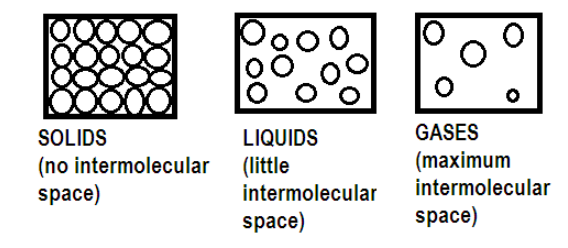
Hence we can conclude the rate of diffusion of liquids is higher than solids due to the free movement of molecules and lack of strong force of attraction in liquids but rate of diffusion of liquids is lower than gases as in gases molecules are quite far apart.
Hence the correct option is option C.
Note: Osmosis is also the special type of diffusion where the movement of molecules occur across a membrane due to change in concentration .
Complete answer:
> We know that matter is composed of molecules and particles at microscopic level. Since the rate of diffusion depends on the free movement of particles and molecules hence we need to study the arrangement of particles in matter and according to the arrangement of particles matter is divided into three subcategories of: solid, liquid and gas.
> Solids have definite shape and volume, that is there is no intermolecular space between its molecules. Its molecules are tightly bound with each other under strong force of attraction. Hence the movement of its molecules is restricted.
> Liquids have definite volume but not definite shape. There is intermolecular space between the molecules of the liquid. Liquid has both viscosity and fluidity. Molecules in liquid can move freely in any direction.
> Gases have neither definite volume nor definite shape it has a lot of intermolecular space and the molecules are far apart from each other making the movement free and easy without touching its other constituent molecules.
Hence we can conclude the rate of diffusion of liquids is higher than solids due to the free movement of molecules and lack of strong force of attraction in liquids but rate of diffusion of liquids is lower than gases as in gases molecules are quite far apart.
Hence the correct option is option C.
Note: Osmosis is also the special type of diffusion where the movement of molecules occur across a membrane due to change in concentration .
Recently Updated Pages
If x a + bt + ct2 where x is in meters and t is in class 11 physics CBSE

A car covers the first half distance between two places class 11 physics CBSE
The resultant of two vectors overrightarrow P and overrightarrow class 11 physics CBSE
Find the value of cos 135 class 11 maths CBSE
A mass M is held in place by an applied force F and class 11 physics CBSE
A solution of glucose in water is labelled as 10 dfracwv class 11 chemistry CBSE
Trending doubts
One Metric ton is equal to kg A 10000 B 1000 C 100 class 11 physics CBSE
Find the value of the expression given below sin 30circ class 11 maths CBSE
What do you mean by retardation What is its SI uni class 11 physics CBSE
Draw a diagram of nephron and explain its structur class 11 biology CBSE
10 examples of friction in our daily life
Difference between physical and chemical change class 11 chemistry CBSE