




The pyramid of biomass is inverted in
A. Pond ecosystem
B. Grassland ecosystem
C. Forest ecosystem
D. All of the above
Answer
 Verified
627.6k+ views
Hint: Biomass is the amount of living matter present in the individual/ population/community/trophic level/ecosystem. Biomass is measured on both fresh and dry weight basis.
Complete answer:
> The pond ecosystem is the freshwater ecosystem. There are two main components of the pond ecosystem: The abiotic component and the Biotic component.
The abiotic component of the pond ecosystem comprises simple inorganic substances such as water, carbon dioxide, oxygen, nitrogen, calcium, phosphorus, etc. and their compounds and organic substances such as amino acids, humus, etc. Only a small amount of these vital nutrients are found in soluble form in the pond water, whereas the major proportion of these compounds resides in the bottom sediments as well as in the organisms themselves. The quantity of light penetrating the water and the ambient temperature and other climatic conditions regulate the rate of the functioning of the pond ecosystem.
The biotic component of a pond ecosystem comprises the producers and variety of consumers. Phytoplanktons (e.g, oscillatoria anabaena, Eudorina, closterium, and volvox), filamentous algae(spirogyra, chara, oedogonium, etc), marginal and emergent plants (Ipomea, typha, phragmites, etc), submerged plants (Potamogeton and vallisneria, etc), and surface floating plants like Eichhornia, pistia, wolffia, etc are producers.
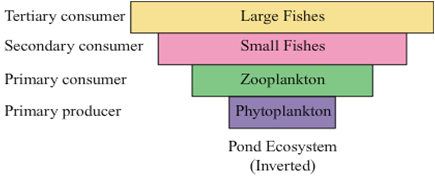
The phytoplanktons are more important as producers in a pond ecosystem than the large plants. The macro consumers represent the animal fauna in the pond ecosystem. These are categorized as primary consumers or herbivores and secondary consumers or carnivores. Zooplanktons like paramecium, Daphnia, Cyclops, Mysids, insect larvae are the primary consumers. These primary consumers are eaten by smaller fishes and crayfishes constituting tertiary consumers.
Decomposers constitute a very important component of the pond ecosystem. A variety of bacteria, fungi, and flagellates are especially abundant in the mud water and the bottom of the ponds. Their principal function is to decompose the excreta of animals and dead bodies of plants and animals and thereby releasing the locked inorganic substances back into the pond ecosystem.
> A grassland ecosystem is the collection of plants, animals, and micro-organisms that live within an environment where grasses are the primary form of vegetation.
> A forest ecosystem is a terrestrial unit of living organisms (plants, animals and microorganisms), all interacting among themselves and with the environment (soil, climate, water, and light) in which they live.
Hence, The correct answer is, option (A).
Note: Pyramid of biomass shows the total biomass present per unit area at different trophic levels. Pyramid of biomass is upright for grassland and forest ecosystems. In a pond, the producers are small organisms, their biomass is least, and this value gradually shows an increase towards the apex of the pyramid, thus making the pyramid of biomass inverted in shape
Complete answer:
> The pond ecosystem is the freshwater ecosystem. There are two main components of the pond ecosystem: The abiotic component and the Biotic component.
The abiotic component of the pond ecosystem comprises simple inorganic substances such as water, carbon dioxide, oxygen, nitrogen, calcium, phosphorus, etc. and their compounds and organic substances such as amino acids, humus, etc. Only a small amount of these vital nutrients are found in soluble form in the pond water, whereas the major proportion of these compounds resides in the bottom sediments as well as in the organisms themselves. The quantity of light penetrating the water and the ambient temperature and other climatic conditions regulate the rate of the functioning of the pond ecosystem.
The biotic component of a pond ecosystem comprises the producers and variety of consumers. Phytoplanktons (e.g, oscillatoria anabaena, Eudorina, closterium, and volvox), filamentous algae(spirogyra, chara, oedogonium, etc), marginal and emergent plants (Ipomea, typha, phragmites, etc), submerged plants (Potamogeton and vallisneria, etc), and surface floating plants like Eichhornia, pistia, wolffia, etc are producers.
The phytoplanktons are more important as producers in a pond ecosystem than the large plants. The macro consumers represent the animal fauna in the pond ecosystem. These are categorized as primary consumers or herbivores and secondary consumers or carnivores. Zooplanktons like paramecium, Daphnia, Cyclops, Mysids, insect larvae are the primary consumers. These primary consumers are eaten by smaller fishes and crayfishes constituting tertiary consumers.
Decomposers constitute a very important component of the pond ecosystem. A variety of bacteria, fungi, and flagellates are especially abundant in the mud water and the bottom of the ponds. Their principal function is to decompose the excreta of animals and dead bodies of plants and animals and thereby releasing the locked inorganic substances back into the pond ecosystem.
> A grassland ecosystem is the collection of plants, animals, and micro-organisms that live within an environment where grasses are the primary form of vegetation.
> A forest ecosystem is a terrestrial unit of living organisms (plants, animals and microorganisms), all interacting among themselves and with the environment (soil, climate, water, and light) in which they live.
Hence, The correct answer is, option (A).
Note: Pyramid of biomass shows the total biomass present per unit area at different trophic levels. Pyramid of biomass is upright for grassland and forest ecosystems. In a pond, the producers are small organisms, their biomass is least, and this value gradually shows an increase towards the apex of the pyramid, thus making the pyramid of biomass inverted in shape
Recently Updated Pages
Master Class 12 Economics: Engaging Questions & Answers for Success

Master Class 12 English: Engaging Questions & Answers for Success
Master Class 12 Social Science: Engaging Questions & Answers for Success
Master Class 12 Maths: Engaging Questions & Answers for Success
Master Class 12 Physics: Engaging Questions & Answers for Success
Master Class 12 Business Studies: Engaging Questions & Answers for Success
Trending doubts
Which are the Top 10 Largest Countries of the World?
Draw a labelled sketch of the human eye class 12 physics CBSE
Differentiate between homogeneous and heterogeneous class 12 chemistry CBSE
Why is the cell called the structural and functional class 12 biology CBSE
Draw ray diagrams each showing i myopic eye and ii class 12 physics CBSE
Which is the correct genotypic ratio of mendel dihybrid class 12 biology CBSE