




The purine and pyrimidine pairs of complementary strands of DNA are held together by
A. H bonds
B. O bonds
C. C bonds
D. N bonds
Answer
 Verified
609k+ views
Hint: The term DNA stands for deoxyribonucleic acid and RNA stands for ribonucleic acid. DNA and RNA are both nucleic acids and either of them is present in the nucleus of the cell. It is the genetic material of an organism.
Complete answer: The structure of DNA is coiled helical in shape which consists of two polynucleotide chains. DNA carries the genetic instruction for the functioning, development, reproduction, and growth of all known organisms and also many viruses. Therefore, DNA is considered the genetic material of an organism. Polynucleotides consist of smaller monomeric units called nucleotides. Each nucleotide is made up of three components: a deoxyribose sugar, a nitrogen-containing nucleobase, and a phosphate group. An organic molecule that contains a nitrogen atom that has chemical properties like the base is called a nitrogenous base. The five types of nitrogenous bases are adenine, guanine, uracil, thymine, and cytosine. The double helix structure of two strands of DNA is due to the hydrogen bonding between the base pairs of purine and pyrimidines. Due to the presence of strong hydrogen bonds between the phosphates the DNA molecule is twisted in shape. In DNA, guanine (G) is paired with cytosine (C) and adenine (A) is paired with thymine (T). These are called complementary base pairs.
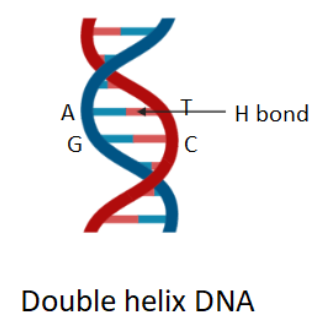
So, option A is the correct option.
Note: Pyrimidine and purine are the two parent compounds from which the nitrogenous bases are derived. Thymine, cytosine, and uracil are included in pyrimidines and have single ring structure. Adenine and guanine are derivatives of purines and have double ring structure. In RNA, the sugar called ribose is present instead of deoxyribose and nitrogenous base uracil is present instead of thymine.
Complete answer: The structure of DNA is coiled helical in shape which consists of two polynucleotide chains. DNA carries the genetic instruction for the functioning, development, reproduction, and growth of all known organisms and also many viruses. Therefore, DNA is considered the genetic material of an organism. Polynucleotides consist of smaller monomeric units called nucleotides. Each nucleotide is made up of three components: a deoxyribose sugar, a nitrogen-containing nucleobase, and a phosphate group. An organic molecule that contains a nitrogen atom that has chemical properties like the base is called a nitrogenous base. The five types of nitrogenous bases are adenine, guanine, uracil, thymine, and cytosine. The double helix structure of two strands of DNA is due to the hydrogen bonding between the base pairs of purine and pyrimidines. Due to the presence of strong hydrogen bonds between the phosphates the DNA molecule is twisted in shape. In DNA, guanine (G) is paired with cytosine (C) and adenine (A) is paired with thymine (T). These are called complementary base pairs.
So, option A is the correct option.
Note: Pyrimidine and purine are the two parent compounds from which the nitrogenous bases are derived. Thymine, cytosine, and uracil are included in pyrimidines and have single ring structure. Adenine and guanine are derivatives of purines and have double ring structure. In RNA, the sugar called ribose is present instead of deoxyribose and nitrogenous base uracil is present instead of thymine.
Recently Updated Pages
Master Class 12 Business Studies: Engaging Questions & Answers for Success

Master Class 12 Chemistry: Engaging Questions & Answers for Success
Master Class 12 Biology: Engaging Questions & Answers for Success
Class 12 Question and Answer - Your Ultimate Solutions Guide
Master Class 11 English: Engaging Questions & Answers for Success
Master Class 11 Social Science: Engaging Questions & Answers for Success
Trending doubts
Which are the Top 10 Largest Countries of the World?
Draw a labelled sketch of the human eye class 12 physics CBSE
The end of compass needle which points towards north class 12 physics CBSE
Differentiate between homogeneous and heterogeneous class 12 chemistry CBSE
Why is the cell called the structural and functional class 12 biology CBSE
When was the first election held in India a 194748 class 12 sst CBSE