




The pteridophyte, popularly known as ‘horsetail’ or a ‘scouring rush’ is
A. Equisetum
B. Fern
C. Lycopodium
D. Psilotum
Answer
 Verified
646.2k+ views
Hint: Pteridophytes belong to the group of vascular plants. Pteridophytes are spore-bearing plants and hence sometimes referred to as cryptogams. They do not produce flowers and seeds. Vascular plants are also called tracheophytes.
Complete answer:
The means of reproduction of pteridophyte is hidden and hence they are called cryptogams. Pteridophytes disperse spores. Pteridophytes include ferns, lycophytes, club mosses, and horsetail. Equisetum is commonly known as horsetail. It belongs to the Equisetaceae family which is commonly referred to as the horsetail family. Horsetail is the only living genus of the horsetail family. These are vascular plants and their means of reproduction is by spores. Equisetum hyemale is called scouring rush or rough horsetail. Scouring horsetail is an avascular, perennial plant. Equisetum hyemale usually grows in gravelly or sandy areas. The structure of the Equisetum hyemale is vertical jointed reed-like stalks of medium or dark green. The stems of Equisetum hyemale are of a branched type. One of the genera of clubmoss is lycopodium. Clubmoss is a type of pteridophyte. It is also called creeping cedars or ground pines. Fern is a vascular plant and they reproduce by spores. Fern is also referred to as Polypodiophyta. Psilotum or whisk fern is a vascular plant but lacks true roots. Therefore, the pteridophyte, popularly known as ‘horsetail’ or a ‘scouring rush’ is Equisetum.
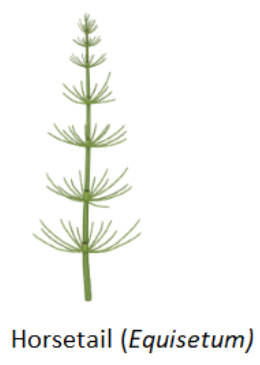
So, option A is the correct option.
Note: Equisetum is an example of a living fossil. Equisetum hyemale is primarily found in riparian zones of streams and rivers and wetlands where it can withstand seasonal flooding. Extracts of Equisetum are used in herbal medicines.
Complete answer:
The means of reproduction of pteridophyte is hidden and hence they are called cryptogams. Pteridophytes disperse spores. Pteridophytes include ferns, lycophytes, club mosses, and horsetail. Equisetum is commonly known as horsetail. It belongs to the Equisetaceae family which is commonly referred to as the horsetail family. Horsetail is the only living genus of the horsetail family. These are vascular plants and their means of reproduction is by spores. Equisetum hyemale is called scouring rush or rough horsetail. Scouring horsetail is an avascular, perennial plant. Equisetum hyemale usually grows in gravelly or sandy areas. The structure of the Equisetum hyemale is vertical jointed reed-like stalks of medium or dark green. The stems of Equisetum hyemale are of a branched type. One of the genera of clubmoss is lycopodium. Clubmoss is a type of pteridophyte. It is also called creeping cedars or ground pines. Fern is a vascular plant and they reproduce by spores. Fern is also referred to as Polypodiophyta. Psilotum or whisk fern is a vascular plant but lacks true roots. Therefore, the pteridophyte, popularly known as ‘horsetail’ or a ‘scouring rush’ is Equisetum.
So, option A is the correct option.
Note: Equisetum is an example of a living fossil. Equisetum hyemale is primarily found in riparian zones of streams and rivers and wetlands where it can withstand seasonal flooding. Extracts of Equisetum are used in herbal medicines.
Recently Updated Pages
Which will be the least stable resonating structure class 11 chemistry CBSE

How many 5 digit telephone numbers can be construc-class-11-maths-CBSE
How do you find the angle of the resultant vector class 11 physics CBSE
Draw labelled diagram of the following i Gram seed class 11 biology CBSE
1 Quintal is equal to a 110 kg b 10 kg c 100kg d 1000 class 11 physics CBSE
What is the need and importance of classification class 11 biology CBSE
Trending doubts
Find the value of the expression given below sin 30circ class 11 maths CBSE
One Metric ton is equal to kg A 10000 B 1000 C 100 class 11 physics CBSE
10 examples of friction in our daily life
Draw a diagram of a plant cell and label at least eight class 11 biology CBSE
Difference between physical and chemical change class 11 chemistry CBSE
Proton was discovered by A Thomson B Rutherford C Chadwick class 11 chemistry CBSE