



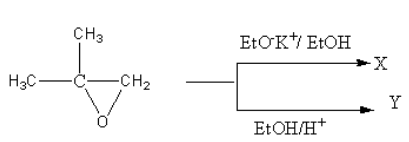
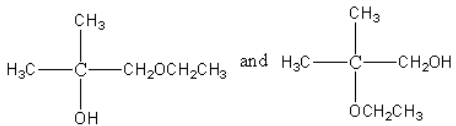
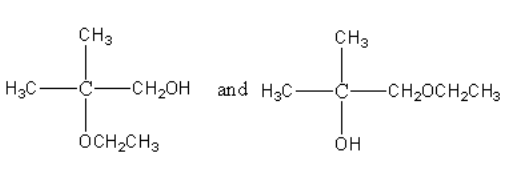
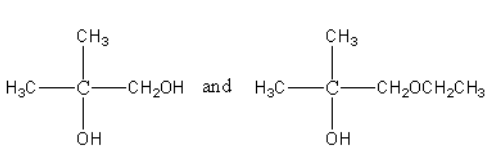
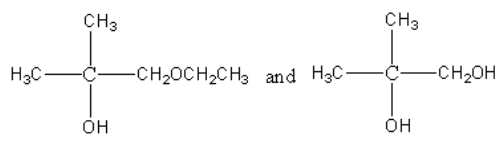
The product X and Y are respectively:
A.
B.
C.
D.
Answer
 Verified
550.8k+ views
Hint: The given reaction is the ring opening reaction of an asymmetric epoxide. Depending on reaction condition asymmetric epoxide undergoes ring opening reaction by \[{\text{S}}{{\text{N}}^{\text{1}}}\] or \[{\text{S}}{{\text{N}}^2}\] mechanism. In the basic medium ring, the opening takes place by \[{\text{S}}{{\text{N}}^2}\] mechanism while in the acidic medium ring opening take place by \[{\text{S}}{{\text{N}}^{\text{1}}}\] mechanism.
Complete step-by-step answer:
The reaction given to us is :
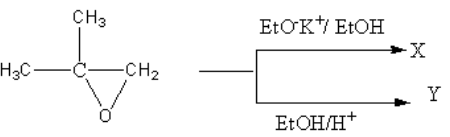
Here we have to identify products X and Y.
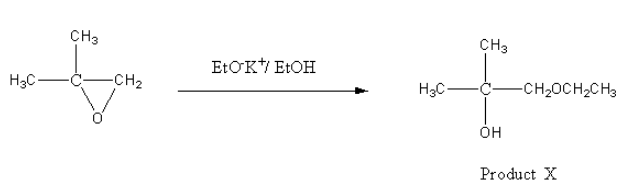
The reagent given for product X is \[{\text{EtO}}{{\text{K}}^{\text{ + }}}{\text{/EtOH}}\] . It is a basic reagent so the ring opening reaction will be carried out by \[{\text{S}}{{\text{N}}^2}\] mechanism. In \[{\text{S}}{{\text{N}}^2}\] mechanism, the nucleophile prefers to attack a less hindering side that is less substituted carbon atom.
Hence, the nucleophile \[{\text{Et}}{{\text{O}}^ - }\] will attack on \[{\text{C}}{{\text{H}}_{\text{2}}}\]and product X will be as follows:
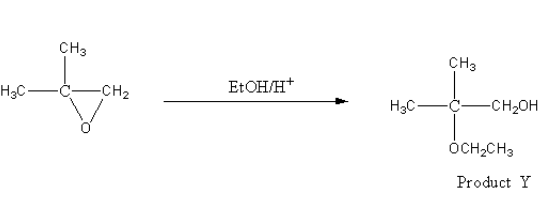
The reagent given for product Y is \[{\text{EtOH/}}{{\text{H}}^{\text{ + }}}\] . It is an acidic reagent so the ring opening reaction will be carried out by \[{\text{S}}{{\text{N}}^{\text{1}}}\] mechanism. In \[{\text{S}}{{\text{N}}^{\text{1}}}\] mechanism, the nucleophile prefers to attack more substituted carbon atoms.
Hence, the nucleophile \[{\text{Et}}{{\text{O}}^ - }\] will attack on \[{\text{C(CH3}}{{\text{)}}_{\text{2}}}\] carbon and product Y will be as follows:
Thus, product X and Y are
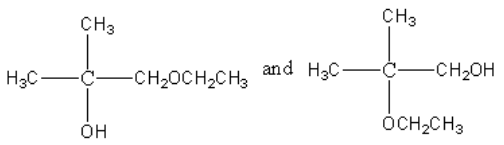
Hence, the correct option is (A).
Note:Asymmetric epoxide shows regioselectivity of product. Symmetric epoxides can give only one product however, asymmetric epoxides give two possible products. Using the reaction condition we can determine the major product out of two possible products. In a basic medium, more substituted alcohol is the product while in an acidic medium less substituted alcohol is the product.
Complete step-by-step answer:
The reaction given to us is :
Here we have to identify products X and Y.
The reagent given for product X is \[{\text{EtO}}{{\text{K}}^{\text{ + }}}{\text{/EtOH}}\] . It is a basic reagent so the ring opening reaction will be carried out by \[{\text{S}}{{\text{N}}^2}\] mechanism. In \[{\text{S}}{{\text{N}}^2}\] mechanism, the nucleophile prefers to attack a less hindering side that is less substituted carbon atom.
Hence, the nucleophile \[{\text{Et}}{{\text{O}}^ - }\] will attack on \[{\text{C}}{{\text{H}}_{\text{2}}}\]and product X will be as follows:
The reagent given for product Y is \[{\text{EtOH/}}{{\text{H}}^{\text{ + }}}\] . It is an acidic reagent so the ring opening reaction will be carried out by \[{\text{S}}{{\text{N}}^{\text{1}}}\] mechanism. In \[{\text{S}}{{\text{N}}^{\text{1}}}\] mechanism, the nucleophile prefers to attack more substituted carbon atoms.
Hence, the nucleophile \[{\text{Et}}{{\text{O}}^ - }\] will attack on \[{\text{C(CH3}}{{\text{)}}_{\text{2}}}\] carbon and product Y will be as follows:
Thus, product X and Y are
Hence, the correct option is (A).
Note:Asymmetric epoxide shows regioselectivity of product. Symmetric epoxides can give only one product however, asymmetric epoxides give two possible products. Using the reaction condition we can determine the major product out of two possible products. In a basic medium, more substituted alcohol is the product while in an acidic medium less substituted alcohol is the product.
Recently Updated Pages
Master Class 12 Economics: Engaging Questions & Answers for Success

Master Class 12 Physics: Engaging Questions & Answers for Success
Master Class 12 English: Engaging Questions & Answers for Success
Master Class 12 Social Science: Engaging Questions & Answers for Success
Master Class 12 Maths: Engaging Questions & Answers for Success
Master Class 12 Business Studies: Engaging Questions & Answers for Success
Trending doubts
Which are the Top 10 Largest Countries of the World?
What are the major means of transport Explain each class 12 social science CBSE
Draw a labelled sketch of the human eye class 12 physics CBSE
Why cannot DNA pass through cell membranes class 12 biology CBSE
Differentiate between insitu conservation and exsitu class 12 biology CBSE
Draw a neat and well labeled diagram of TS of ovary class 12 biology CBSE