




The primary coils of a step- down transformer have _________ number of turns.
A.)More
B.)Less
C.)Same
D.)None of these
Answer
 Verified
619.5k+ views
Hint- As we know that a transformer is an electrical device which is used to increase or decrease the output voltage. Depending upon whether we have to increase or decrease the output voltage the number of turns in the primary and secondary coils decided.
Complete step-by-step answer:
Primary coils are those coils which are connected to the input side of the transformer and Secondary coils are those which are connected to the output side of the transformer.
In the figure
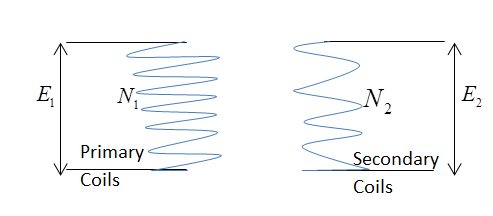
\[{N_1}\] is the number of turns in the primary coil
${N_2}$ is the number of turns in the secondary coil
As we know that as the number of turn’s increases the flux in that coils also increases.
Flux is directly proportional to the ampere turns.
Now in case of step- down transformers, we have to decrease the output voltage of the transformer.
Therefore the number of turns in the primary coils must be greater than the number of turns in the secondary coils because as the number of turns increases the flux linked to that coils increases and hence the output voltage increases.
If the number of turns of secondary coils is less than the primary coils, the flux linked to the secondary coils is less than the primary coils and hence the voltage induced in the secondary coils will be less as in case of step- down transformer.
Hence, the primary coils of step- down transformers have more number of turns and the correct option is A.
Note- In order to solve these types of questions, learn the basic concept of transformers and how transformers work. The transformer works on the principle of mutual inductance between two coils which is linked by common magnetic flux. Also the transformer in which the number of turns in the secondary coils is more than the primary coils, the transformer is known as step-up transformer.
Complete step-by-step answer:
Primary coils are those coils which are connected to the input side of the transformer and Secondary coils are those which are connected to the output side of the transformer.
In the figure
\[{N_1}\] is the number of turns in the primary coil
${N_2}$ is the number of turns in the secondary coil
As we know that as the number of turn’s increases the flux in that coils also increases.
Flux is directly proportional to the ampere turns.
Now in case of step- down transformers, we have to decrease the output voltage of the transformer.
Therefore the number of turns in the primary coils must be greater than the number of turns in the secondary coils because as the number of turns increases the flux linked to that coils increases and hence the output voltage increases.
If the number of turns of secondary coils is less than the primary coils, the flux linked to the secondary coils is less than the primary coils and hence the voltage induced in the secondary coils will be less as in case of step- down transformer.
Hence, the primary coils of step- down transformers have more number of turns and the correct option is A.
Note- In order to solve these types of questions, learn the basic concept of transformers and how transformers work. The transformer works on the principle of mutual inductance between two coils which is linked by common magnetic flux. Also the transformer in which the number of turns in the secondary coils is more than the primary coils, the transformer is known as step-up transformer.
Recently Updated Pages
Master Class 12 Business Studies: Engaging Questions & Answers for Success

Master Class 12 Chemistry: Engaging Questions & Answers for Success
Master Class 12 Biology: Engaging Questions & Answers for Success
Class 12 Question and Answer - Your Ultimate Solutions Guide
Master Class 11 English: Engaging Questions & Answers for Success
Master Class 11 Maths: Engaging Questions & Answers for Success
Trending doubts
Which is more stable and why class 12 chemistry CBSE
Which are the Top 10 Largest Countries of the World?
Draw a labelled sketch of the human eye class 12 physics CBSE
Differentiate between homogeneous and heterogeneous class 12 chemistry CBSE
What are the major means of transport Explain each class 12 social science CBSE
Sulphuric acid is known as the king of acids State class 12 chemistry CBSE