




The powers of the lenses of a telescope are 0.5and 20 diopters. If the final image is formed at the minimum distance of distinct vision (25cm) then what will be the length of the tube?
Answer
 Verified
552.3k+ views
Hint:The telescope works on the principle that first it brings the image of any far away object closer and then it magnifies that image using a magnifying glass. First, we shall find the relation between the focal length and power of a lens. Henceforth, we will be able to find the length of the tube of the telescope as it is the sum of the focal lengths of the two lenses.
Complete answer:
The telescope consists of two lenses called the objective lens and the eyepiece lens. The objective lens forms the diminished image of any far-off object. Then this image acts as the object for the eyepiece lens which finally magnifies it and makes it easy for the human eye to observe.
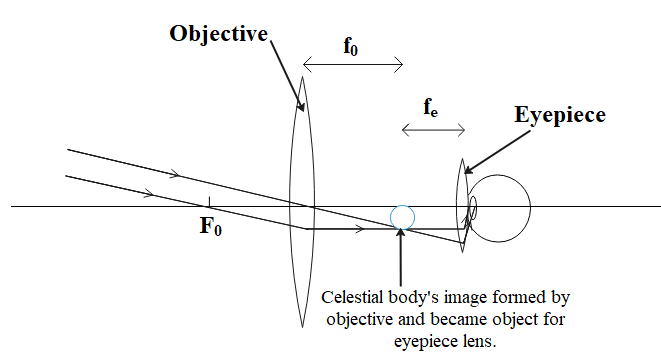
Given that power of lens 1, ${{P}_{1}}=0.5D$ and power of lens 2, ${{P}_{2}}=20D$
The power of a lens $\left( P \right)$ and its focal length $\left( f \right)$ are related as:
$\begin{align}
& P=\dfrac{1}{f} \\
& \Rightarrow f=\dfrac{1}{P} \\
\end{align}$
where focal length is in meters.
Thus, focal length of lens 1, ${{f}_{1}}=\dfrac{1}{0.5}=2m$
And focal length of lens 2, ${{f}_{2}}=\dfrac{1}{20}=0.05m$
The length of tube, $L$ of telescope is equal to the sum of the two focal lengths of the objective lens and the eyepiece lens.
$\begin{align}
& \Rightarrow L={{f}_{1}}+{{f}_{2}} \\
& \Rightarrow L=2+0.05 \\
& \Rightarrow L=2.05m \\
\end{align}$
Therefore, the length of the tube of the telescope is $2.05m$.
Note:
For a convex lens to act as magnifying devices, the object to be observed should be kept within the focal length of the convex lens. All the objects lying outside the range of the focal length would be very blurry. Hence, a simple convex lens cannot be used to see the far away celestial bodies in a magnified manner and we need a telescope consisting of an arrangement of two convex lenses to observe such objects.
Complete answer:
The telescope consists of two lenses called the objective lens and the eyepiece lens. The objective lens forms the diminished image of any far-off object. Then this image acts as the object for the eyepiece lens which finally magnifies it and makes it easy for the human eye to observe.
Given that power of lens 1, ${{P}_{1}}=0.5D$ and power of lens 2, ${{P}_{2}}=20D$
The power of a lens $\left( P \right)$ and its focal length $\left( f \right)$ are related as:
$\begin{align}
& P=\dfrac{1}{f} \\
& \Rightarrow f=\dfrac{1}{P} \\
\end{align}$
where focal length is in meters.
Thus, focal length of lens 1, ${{f}_{1}}=\dfrac{1}{0.5}=2m$
And focal length of lens 2, ${{f}_{2}}=\dfrac{1}{20}=0.05m$
The length of tube, $L$ of telescope is equal to the sum of the two focal lengths of the objective lens and the eyepiece lens.
$\begin{align}
& \Rightarrow L={{f}_{1}}+{{f}_{2}} \\
& \Rightarrow L=2+0.05 \\
& \Rightarrow L=2.05m \\
\end{align}$
Therefore, the length of the tube of the telescope is $2.05m$.
Note:
For a convex lens to act as magnifying devices, the object to be observed should be kept within the focal length of the convex lens. All the objects lying outside the range of the focal length would be very blurry. Hence, a simple convex lens cannot be used to see the far away celestial bodies in a magnified manner and we need a telescope consisting of an arrangement of two convex lenses to observe such objects.
Recently Updated Pages
Master Class 12 Economics: Engaging Questions & Answers for Success

Master Class 12 Physics: Engaging Questions & Answers for Success
Master Class 12 English: Engaging Questions & Answers for Success
Master Class 12 Social Science: Engaging Questions & Answers for Success
Master Class 12 Maths: Engaging Questions & Answers for Success
Master Class 12 Business Studies: Engaging Questions & Answers for Success
Trending doubts
Which are the Top 10 Largest Countries of the World?
What are the major means of transport Explain each class 12 social science CBSE
Draw a labelled sketch of the human eye class 12 physics CBSE
Why cannot DNA pass through cell membranes class 12 biology CBSE
Differentiate between insitu conservation and exsitu class 12 biology CBSE
Draw a neat and well labeled diagram of TS of ovary class 12 biology CBSE