




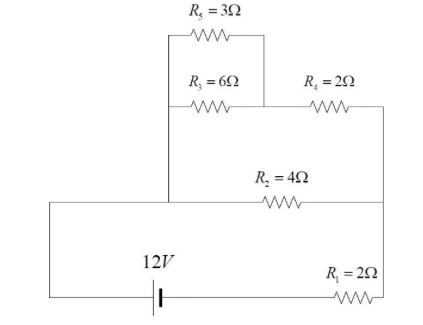
The power dissipated across resistor ${R_5}$ in the network given below is
A. 3 watt
B. $\dfrac{3}{4}$ watt
C. $\dfrac{{27}}{4}$ watt
D. 9 watt
Answer
 Verified
537.3k+ views
Hint:In order to find power through a resistor, the required quantities are current through the resistor and the resistance of the resistor. By these, the power can be calculated by the Joule’s law of heating –
$P = {I^2}R$
where I = current and R = resistance.
Step-by-step solution:
When 2 resistors are connected in series, the net resistance of the combination is the sum of the individual resistances.
$R = {R_1} + {R_2}$
When 2 resistors are connected in parallel, the net resistance of the combination is the reciprocal of the sum of reciprocals of individual resistances.
$\dfrac{1}{R} = \dfrac{1}{{{R_1}}} + \dfrac{1}{{{R_2}}}$
$ \Rightarrow R = \dfrac{{{R_1}{R_2}}}{{{R_1} + {R_2}}}$
Consider the arrangement of resistors connected in the given fashion, subject to the potential difference of 12V.
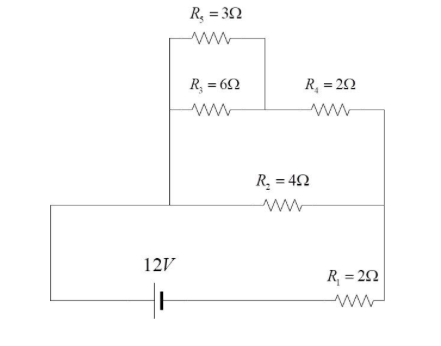
In this circuit, the resistors are connected as follows:
The parallel combination of ${R_3}$ is connected to ${R_5}$. This combination is in series with ${R_4}$. This entire combination is in parallel with ${R_2}$. The above entire combination is in series with ${R_1}$.
Hence, the net resistance R is given by –
$R = {R_1} + \left( {{R_2}//\left( {\left( {{R_3}//{R_5}} \right) + {R_4}} \right)} \right)$
Let us substitute the values one-by-one and determine the resistance by applying the above formula for the net resistance.
${R_3}//{R_5} = \dfrac{{{R_3}{R_5}}}{{{R_3} + {R_5}}} = \dfrac{{3 \times 6}}{{3 + 6}} = \dfrac{{18}}{9} = 2\Omega $
${R_3}//{R_5} + {R_4} = 2 + 2 = 4\Omega $
${R_2}//\left( {\left( {{R_3}//{R_5}} \right) + {R_4}} \right) = 4//4 = \dfrac{{4 \times 4}}{{4 + 4}} = \dfrac{{16}}{8} = 2\Omega $
Finally, the net resistance is the series combination of ${R_1}$ with the above combination.
$R = {R_1} + 2 = 2 + 2 = 4\Omega $
The net current is given by –
$I = \dfrac{V}{R} = \dfrac{{12}}{4} = 3A$
In a parallel combination, the current branches depending on the resistances in the branches.
The current flowing through the combination ${R_2}//\left( {\left( {{R_3}//{R_5}} \right) + {R_4}} \right)$ and ${R_1}$ is the same since they are in series.
The current branches in the parallel combination of ${R_2}$ and ${R_3}//{R_5} + {R_4}$ .
The branch current is calculated by the formula, ${I_1} = \dfrac{{I{R_2}}}{{{R_1} + {R_2}}}$
Applying the branch current formula to the combination of ${R_3}//{R_5} + {R_4}$, we have –
${I_{{R_3}//{R_5} + {R_4}}} = {I_{C3}} = \dfrac{{I{R_2}}}{{\left( {{R_3}//{R_5} + {R_4}} \right) + {R_2}}} = \dfrac{{3 \times 4}}{{4 + 4}} = \dfrac{{12}}{8} = \dfrac{3}{2}A$
Now, the current ${I_{C3}}$ flowing through the parallel combination ${R_3}//{R_5}$ and ${R_4}$ is the same since they are in series. This current branches in the parallel combination.
The branch current, \[{I_5} = \dfrac{{{I_{C3}}{R_3}}}{{{R_3} + {R_4}}} = \dfrac{{\dfrac{3}{2} \times 6}}{{6 + 3}} = \dfrac{9}{9} = 1A\]
Hence, the power across ${R_5}$ ,
$P = I_5^2{R_5} = {1^2} \times 3 = 1 \times 3 = 3W$
Hence, the correct option is Option A.
Note:The formula for derivation of branch current is as follows:
If ${R_1}$ and ${R_2}$ are in parallel, the current through resistor ${R_1}$ , is given by –
${I_1} = \dfrac{V}{{{R_1}}}$
where V = potential difference across the combination.
The potential difference across the combination is given by –
$V = I{R_p}$
where I = current in main branch and ${R_p}$ = net resistance of combination
${R_p} = \dfrac{{{R_1}{R_2}}}{{{R_1} + {R_2}}}$
Substituting,
$V = I\dfrac{{{R_1}{R_2}}}{{{R_1} + {R_2}}}$
Thus,
${I_1} = \dfrac{V}{{{R_1}}}$
${I_1} = \dfrac{I}{{{R_1}}} \times \dfrac{{{R_1}{R_2}}}{{{R_1} + {R_2}}} = \dfrac{{I{R_2}}}{{{R_1} + {R_2}}}$
$P = {I^2}R$
where I = current and R = resistance.
Step-by-step solution:
When 2 resistors are connected in series, the net resistance of the combination is the sum of the individual resistances.
$R = {R_1} + {R_2}$
When 2 resistors are connected in parallel, the net resistance of the combination is the reciprocal of the sum of reciprocals of individual resistances.
$\dfrac{1}{R} = \dfrac{1}{{{R_1}}} + \dfrac{1}{{{R_2}}}$
$ \Rightarrow R = \dfrac{{{R_1}{R_2}}}{{{R_1} + {R_2}}}$
Consider the arrangement of resistors connected in the given fashion, subject to the potential difference of 12V.
In this circuit, the resistors are connected as follows:
The parallel combination of ${R_3}$ is connected to ${R_5}$. This combination is in series with ${R_4}$. This entire combination is in parallel with ${R_2}$. The above entire combination is in series with ${R_1}$.
Hence, the net resistance R is given by –
$R = {R_1} + \left( {{R_2}//\left( {\left( {{R_3}//{R_5}} \right) + {R_4}} \right)} \right)$
Let us substitute the values one-by-one and determine the resistance by applying the above formula for the net resistance.
${R_3}//{R_5} = \dfrac{{{R_3}{R_5}}}{{{R_3} + {R_5}}} = \dfrac{{3 \times 6}}{{3 + 6}} = \dfrac{{18}}{9} = 2\Omega $
${R_3}//{R_5} + {R_4} = 2 + 2 = 4\Omega $
${R_2}//\left( {\left( {{R_3}//{R_5}} \right) + {R_4}} \right) = 4//4 = \dfrac{{4 \times 4}}{{4 + 4}} = \dfrac{{16}}{8} = 2\Omega $
Finally, the net resistance is the series combination of ${R_1}$ with the above combination.
$R = {R_1} + 2 = 2 + 2 = 4\Omega $
The net current is given by –
$I = \dfrac{V}{R} = \dfrac{{12}}{4} = 3A$
In a parallel combination, the current branches depending on the resistances in the branches.
The current flowing through the combination ${R_2}//\left( {\left( {{R_3}//{R_5}} \right) + {R_4}} \right)$ and ${R_1}$ is the same since they are in series.
The current branches in the parallel combination of ${R_2}$ and ${R_3}//{R_5} + {R_4}$ .
The branch current is calculated by the formula, ${I_1} = \dfrac{{I{R_2}}}{{{R_1} + {R_2}}}$
Applying the branch current formula to the combination of ${R_3}//{R_5} + {R_4}$, we have –
${I_{{R_3}//{R_5} + {R_4}}} = {I_{C3}} = \dfrac{{I{R_2}}}{{\left( {{R_3}//{R_5} + {R_4}} \right) + {R_2}}} = \dfrac{{3 \times 4}}{{4 + 4}} = \dfrac{{12}}{8} = \dfrac{3}{2}A$
Now, the current ${I_{C3}}$ flowing through the parallel combination ${R_3}//{R_5}$ and ${R_4}$ is the same since they are in series. This current branches in the parallel combination.
The branch current, \[{I_5} = \dfrac{{{I_{C3}}{R_3}}}{{{R_3} + {R_4}}} = \dfrac{{\dfrac{3}{2} \times 6}}{{6 + 3}} = \dfrac{9}{9} = 1A\]
Hence, the power across ${R_5}$ ,
$P = I_5^2{R_5} = {1^2} \times 3 = 1 \times 3 = 3W$
Hence, the correct option is Option A.
Note:The formula for derivation of branch current is as follows:
If ${R_1}$ and ${R_2}$ are in parallel, the current through resistor ${R_1}$ , is given by –
${I_1} = \dfrac{V}{{{R_1}}}$
where V = potential difference across the combination.
The potential difference across the combination is given by –
$V = I{R_p}$
where I = current in main branch and ${R_p}$ = net resistance of combination
${R_p} = \dfrac{{{R_1}{R_2}}}{{{R_1} + {R_2}}}$
Substituting,
$V = I\dfrac{{{R_1}{R_2}}}{{{R_1} + {R_2}}}$
Thus,
${I_1} = \dfrac{V}{{{R_1}}}$
${I_1} = \dfrac{I}{{{R_1}}} \times \dfrac{{{R_1}{R_2}}}{{{R_1} + {R_2}}} = \dfrac{{I{R_2}}}{{{R_1} + {R_2}}}$
Recently Updated Pages
Master Class 12 Social Science: Engaging Questions & Answers for Success

Master Class 12 Physics: Engaging Questions & Answers for Success
Master Class 12 Maths: Engaging Questions & Answers for Success
Master Class 12 Economics: Engaging Questions & Answers for Success
Master Class 12 Chemistry: Engaging Questions & Answers for Success
Master Class 12 Business Studies: Engaging Questions & Answers for Success
Trending doubts
Which are the Top 10 Largest Countries of the World?
Draw a labelled sketch of the human eye class 12 physics CBSE
Explain the structure of megasporangium class 12 biology CBSE
What are the major means of transport Explain each class 12 social science CBSE
How many chromosomes are found in human ovum a 46 b class 12 biology CBSE
The diagram of the section of a maize grain is given class 12 biology CBSE