




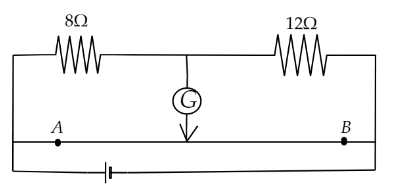
The potentiometer wire AB shown in figure is \[40\,cm\] long. Where should the free end of the galvanometer be connected on AB so that the galvanometer may show zero deflection?
Answer
 Verified
581.4k+ views
Hint:Use Wheatstone bridge principle at null condition to find the length of the wire at null condition. Wheatstone bridge principle says that the ratio of the resistances at null condition is equal.
Formula used:
According to the Wheatstone bridge principle at null condition,
\[\dfrac{P}{Q} = \dfrac{R}{S}\]
where \[P\] is the resistance at first arm, \[Q\] is the resistance at second arm, \[R\] is the resistance at third arm and \[S\] is the resistance at third arm.
Complete step by step answer:
We have given here a potentiometer of length \[40\,cm\] which has resistance \[8\Omega \] and \[12\Omega \]. Now, the current through the galvanometer is zero for zero deflection of the galvanometer. Now, since there are two resistances connected to it, the potentiometer acts like a Wheatstone bridge. Now, we know that the in Wheatstone bridge null condition current through the galvanometer is also zero.
From, Wheatstone bridge principle we have,
\[\dfrac{P}{Q} = \dfrac{R}{S}\]
where \[P\] is the resistance at first arm, \[Q\] is the resistance at second arm, \[R\] is the resistance at third arm and \[S\] is the resistance at third arm.
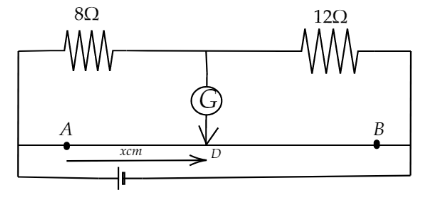
now, let the null point be at \[xcm\] from point A. So, resistance of the length DB will be \[(40 - x)\,cm\]
Now, from Wheatstone bridge principle we can write,
\[\dfrac{8}{{12}} = \dfrac{x}{{40 - x}}\].
So, upon simplifying we have,
\[12x = 320 - 8x\]
\[\Rightarrow 20x = 320\]
\[\therefore x = 16\]
Hence, the null point of the galvanometer will be at \[16\,cm\] from the point A.
Note: The Wheatstone bridge principle has several from finding unknown resistance to unknown voltage the Wheatstone bridge principle is widely used. The dimension of the resistance used must be of low resistance to operate the potentiometer accurately since the resistance of the potentiometer wire is low.
Formula used:
According to the Wheatstone bridge principle at null condition,
\[\dfrac{P}{Q} = \dfrac{R}{S}\]
where \[P\] is the resistance at first arm, \[Q\] is the resistance at second arm, \[R\] is the resistance at third arm and \[S\] is the resistance at third arm.
Complete step by step answer:
We have given here a potentiometer of length \[40\,cm\] which has resistance \[8\Omega \] and \[12\Omega \]. Now, the current through the galvanometer is zero for zero deflection of the galvanometer. Now, since there are two resistances connected to it, the potentiometer acts like a Wheatstone bridge. Now, we know that the in Wheatstone bridge null condition current through the galvanometer is also zero.
From, Wheatstone bridge principle we have,
\[\dfrac{P}{Q} = \dfrac{R}{S}\]
where \[P\] is the resistance at first arm, \[Q\] is the resistance at second arm, \[R\] is the resistance at third arm and \[S\] is the resistance at third arm.
now, let the null point be at \[xcm\] from point A. So, resistance of the length DB will be \[(40 - x)\,cm\]
Now, from Wheatstone bridge principle we can write,
\[\dfrac{8}{{12}} = \dfrac{x}{{40 - x}}\].
So, upon simplifying we have,
\[12x = 320 - 8x\]
\[\Rightarrow 20x = 320\]
\[\therefore x = 16\]
Hence, the null point of the galvanometer will be at \[16\,cm\] from the point A.
Note: The Wheatstone bridge principle has several from finding unknown resistance to unknown voltage the Wheatstone bridge principle is widely used. The dimension of the resistance used must be of low resistance to operate the potentiometer accurately since the resistance of the potentiometer wire is low.
Recently Updated Pages
Master Class 12 Economics: Engaging Questions & Answers for Success

Master Class 12 Social Science: Engaging Questions & Answers for Success
Master Class 12 English: Engaging Questions & Answers for Success
Master Class 12 Maths: Engaging Questions & Answers for Success
Master Class 12 Physics: Engaging Questions & Answers for Success
Master Class 12 Biology: Engaging Questions & Answers for Success
Trending doubts
Draw a labelled sketch of the human eye class 12 physics CBSE
Which are the Top 10 Largest Countries of the World?
Draw ray diagrams each showing i myopic eye and ii class 12 physics CBSE
Which is the correct genotypic ratio of mendel dihybrid class 12 biology CBSE
Differentiate between homogeneous and heterogeneous class 12 chemistry CBSE
Which animal never drinks water in its entire life class 12 biology CBSE