




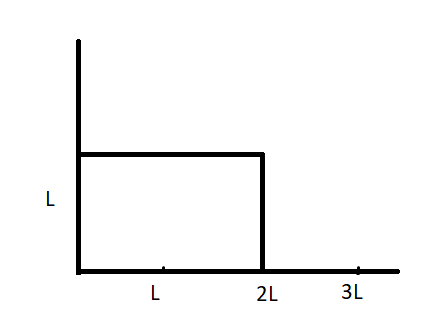
The position vector of the centre of mass $\overrightarrow r cm$ of an asymmetric uniform bar of negligible area of cross-section as shown in figure is:
A. $\overrightarrow r cm = \dfrac{{13}}{8}L\widehat x + \dfrac{5}{8}L\widehat y$
B. $\overrightarrow r cm = \dfrac{3}{8}L\widehat x + \dfrac{{11}}{8}L\widehat y$
C. $\overrightarrow r cm = \dfrac{{11}}{8}L\widehat x + \dfrac{3}{8}L\widehat y$
D. $\overrightarrow r cm = \dfrac{5}{8}L\widehat x + \dfrac{{13}}{8}L\widehat y$
Answer
 Verified
583.8k+ views
Hint:-In this question, we can use the formula of centre of mass. We can find the $x,y$coordinates of the particles separately. After that we can substitute these values in the equation of position vector.
Complete step-by-step solution:
We know that the centre of mass of a n particle system is given as-
${x_{cm}} = \dfrac{{{m_1}{x_1} + {m_2}{x_2} + ......}}{{{m_1} + {m_2} + .....}}$ (i)
${y_{cm}} = \dfrac{{{m_1}{y_1} + {m_2}{y_2} + ......}}{{{m_1} + {m_2} + .....}}$ (ii)
Where ${m_1} + {m_2} + .....$ are the masses of the particles and ${x_1} + {x_2} + ......$ and \[{y_1} + {y_2} + ......\] are the $x,y$ coordinates of the particles.
Now, from the figure,
For ${x_{cm}}$ ,
${m_1} = 2m,m{}_2 = m,{m_3} = m$ and ${x_1} = L,{x_2} = 2L,{x_3} = \dfrac{{5L}}{2}$
So, putting the above values in the equation (i), we get-
$
{x_{cm}} = \dfrac{{2m \times L + m \times 2L + m \times \dfrac{{5L}}{2}}}{{2m + m + m}} \\
\Rightarrow {x_{cm}} = \dfrac{{13}}{8}L \\
$
Similarly, for ${y_{cm}}$,
${m_1} = 2m,m{}_2 = m,{m_3} = m$ and ${y_1} = L,{y_2} = \dfrac{L}{2},{y_3} = 0$
So, putting the values in the equation (ii), we get-
$
{y_{cm}} = \dfrac{{2m \times L + m \times \dfrac{L}{2} + m \times 0}}{{2m + m + m}} \\
\Rightarrow {y_{cm}} = \dfrac{5}{8}L \\
$
Thus, the position vector of the centre of mass =\[\dfrac{{13}}{8}L\widehat x + \dfrac{5}{8}L\widehat y\] .
Hence option A is correct.
Additional Information:-
Centre of mass is defined as the point at which the total mass of the body works. In a body, there are an infinite number of particles having different masses. We can’t calculate the mass of each particle as they are very small in size. So, we assume that at a point the total mass of the body works. In physics, all the calculations related to the motion are done with the help of centre of mass.
Note:- In this question, we have to remember the formula of centre of mass. We should also remember that the $x,y$coordinates will be found separately. The values of $x,y$are different for the same mass. We should keep in mind that the value of ${x_{cm}}$is written with $\widehat x$ and the value of ${y_{cm}}$is written with $\widehat y$.
Complete step-by-step solution:
We know that the centre of mass of a n particle system is given as-
${x_{cm}} = \dfrac{{{m_1}{x_1} + {m_2}{x_2} + ......}}{{{m_1} + {m_2} + .....}}$ (i)
${y_{cm}} = \dfrac{{{m_1}{y_1} + {m_2}{y_2} + ......}}{{{m_1} + {m_2} + .....}}$ (ii)
Where ${m_1} + {m_2} + .....$ are the masses of the particles and ${x_1} + {x_2} + ......$ and \[{y_1} + {y_2} + ......\] are the $x,y$ coordinates of the particles.
Now, from the figure,
For ${x_{cm}}$ ,
${m_1} = 2m,m{}_2 = m,{m_3} = m$ and ${x_1} = L,{x_2} = 2L,{x_3} = \dfrac{{5L}}{2}$
So, putting the above values in the equation (i), we get-
$
{x_{cm}} = \dfrac{{2m \times L + m \times 2L + m \times \dfrac{{5L}}{2}}}{{2m + m + m}} \\
\Rightarrow {x_{cm}} = \dfrac{{13}}{8}L \\
$
Similarly, for ${y_{cm}}$,
${m_1} = 2m,m{}_2 = m,{m_3} = m$ and ${y_1} = L,{y_2} = \dfrac{L}{2},{y_3} = 0$
So, putting the values in the equation (ii), we get-
$
{y_{cm}} = \dfrac{{2m \times L + m \times \dfrac{L}{2} + m \times 0}}{{2m + m + m}} \\
\Rightarrow {y_{cm}} = \dfrac{5}{8}L \\
$
Thus, the position vector of the centre of mass =\[\dfrac{{13}}{8}L\widehat x + \dfrac{5}{8}L\widehat y\] .
Hence option A is correct.
Additional Information:-
Centre of mass is defined as the point at which the total mass of the body works. In a body, there are an infinite number of particles having different masses. We can’t calculate the mass of each particle as they are very small in size. So, we assume that at a point the total mass of the body works. In physics, all the calculations related to the motion are done with the help of centre of mass.
Note:- In this question, we have to remember the formula of centre of mass. We should also remember that the $x,y$coordinates will be found separately. The values of $x,y$are different for the same mass. We should keep in mind that the value of ${x_{cm}}$is written with $\widehat x$ and the value of ${y_{cm}}$is written with $\widehat y$.
Recently Updated Pages
Master Class 12 Economics: Engaging Questions & Answers for Success

Master Class 12 Physics: Engaging Questions & Answers for Success
Master Class 12 English: Engaging Questions & Answers for Success
Master Class 12 Social Science: Engaging Questions & Answers for Success
Master Class 12 Maths: Engaging Questions & Answers for Success
Master Class 12 Business Studies: Engaging Questions & Answers for Success
Trending doubts
Which are the Top 10 Largest Countries of the World?
What are the major means of transport Explain each class 12 social science CBSE
Draw a labelled sketch of the human eye class 12 physics CBSE
Why cannot DNA pass through cell membranes class 12 biology CBSE
Differentiate between insitu conservation and exsitu class 12 biology CBSE
Draw a neat and well labeled diagram of TS of ovary class 12 biology CBSE