




The polarizing angle for a medium is found to be $ {60^0} $ . The critical angle of the medium is
A. $ {\sin ^{ - 1}}(\dfrac{1}{{\sqrt 2 }}) $
B. $ {\sin ^{ - 1}}(\dfrac{{\sqrt 3 }}{{\sqrt 2 }}) $
C. $ {\sin ^{ - 1}}(\dfrac{1}{{\sqrt 3 }}) $
D. $ {\sin ^{ - 1}}(\dfrac{1}{4}) $
E. $ {\sin ^{ - 1}}(\dfrac{2}{{\sqrt 3 }}) $
Answer
 Verified
599.1k+ views
Hint: The polarizing angle of the medium is given. Using that we will find the relative refractive index. When a ray of light strikes from a denser medium at a particular angle to a rarer medium, the refracted ray will make an angle of $ {90^0} $ with the normal. Applying these conditions in the Snell’s law we can find the critical angle. $ {\theta _c} $
Formula used
$ \tan {\theta _p} = \dfrac{{{n_2}}}{{{n_1}}} $ , $ {n_2} > {n_1} $ , $ {\theta _p} $ is the polarizing angle and $ {n_1} $ and $ {n_2} $ are the refractive indices of medium 1 and 2 respectively
$ {n_1}sin{\theta _1} = .{n_2}sin{\theta _2}. $ Where $ {\theta _1} $ is the incident angle, $ {\theta _2} $ is the refracted angle, $ {n_2} $ refractive index and $ {n_1} $ incident index.
$ \sin {\theta _c} = \dfrac{{{n_1}}}{{{n_2}}} $ ,where $ {\theta _c} $ is the critical angle, $ {n_2} $ is the denser medium and $ {n_1} $ is the rarer medium (usually rarer medium is air $ {n_1} = 1 $ )
Complete step-by-step answer:
When a ray of light is incident on a denser medium at a particular angle the reflected light will be linearly polarized. The tangent of this incident angle (polarizing angle) gives the refractive index. This polarizing angle is also known as Brewster’s angle. When light strikes at a particular angle known as Brewster’s angle the reflected and refracted rays will be perpendicular to each other and also the reflected ray will be linearly polarized. The polarizing angle is found by . $ \tan {\theta _p} = \dfrac{{{n_2}}}{{{n_1}}} $ , $ {n_2} > {n_1} $ $ {\theta _p} $ is the polarizing angle and $ {n_1} $ and $ {n_2} $ are the refractive indices of medium 1 and 2 respectively
Here $ {n_1} = 1 $ and given $ {\theta _p} = {60^0} $
$ \sqrt 3 = {n_2} $
Snell’s law: It describes the relation between the angle of incidence and refraction .The law states that the ratio of sine of incident angle and sine of refracted angle will be equal to the ratio of refractive index( $ {n_2} $ )and incident index ( $ {n_1} $ ) Using Snell’s law,
$ {n_1}sin{\theta _1} = .{n_2}sin{\theta _2}. $
Here, $ {n_1} = 1 $ and $ {n_2} = \sqrt 3 $ .At critical angle $ {\theta _1} = {90^0} $ and $ {\theta _2} = {\theta _c} $
$ \sin {\theta _c} = \dfrac{1}{{\sqrt 3 }} $
$ {\theta _c} = {\sin ^{ - 1}}\dfrac{1}{{\sqrt 3 }} $
The correct option is C
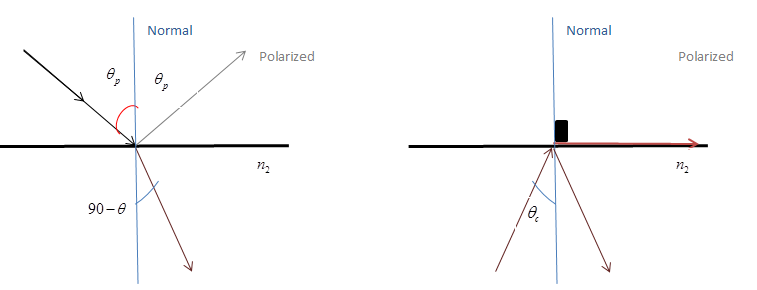
Note: The incident ray will be not polarized when it hits the denser medium. It is temporarily absorbed by the medium. Electrons there oscillate in the direction of electric field vectors which are perpendicular to the refracted ray. These atoms re-emit the light to give the reflected and refracted rays. Since it is an electromagnetic wave the electric field vectors (which have the same direction in which the electrons where oscillating) will be perpendicular to the direction of propagation of the wave.
The only possible direction for the electric field vector of the reflected wave is perpendicular to the plane since it should be perpendicular to the direction of propagation of the wave .That’s the reason the reflected ray is linearly polarized. The refracted ray will be partly polarized as there are more electric field vectors in the plane than perpendicular to the plane. For all other angles than 0 degrees and Brewster angle the reflected ray also will be partly polarized.
We can also use this direct formula $ \sin {\theta _c} = \dfrac{1}{{\tan {\theta _p}}} $ , when the rarer medium is air, $ {\theta _p} $ is the polarizing angle and $ {\theta _c} $ is the critical angle.
Formula used
$ \tan {\theta _p} = \dfrac{{{n_2}}}{{{n_1}}} $ , $ {n_2} > {n_1} $ , $ {\theta _p} $ is the polarizing angle and $ {n_1} $ and $ {n_2} $ are the refractive indices of medium 1 and 2 respectively
$ {n_1}sin{\theta _1} = .{n_2}sin{\theta _2}. $ Where $ {\theta _1} $ is the incident angle, $ {\theta _2} $ is the refracted angle, $ {n_2} $ refractive index and $ {n_1} $ incident index.
$ \sin {\theta _c} = \dfrac{{{n_1}}}{{{n_2}}} $ ,where $ {\theta _c} $ is the critical angle, $ {n_2} $ is the denser medium and $ {n_1} $ is the rarer medium (usually rarer medium is air $ {n_1} = 1 $ )
Complete step-by-step answer:
When a ray of light is incident on a denser medium at a particular angle the reflected light will be linearly polarized. The tangent of this incident angle (polarizing angle) gives the refractive index. This polarizing angle is also known as Brewster’s angle. When light strikes at a particular angle known as Brewster’s angle the reflected and refracted rays will be perpendicular to each other and also the reflected ray will be linearly polarized. The polarizing angle is found by . $ \tan {\theta _p} = \dfrac{{{n_2}}}{{{n_1}}} $ , $ {n_2} > {n_1} $ $ {\theta _p} $ is the polarizing angle and $ {n_1} $ and $ {n_2} $ are the refractive indices of medium 1 and 2 respectively
Here $ {n_1} = 1 $ and given $ {\theta _p} = {60^0} $
$ \sqrt 3 = {n_2} $
Snell’s law: It describes the relation between the angle of incidence and refraction .The law states that the ratio of sine of incident angle and sine of refracted angle will be equal to the ratio of refractive index( $ {n_2} $ )and incident index ( $ {n_1} $ ) Using Snell’s law,
$ {n_1}sin{\theta _1} = .{n_2}sin{\theta _2}. $
Here, $ {n_1} = 1 $ and $ {n_2} = \sqrt 3 $ .At critical angle $ {\theta _1} = {90^0} $ and $ {\theta _2} = {\theta _c} $
$ \sin {\theta _c} = \dfrac{1}{{\sqrt 3 }} $
$ {\theta _c} = {\sin ^{ - 1}}\dfrac{1}{{\sqrt 3 }} $
The correct option is C
Note: The incident ray will be not polarized when it hits the denser medium. It is temporarily absorbed by the medium. Electrons there oscillate in the direction of electric field vectors which are perpendicular to the refracted ray. These atoms re-emit the light to give the reflected and refracted rays. Since it is an electromagnetic wave the electric field vectors (which have the same direction in which the electrons where oscillating) will be perpendicular to the direction of propagation of the wave.
The only possible direction for the electric field vector of the reflected wave is perpendicular to the plane since it should be perpendicular to the direction of propagation of the wave .That’s the reason the reflected ray is linearly polarized. The refracted ray will be partly polarized as there are more electric field vectors in the plane than perpendicular to the plane. For all other angles than 0 degrees and Brewster angle the reflected ray also will be partly polarized.
We can also use this direct formula $ \sin {\theta _c} = \dfrac{1}{{\tan {\theta _p}}} $ , when the rarer medium is air, $ {\theta _p} $ is the polarizing angle and $ {\theta _c} $ is the critical angle.
Recently Updated Pages
Master Class 12 Economics: Engaging Questions & Answers for Success

Master Class 12 Physics: Engaging Questions & Answers for Success
Master Class 12 English: Engaging Questions & Answers for Success
Master Class 12 Social Science: Engaging Questions & Answers for Success
Master Class 12 Maths: Engaging Questions & Answers for Success
Master Class 12 Business Studies: Engaging Questions & Answers for Success
Trending doubts
Which are the Top 10 Largest Countries of the World?
What are the major means of transport Explain each class 12 social science CBSE
Draw a labelled sketch of the human eye class 12 physics CBSE
Why cannot DNA pass through cell membranes class 12 biology CBSE
Differentiate between insitu conservation and exsitu class 12 biology CBSE
Draw a neat and well labeled diagram of TS of ovary class 12 biology CBSE