




The polar coordinates of the vertices of a triangle are $\left( 0,0 \right),\left( 3,\dfrac{\pi }{2} \right)\ and\ \left( 3,\dfrac{\pi }{6} \right)$. Then the triangle is,
A. Right angled
B. Isosceles
C. Equilateral
D. None of these
Answer
 Verified
645.9k+ views
Hint: In the above question we will first find the all side of triangle by using the distance formula between $\left( {{x}_{1}},{{y}_{1}} \right)\ and\ \left( {{x}_{2}},{{y}_{2}} \right)$ as follows:
$D=\sqrt{{{\left( {{x}_{2}}-{{x}_{1}} \right)}^{2}}+{{\left( {{y}_{2}}-{{y}_{1}} \right)}^{2}}}$
Also, we will use the formula to change the polar coordinates into Cartesian coordinates as follows:
Let, we have polar coordinates $\left( r,\theta \right)$ then in Cartesian coordinates,
X coordinates $=r\cos \theta $
Y coordinates $=r\sin \theta $
Complete step-by-step answer:
We have been given the polar coordinates of the vertices of a triangle are $\left( 0,0 \right),\left( 3,\dfrac{\pi }{2} \right)\ and\ \left( 3,\dfrac{\pi }{6} \right)$.
Let us suppose a $\Delta ABC$ where $A\left( 0,0 \right),B\left( 3,\dfrac{\pi }{2} \right)\ and\ C\left( 3,\dfrac{\pi }{6} \right)$.
We know that in Cartesian form the polar coordinates $\left( r,\theta \right)$ is written as;
X coordinates $=r\cos \theta $
Y coordinates $=r\sin \theta $
$B\left( 3,\dfrac{\pi }{2} \right)$
X coordinates $=3\cos \dfrac{\pi }{2}=3\times 0=0$
Y coordinates $=3\sin \dfrac{\pi }{2}=3\times 1=3$
$C\left( 3,\dfrac{\pi }{6} \right)$
X coordinates $=3\cos \dfrac{\pi }{6}=3\times \dfrac{\sqrt{3}}{2}=\dfrac{3\sqrt{3}}{2}$
Y coordinates $=3\sin \dfrac{\pi }{6}=3\times \dfrac{1}{2}=\dfrac{3}{2}$
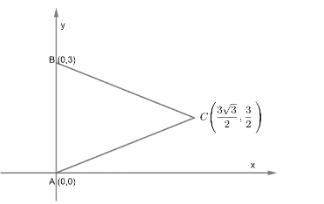
We know that distance between two points $\left( {{x}_{1}},{{y}_{1}} \right)\ and\ \left( {{x}_{2}},{{y}_{2}} \right)$ is given by,
$D=\sqrt{{{\left( {{x}_{2}}-{{x}_{1}} \right)}^{2}}+{{\left( {{y}_{2}}-{{y}_{1}} \right)}^{2}}}$
We have $A\left( 0,0 \right)\ and\ B\left( 0,3 \right)$
$\begin{align}
& \Rightarrow AB=\sqrt{{{\left( 0-0 \right)}^{2}}+{{\left( 3-0 \right)}^{2}}} \\
& =\sqrt{0+9} \\
& =3 \\
\end{align}$
Also, we have $A\left( 0,0 \right)\ and\ C\left( \dfrac{3\sqrt{3}}{2},\dfrac{3}{2} \right)$
$\begin{align}
& \Rightarrow AC=\sqrt{{{\left( \dfrac{3\sqrt{3}}{2}-0 \right)}^{2}}+{{\left( \dfrac{3}{2}-0 \right)}^{2}}} \\
& =\sqrt{\dfrac{27}{4}+\dfrac{9}{4}} \\
& =\sqrt{\dfrac{36}{4}} \\
& =\dfrac{6}{2} \\
& =3 \\
\end{align}$
Again, we have $B\left( 0,3 \right)\ and\ C\left( \dfrac{3\sqrt{3}}{2},\dfrac{3}{2} \right)$
$\begin{align}
& \Rightarrow BC=\sqrt{{{\left( \dfrac{3\sqrt{3}}{2}-0 \right)}^{2}}+{{\left( \dfrac{3}{2}-0 \right)}^{2}}} \\
& =\sqrt{\dfrac{27}{4}+{{\left( \dfrac{-3}{2} \right)}^{2}}} \\
& =\sqrt{\dfrac{27}{4}+\dfrac{9}{4}} \\
& =\sqrt{\dfrac{36}{4}} \\
& =\dfrac{6}{2} \\
& =3 \\
\end{align}$
So, we get $AB=BC=AC=3unit$.
We know that if a triangle has all its sides equal then it must be an equilateral triangle.
Hence, ABC is an equilateral triangle.
Therefore, the correct option of the given question is option C.
Note: We can also find the type of triangle by finding the angles between the lines of the triangle and in that case we get each angle equal to $60{}^\circ $. Hence, it is an equilateral triangle. Also, remember that we have been given the coordinates in polar form. So, we must have to change it into Cartesian form otherwise we will make mistakes and treat it like Cartesian coordinates.
$D=\sqrt{{{\left( {{x}_{2}}-{{x}_{1}} \right)}^{2}}+{{\left( {{y}_{2}}-{{y}_{1}} \right)}^{2}}}$
Also, we will use the formula to change the polar coordinates into Cartesian coordinates as follows:
Let, we have polar coordinates $\left( r,\theta \right)$ then in Cartesian coordinates,
X coordinates $=r\cos \theta $
Y coordinates $=r\sin \theta $
Complete step-by-step answer:
We have been given the polar coordinates of the vertices of a triangle are $\left( 0,0 \right),\left( 3,\dfrac{\pi }{2} \right)\ and\ \left( 3,\dfrac{\pi }{6} \right)$.
Let us suppose a $\Delta ABC$ where $A\left( 0,0 \right),B\left( 3,\dfrac{\pi }{2} \right)\ and\ C\left( 3,\dfrac{\pi }{6} \right)$.
We know that in Cartesian form the polar coordinates $\left( r,\theta \right)$ is written as;
X coordinates $=r\cos \theta $
Y coordinates $=r\sin \theta $
$B\left( 3,\dfrac{\pi }{2} \right)$
X coordinates $=3\cos \dfrac{\pi }{2}=3\times 0=0$
Y coordinates $=3\sin \dfrac{\pi }{2}=3\times 1=3$
$C\left( 3,\dfrac{\pi }{6} \right)$
X coordinates $=3\cos \dfrac{\pi }{6}=3\times \dfrac{\sqrt{3}}{2}=\dfrac{3\sqrt{3}}{2}$
Y coordinates $=3\sin \dfrac{\pi }{6}=3\times \dfrac{1}{2}=\dfrac{3}{2}$
We know that distance between two points $\left( {{x}_{1}},{{y}_{1}} \right)\ and\ \left( {{x}_{2}},{{y}_{2}} \right)$ is given by,
$D=\sqrt{{{\left( {{x}_{2}}-{{x}_{1}} \right)}^{2}}+{{\left( {{y}_{2}}-{{y}_{1}} \right)}^{2}}}$
We have $A\left( 0,0 \right)\ and\ B\left( 0,3 \right)$
$\begin{align}
& \Rightarrow AB=\sqrt{{{\left( 0-0 \right)}^{2}}+{{\left( 3-0 \right)}^{2}}} \\
& =\sqrt{0+9} \\
& =3 \\
\end{align}$
Also, we have $A\left( 0,0 \right)\ and\ C\left( \dfrac{3\sqrt{3}}{2},\dfrac{3}{2} \right)$
$\begin{align}
& \Rightarrow AC=\sqrt{{{\left( \dfrac{3\sqrt{3}}{2}-0 \right)}^{2}}+{{\left( \dfrac{3}{2}-0 \right)}^{2}}} \\
& =\sqrt{\dfrac{27}{4}+\dfrac{9}{4}} \\
& =\sqrt{\dfrac{36}{4}} \\
& =\dfrac{6}{2} \\
& =3 \\
\end{align}$
Again, we have $B\left( 0,3 \right)\ and\ C\left( \dfrac{3\sqrt{3}}{2},\dfrac{3}{2} \right)$
$\begin{align}
& \Rightarrow BC=\sqrt{{{\left( \dfrac{3\sqrt{3}}{2}-0 \right)}^{2}}+{{\left( \dfrac{3}{2}-0 \right)}^{2}}} \\
& =\sqrt{\dfrac{27}{4}+{{\left( \dfrac{-3}{2} \right)}^{2}}} \\
& =\sqrt{\dfrac{27}{4}+\dfrac{9}{4}} \\
& =\sqrt{\dfrac{36}{4}} \\
& =\dfrac{6}{2} \\
& =3 \\
\end{align}$
So, we get $AB=BC=AC=3unit$.
We know that if a triangle has all its sides equal then it must be an equilateral triangle.
Hence, ABC is an equilateral triangle.
Therefore, the correct option of the given question is option C.
Note: We can also find the type of triangle by finding the angles between the lines of the triangle and in that case we get each angle equal to $60{}^\circ $. Hence, it is an equilateral triangle. Also, remember that we have been given the coordinates in polar form. So, we must have to change it into Cartesian form otherwise we will make mistakes and treat it like Cartesian coordinates.
Recently Updated Pages
Master Class 12 Business Studies: Engaging Questions & Answers for Success

Master Class 12 Chemistry: Engaging Questions & Answers for Success
Master Class 12 Biology: Engaging Questions & Answers for Success
Class 12 Question and Answer - Your Ultimate Solutions Guide
Master Class 11 English: Engaging Questions & Answers for Success
Master Class 11 Social Science: Engaging Questions & Answers for Success
Trending doubts
Which are the Top 10 Largest Countries of the World?
The total number of vertebrae in man is a30 b31 c32 class 12 biology CBSE
Draw a labelled sketch of the human eye class 12 physics CBSE
The number of cranial nerves in a frog is A 10 pairs class 12 biology CBSE
Differentiate between homogeneous and heterogeneous class 12 chemistry CBSE
Differentiate between Pyramid of energy and pyramid class 12 biology CBSE