




The plots of $\dfrac{1}{{{X_A}}}\;\rm{vs}\;\dfrac{1}{{{Y_A}}}$(where ${X_A}$and ${Y_A}$are the mole fraction of liquid $A$ in liquid and vapor respectively) is linear with slope and intercepts respectively.
(A) $P_A^0/P_B^0$ and $\dfrac{{(P_A^0 - P_B^0)}}{{P_B^0}}$
(B) $P_A^0/P_B^0$ and $\dfrac{{(P_B^0 - P_A^0)}}{{P_B^0}}$
(C) $P_B^0/P_A^0$ and $\dfrac{{(P_A^0 - P_B^0)}}{{P_B^0}}$
(D) $P_B^0/P_A^0$ and $\dfrac{{(P_B^0 - P_A^0)}}{{P_B^0}}$
Answer
 Verified
592.5k+ views
Hint:
This question can be explained on the basis of Raoult’s law. The law states that partial pressure of each component of an ideal mixture of liquid is equal to the vapor pressure of pure components multiplied by its mole fraction.
Let liquid mixture has two components A and B.
Partial pressure of A is ${P_A} = P_A^0x_A$
Partial pressure of B is ${P_B} = P_B^0x_B$
$P_A^0 = $vapor pressure of liquid A.
$x_A = $mole fraction of A.
$P_B^0 = $vapor pressure of liquid B.
$x_B = $mole fraction of B.
Complete Step by Step Solution:
In the given equation:
$x_A = $mole fraction of A in liquid state
$y_A = $mole fraction of A in vapor phase
If we plot a graph of $\dfrac{1}{{x_A}}$vs $\dfrac{1}{{y_A}}$we get a straight line.
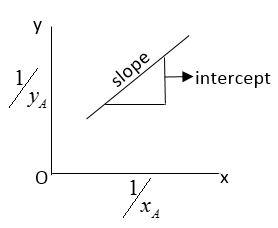
Let $P_A^0$be partial pressure of liquid A and $P_B^0$partial of vapor.
By Raoult’s law we have,
${P_A} = P_A^0x_A$_____ (1)
${P_B} = P_B^0x_B$_____ (2)
And $P_A^1 = {P_M}{Y_A}$and $P_B^1 = {P_m}{Y_B}$
$\therefore \dfrac{{{P_A}}}{{{Y_A}}} = \dfrac{{P_B^1}}{{{Y_B}}}$
$\Rightarrow \dfrac{{P_A^0x_A}}{{y_A}} = \dfrac{{P_B^0x_B}}{{y_B}} = \dfrac{{P_B^0(1 - x_A)}}{{(1 - y_A)}}$
As we know the sum of mole fraction of $x_A$and $x_B$is 1.
$x_A + x_B = 1$ and $y_A + y_B = 1$
$\Rightarrow x_B - (1 - x_A)$
$\Rightarrow y_B - (1 - y_A)$
$\Rightarrow \dfrac{{P_B^0}}{{x_A}} = \dfrac{{P_A^0}}{{y_A}} + (P_B^0 - P_A^0)$
$\Rightarrow \dfrac{1}{{x_A}} = \dfrac{1}{{y_A}}.\dfrac{{P_A^0}}{{P_B^0}} + \dfrac{{(P_B^0 - P_A^0)}}{{({P_B})}}$
Comparing above equation with $ y = mx + c$ we get
$y = \dfrac{1}{{{x_A}}}$
$x = \dfrac{1}{{{y_A}}}$
$m = \dfrac{{P_A^0}}{{P_B^0}}$
$c = \left( {\dfrac{{P_B^0 - P_A^0}}{{{P_B}}}} \right)$
Here, y and x are variable
$m = slope = \dfrac{{P_A^0}}{{P_B^0}}$
$c = \rm{intercept} = \left[ {\dfrac{{P_B^0 - P_A^0}}{{{P_B}}}} \right] $
Therefore, from the above explanation the correct option is (D) $P_B^0/P_A^0$ and $\dfrac{{(P_B^0 - P_A^0)}}{{P_B^0}}$
Raoult’s law is used to estimate the contribution of an individual component of a liquid or solid mixture to total pressure exerted by the system.
Note:
We should know that Raoult’s law is applicable to solutions containing non-volatile solute. It is not applicable for solute which dissociate or associate in the solution.
This question can be explained on the basis of Raoult’s law. The law states that partial pressure of each component of an ideal mixture of liquid is equal to the vapor pressure of pure components multiplied by its mole fraction.
Let liquid mixture has two components A and B.
Partial pressure of A is ${P_A} = P_A^0x_A$
Partial pressure of B is ${P_B} = P_B^0x_B$
$P_A^0 = $vapor pressure of liquid A.
$x_A = $mole fraction of A.
$P_B^0 = $vapor pressure of liquid B.
$x_B = $mole fraction of B.
Complete Step by Step Solution:
In the given equation:
$x_A = $mole fraction of A in liquid state
$y_A = $mole fraction of A in vapor phase
If we plot a graph of $\dfrac{1}{{x_A}}$vs $\dfrac{1}{{y_A}}$we get a straight line.
Let $P_A^0$be partial pressure of liquid A and $P_B^0$partial of vapor.
By Raoult’s law we have,
${P_A} = P_A^0x_A$_____ (1)
${P_B} = P_B^0x_B$_____ (2)
And $P_A^1 = {P_M}{Y_A}$and $P_B^1 = {P_m}{Y_B}$
$\therefore \dfrac{{{P_A}}}{{{Y_A}}} = \dfrac{{P_B^1}}{{{Y_B}}}$
$\Rightarrow \dfrac{{P_A^0x_A}}{{y_A}} = \dfrac{{P_B^0x_B}}{{y_B}} = \dfrac{{P_B^0(1 - x_A)}}{{(1 - y_A)}}$
As we know the sum of mole fraction of $x_A$and $x_B$is 1.
$x_A + x_B = 1$ and $y_A + y_B = 1$
$\Rightarrow x_B - (1 - x_A)$
$\Rightarrow y_B - (1 - y_A)$
$\Rightarrow \dfrac{{P_B^0}}{{x_A}} = \dfrac{{P_A^0}}{{y_A}} + (P_B^0 - P_A^0)$
$\Rightarrow \dfrac{1}{{x_A}} = \dfrac{1}{{y_A}}.\dfrac{{P_A^0}}{{P_B^0}} + \dfrac{{(P_B^0 - P_A^0)}}{{({P_B})}}$
Comparing above equation with $ y = mx + c$ we get
$y = \dfrac{1}{{{x_A}}}$
$x = \dfrac{1}{{{y_A}}}$
$m = \dfrac{{P_A^0}}{{P_B^0}}$
$c = \left( {\dfrac{{P_B^0 - P_A^0}}{{{P_B}}}} \right)$
Here, y and x are variable
$m = slope = \dfrac{{P_A^0}}{{P_B^0}}$
$c = \rm{intercept} = \left[ {\dfrac{{P_B^0 - P_A^0}}{{{P_B}}}} \right] $
Therefore, from the above explanation the correct option is (D) $P_B^0/P_A^0$ and $\dfrac{{(P_B^0 - P_A^0)}}{{P_B^0}}$
Raoult’s law is used to estimate the contribution of an individual component of a liquid or solid mixture to total pressure exerted by the system.
Note:
We should know that Raoult’s law is applicable to solutions containing non-volatile solute. It is not applicable for solute which dissociate or associate in the solution.
Recently Updated Pages
Basicity of sulphurous acid and sulphuric acid are

Master Class 12 English: Engaging Questions & Answers for Success
Master Class 12 Social Science: Engaging Questions & Answers for Success
Master Class 12 Maths: Engaging Questions & Answers for Success
Master Class 12 Economics: Engaging Questions & Answers for Success
Master Class 12 Physics: Engaging Questions & Answers for Success
Trending doubts
Give 10 examples of unisexual and bisexual flowers
Coming together federation is practiced in A India class 12 social science CBSE
Write the formula to find the shortest distance between class 12 maths CBSE
Find the foot of the perpendicular from point232to class 12 maths CBSE
How was the Civil Disobedience Movement different from class 12 social science CBSE
How is democracy better than other forms of government class 12 social science CBSE