




The plants with the weak stem growing by spreading on the ground are
A. Creepers
B. Runners
C. Climbers
D. None of the above
Answer
 Verified
550.1k+ views
Hint: New plants arise from the nodes of these plants.
Complete answer:
Creepers are plants that have weak stems and can not stand upright. Creepers are also known as prostate or sub-aerial weak stems. They grow by spreading stems and branches on the ground (sometimes water), new plants develop from the nodes of the branches and stems. The formation of adventitious roots at each node occurs.
Additional Information:
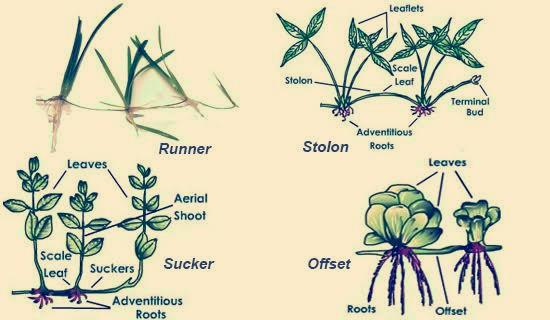
The subaerial or prostate weak stems can be divided into four categories:
- Runner: These plants have creeping horizontal branches and long internodes. Aerial shoots and roots develop from the axillary buds present at nodes. New plants develop from the nodes when the main stem breaks off. Examples include doob grass, wood sorrel, etc.
- Sucker: In suckers, a prostate or subaerial stem originated from the main stem and after growing horizontally below the soil surface for some distance it grows upward obliquely to give rise to new plants. Examples include Mentha arvensis, and Chrysanthemum.
- Offset: This is a weak, elongated branch, which produces a tuft of roots below and a cluster of leaves above at each internode. Examples include Eichhornia and Pistia. Eichhornia or water hyacinth is known as the terror of Bengal as it propagates very fast vegetatively.
- Stolon: The stems grow aerially for some length and then arches downward to meet the soil, from that point a new plant develops. Examples are Colocasia, Mentha piperita, and passionflower.
So, the correct answer is, “The plants with the weak stem growing by spreading on the ground are creepers.”
Note: Trailers also have weak stems like creepers, but these plants have only one fixed main root from where other branches develop and propagate, they trail along with the soil and no development of roots at nodes takes place.
Complete answer:
Creepers are plants that have weak stems and can not stand upright. Creepers are also known as prostate or sub-aerial weak stems. They grow by spreading stems and branches on the ground (sometimes water), new plants develop from the nodes of the branches and stems. The formation of adventitious roots at each node occurs.
Additional Information:
The subaerial or prostate weak stems can be divided into four categories:
- Runner: These plants have creeping horizontal branches and long internodes. Aerial shoots and roots develop from the axillary buds present at nodes. New plants develop from the nodes when the main stem breaks off. Examples include doob grass, wood sorrel, etc.
- Sucker: In suckers, a prostate or subaerial stem originated from the main stem and after growing horizontally below the soil surface for some distance it grows upward obliquely to give rise to new plants. Examples include Mentha arvensis, and Chrysanthemum.
- Offset: This is a weak, elongated branch, which produces a tuft of roots below and a cluster of leaves above at each internode. Examples include Eichhornia and Pistia. Eichhornia or water hyacinth is known as the terror of Bengal as it propagates very fast vegetatively.
- Stolon: The stems grow aerially for some length and then arches downward to meet the soil, from that point a new plant develops. Examples are Colocasia, Mentha piperita, and passionflower.
So, the correct answer is, “The plants with the weak stem growing by spreading on the ground are creepers.”
Note: Trailers also have weak stems like creepers, but these plants have only one fixed main root from where other branches develop and propagate, they trail along with the soil and no development of roots at nodes takes place.
Recently Updated Pages
Master Class 11 Social Science: Engaging Questions & Answers for Success

Master Class 11 English: Engaging Questions & Answers for Success
Master Class 11 Maths: Engaging Questions & Answers for Success
Master Class 11 Chemistry: Engaging Questions & Answers for Success
Master Class 11 Biology: Engaging Questions & Answers for Success
Master Class 11 Physics: Engaging Questions & Answers for Success
Trending doubts
One Metric ton is equal to kg A 10000 B 1000 C 100 class 11 physics CBSE
Difference Between Prokaryotic Cells and Eukaryotic Cells
How many of the following diseases can be studied with class 11 biology CBSE
Draw a diagram of a plant cell and label at least eight class 11 biology CBSE
Two of the body parts which do not appear in MRI are class 11 biology CBSE
Which gas is abundant in air class 11 chemistry CBSE