




The plane face of a plano convex lens is silvered. If \[\mu \] is the refractive index and \[r\] the radius of curvature of the curved surface, then the system behaves like a concave mirror of radius-
(A). \[\dfrac{r}{\mu }\]
(B). \[\dfrac{r}{\mu -1}\]
(C). \[r\mu \]
(D). \[r(\mu -1)\]
Answer
 Verified
588k+ views
Hint: When a plano convex lens is silvered from one end, it acts as a mirror. The final image formation will take after the light ray undergoes reflection once from silvered surface and refraction twice on the lens surface. Using the formula for the combination of lens and mirror, we can calculate focus and use it to calculate radius of curvature of mirror.
Formula used:
\[\dfrac{1}{{{f}_{s}}}=\dfrac{1}{{{f}_{m}}}+\dfrac{2}{{{f}_{l}}}\]
\[\dfrac{1}{{{f}_{l}}}=(\mu -1)\left( \dfrac{1}{{{R}_{1}}}-\dfrac{1}{{{R}_{2}}} \right)\]
Complete step by step solution:
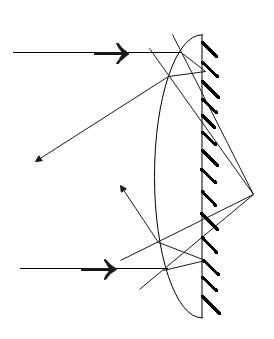
When lens and mirrors are in combination, the new focus is given by the formula-
\[\dfrac{1}{{{f}_{s}}}=\dfrac{1}{{{f}_{m}}}+\dfrac{1}{{{f}_{l}}}+\dfrac{1}{{{f}_{l}}}\] [As the ray of light undergoes refraction twice on the surface of lens]
\[\]
\[\Rightarrow \dfrac{1}{{{f}_{s}}}=\dfrac{1}{{{f}_{m}}}+\dfrac{2}{{{f}_{l}}}\] - (1)
Here, \[{{f}_{s}}\] is the equivalent focus of lens and mirror combination
\[{{f}_{m}}\] is the focus of mirror
\[{{f}_{l}}\] is the focus of lens
As mirror is plane, \[R=\infty \] therefore \[{{f}_{m}}=\infty \] so, \[\dfrac{1}{{{f}_{m}}}=0\] .
For a lens,
\[\dfrac{1}{{{f}_{l}}}=(\mu -1)\left( \dfrac{1}{{{R}_{1}}}-\dfrac{1}{{{R}_{2}}} \right)\] - (2)
Here,
\[\mu \] is the refractive index
\[{{R}_{1}}\] is the radius of first surface
\[{{R}_{2}}\] is the radius of second surface
For lens of plano-convex lens, substituting values in eq (2), we get,
\[\dfrac{1}{{{f}_{l}}}=(\mu -1)\left( \dfrac{1}{r} \right)\]
Substituting in eq (1), we get,
\[\begin{align}
& \dfrac{1}{{{f}_{s}}}=\dfrac{1}{{{f}_{m}}}+\dfrac{2}{{{f}_{l}}} \\
& \dfrac{1}{{{f}_{s}}}=0+2\left( \dfrac{\mu -1}{r} \right) \\
& \Rightarrow {{f}_{s}}=\dfrac{r}{2(\mu -1)} \\
\end{align}\]
The focus of the resultant concave mirror is \[\dfrac{r}{2(\mu -1)}\] . We know, for a mirror, \[R=2f\]
Therefore, the radius of the resultant concave mirror will be-
\[R=2\times \dfrac{r}{2(\mu -1)}=\dfrac{r}{(\mu -1)}\]
Radius of curvature is \[\dfrac{r}{(\mu -1)}\] .
So, the correct answer is “Option B”.
Note: Several combinations of lenses are possible like concavo-convex, convexo-concave, plano-concave, plano-convex etc. When one part of these lenses is silvered they act as mirrors. By convention, we take all the distances to the left as negative and all the distances to the right as positive.
Formula used:
\[\dfrac{1}{{{f}_{s}}}=\dfrac{1}{{{f}_{m}}}+\dfrac{2}{{{f}_{l}}}\]
\[\dfrac{1}{{{f}_{l}}}=(\mu -1)\left( \dfrac{1}{{{R}_{1}}}-\dfrac{1}{{{R}_{2}}} \right)\]
Complete step by step solution:
When lens and mirrors are in combination, the new focus is given by the formula-
\[\dfrac{1}{{{f}_{s}}}=\dfrac{1}{{{f}_{m}}}+\dfrac{1}{{{f}_{l}}}+\dfrac{1}{{{f}_{l}}}\] [As the ray of light undergoes refraction twice on the surface of lens]
\[\]
\[\Rightarrow \dfrac{1}{{{f}_{s}}}=\dfrac{1}{{{f}_{m}}}+\dfrac{2}{{{f}_{l}}}\] - (1)
Here, \[{{f}_{s}}\] is the equivalent focus of lens and mirror combination
\[{{f}_{m}}\] is the focus of mirror
\[{{f}_{l}}\] is the focus of lens
As mirror is plane, \[R=\infty \] therefore \[{{f}_{m}}=\infty \] so, \[\dfrac{1}{{{f}_{m}}}=0\] .
For a lens,
\[\dfrac{1}{{{f}_{l}}}=(\mu -1)\left( \dfrac{1}{{{R}_{1}}}-\dfrac{1}{{{R}_{2}}} \right)\] - (2)
Here,
\[\mu \] is the refractive index
\[{{R}_{1}}\] is the radius of first surface
\[{{R}_{2}}\] is the radius of second surface
For lens of plano-convex lens, substituting values in eq (2), we get,
\[\dfrac{1}{{{f}_{l}}}=(\mu -1)\left( \dfrac{1}{r} \right)\]
Substituting in eq (1), we get,
\[\begin{align}
& \dfrac{1}{{{f}_{s}}}=\dfrac{1}{{{f}_{m}}}+\dfrac{2}{{{f}_{l}}} \\
& \dfrac{1}{{{f}_{s}}}=0+2\left( \dfrac{\mu -1}{r} \right) \\
& \Rightarrow {{f}_{s}}=\dfrac{r}{2(\mu -1)} \\
\end{align}\]
The focus of the resultant concave mirror is \[\dfrac{r}{2(\mu -1)}\] . We know, for a mirror, \[R=2f\]
Therefore, the radius of the resultant concave mirror will be-
\[R=2\times \dfrac{r}{2(\mu -1)}=\dfrac{r}{(\mu -1)}\]
Radius of curvature is \[\dfrac{r}{(\mu -1)}\] .
So, the correct answer is “Option B”.
Note: Several combinations of lenses are possible like concavo-convex, convexo-concave, plano-concave, plano-convex etc. When one part of these lenses is silvered they act as mirrors. By convention, we take all the distances to the left as negative and all the distances to the right as positive.
Recently Updated Pages
Master Class 12 Social Science: Engaging Questions & Answers for Success

Master Class 12 Physics: Engaging Questions & Answers for Success
Master Class 12 Maths: Engaging Questions & Answers for Success
Master Class 12 Economics: Engaging Questions & Answers for Success
Master Class 12 Chemistry: Engaging Questions & Answers for Success
Master Class 12 Business Studies: Engaging Questions & Answers for Success
Trending doubts
Which are the Top 10 Largest Countries of the World?
Draw a labelled sketch of the human eye class 12 physics CBSE
Explain the structure of megasporangium class 12 biology CBSE
What are the major means of transport Explain each class 12 social science CBSE
How many chromosomes are found in human ovum a 46 b class 12 biology CBSE
The diagram of the section of a maize grain is given class 12 biology CBSE