




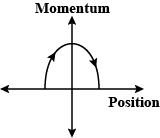
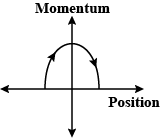
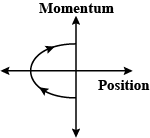
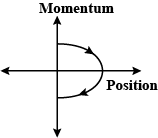
The phase space diagram for a ball thrown vertically up from ground is:

(A)
(B)
(C)
(D)
Answer
 Verified
534k+ views
Hint: We shall first understand what a phase-space diagram is and then try to answer our problem. The phase space diagrams are useful tools in analyzing all kinds of dynamical problems. They are especially useful in studying the changes in motion as initial position and momentum are changed. We shall use this definition to construct the phase-space diagram for a ball thrown vertically upwards as shown in the above graph.
Complete answer:
Now, we know that, when a ball is thrown vertically upwards (perpendicular to the ground), the ball reaches its maximum height when its velocity becomes equal to zero. So, we can say at maximum displacement, the momentum of the ball is zero.
Now, when the ball started from the ground, let us say it has a velocity V in the upward direction. Ignoring the air resistance, we can say that just before reaching the ground after completing one cycle, the velocity of the ball is -V. Hence, it starts with a maximum positive momentum and ends its journey at maximum negative momentum.
From these two-analyses done above, we can conclude that the ball starts off with maximum positive momentum. The momentum then becomes zero at maximum displacement, that is, the greatest position from the point of start and ends at maximum negative momentum.
Hence, option (D) represents the only correct space-phase diagram for a ball thrown vertically upwards.
Note:
We should be aware of the language of the question, as sometimes there may be some tricky terms. If we somehow are unable to interpret the question, we should seek help from the given options and try to come to a conclusion only if we are one hundred percent sure of it.
Complete answer:
Now, we know that, when a ball is thrown vertically upwards (perpendicular to the ground), the ball reaches its maximum height when its velocity becomes equal to zero. So, we can say at maximum displacement, the momentum of the ball is zero.
Now, when the ball started from the ground, let us say it has a velocity V in the upward direction. Ignoring the air resistance, we can say that just before reaching the ground after completing one cycle, the velocity of the ball is -V. Hence, it starts with a maximum positive momentum and ends its journey at maximum negative momentum.
From these two-analyses done above, we can conclude that the ball starts off with maximum positive momentum. The momentum then becomes zero at maximum displacement, that is, the greatest position from the point of start and ends at maximum negative momentum.
Hence, option (D) represents the only correct space-phase diagram for a ball thrown vertically upwards.
Note:
We should be aware of the language of the question, as sometimes there may be some tricky terms. If we somehow are unable to interpret the question, we should seek help from the given options and try to come to a conclusion only if we are one hundred percent sure of it.
Recently Updated Pages
Master Class 11 Computer Science: Engaging Questions & Answers for Success

Master Class 11 Business Studies: Engaging Questions & Answers for Success
Master Class 11 Economics: Engaging Questions & Answers for Success
Master Class 11 English: Engaging Questions & Answers for Success
Master Class 11 Maths: Engaging Questions & Answers for Success
Master Class 11 Biology: Engaging Questions & Answers for Success
Trending doubts
There are 720 permutations of the digits 1 2 3 4 5 class 11 maths CBSE
Discuss the various forms of bacteria class 11 biology CBSE
Draw a diagram of a plant cell and label at least eight class 11 biology CBSE
Explain zero factorial class 11 maths CBSE
What organs are located on the left side of your body class 11 biology CBSE
Draw a diagram of nephron and explain its structur class 11 biology CBSE