




The period of oscillation of compass needle will be $8s$ at a place where dip angle is ${{30}^{\circ }}$ and magnetic field will be${{B}_{1}}$. At another place where dip angle is ${{60}^{\circ }}$and magnetic field is${{B}_{2}}$, the period of oscillation has been given as $4s$, then what will be the ratio of the magnetic field,$\dfrac{{{B}_{2}}}{{{B}_{1}}}$?
Answer
 Verified
618k+ views
Hint: in order to find the ratio of $\dfrac{{{B}_{2}}}{{{B}_{1}}}$ we require to get the value of the horizontal component ${{B}_{H}}$ and by the use of the concept and formula of time period magnetic field the required value can be found. The time period can be found by taking the product of twice the pi and the square root of the ratio of the moment of inertia and the product of the magnetic moment and magnetic field at the horizontal component.
Complete step by step solution:
Here in the equation, the period of oscillation of a compass needle has been given as $8s$ at a specific place where the angle of dip is ${{30}^{\circ }}$and the value of magnetic field has been given as ${{B}_{1}}$. At so many other place where the angle of dip is ${{60}^{\circ }}$the value of magnetic field will be ${{B}_{2}}$ and the period of oscillation of the compass needle will be $4s$. We should know the formula for time period at first.
$T=2\pi \sqrt{\dfrac{I}{M{{B}_{H}}}}$……………. (1)
Where, $T$ will be representing the time period, $I$will be representing the moment of inertia, $M$ will be representing the magnetic moment, ${{B}_{H}}$ will be representing the horizontal component of the magnetic field. Here, by the diagram of the magnetic field of earth, we can write that,
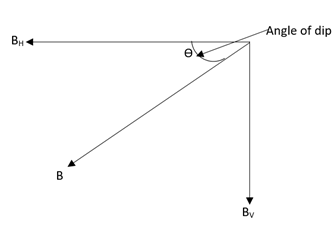
$\theta $ be the angle of the dip, ${{B}_{V}}$ will be representing the vertical component of the magnetic field, $B$ is representing the net magnetic field of the earth. From the above figure we can write that,
${{B}_{H}}=B\cos \theta $………….. (2)
Therefore from the equation (1) and (2), we can write that,
\[\begin{align}
& {{T}_{1}}=\text{ }2\pi ~\sqrt{\dfrac{I}{M{{B}_{1}}\cos 60{}^\circ }}..........(3) \\
& {{T}_{2}}=\text{ }2\pi \sqrt{\dfrac{I}{M{{B}_{2}}\cos 60{}^\circ }}...........(4) \\
\end{align}\]
As for the compass needle, the moment of inertia and magnetic moment are constant so \[I\] and \[M\]will not vary. Now by putting all the mentioned values of the time and the angles and dividing (3) and (4) we get,
\[\begin{align}
& \dfrac{8}{4}=\dfrac{\sqrt{{{B}_{2}}\cos 60{}^\circ }}{\sqrt{{{B}_{1}}\cos 30{}^\circ }} \\
& \Rightarrow 2=\dfrac{\sqrt{{{B}_{2}}\cos 60{}^\circ }}{\sqrt{{{B}_{1}}\cos 30{}^\circ }} \\
\end{align}\]
Now taking square on both sides we can write that,
\[\Rightarrow 4=\dfrac{{{B}_{2}}\cos 60{}^\circ }{{{B}_{1}}\cos 30{}^\circ }\]
By applying the values of \[\cos 60{}^\circ \]and \[\cos 30{}^\circ \] as $\dfrac{1}{2}$ and $\dfrac{\sqrt{3}}{2}$ respectively, we get that,
\[\begin{align}
& \Rightarrow 4=\dfrac{{{B}_{2}}}{{{B}_{1}}}\times \dfrac{1}{2}\times \dfrac{2}{\sqrt{3}} \\
& \Rightarrow 4\times \sqrt{3}=\dfrac{{{B}_{2}}}{{{B}_{1}}} \\
& \therefore \dfrac{{{B}_{2}}}{{{B}_{1}}}=4\sqrt{3} \\
\end{align}\]
Now the ratio of $\dfrac{{{B}_{2}}}{{{B}_{1}}}$ has been obtained as \[4\sqrt{3}\].
Note:
A magnetic field is a vector that defines the magnetic impact on the moving electric charges, electric currents and magnetic materials. The angle of dip is the angle between the earth’s net magnetic field and its horizontal component.
Complete step by step solution:
Here in the equation, the period of oscillation of a compass needle has been given as $8s$ at a specific place where the angle of dip is ${{30}^{\circ }}$and the value of magnetic field has been given as ${{B}_{1}}$. At so many other place where the angle of dip is ${{60}^{\circ }}$the value of magnetic field will be ${{B}_{2}}$ and the period of oscillation of the compass needle will be $4s$. We should know the formula for time period at first.
$T=2\pi \sqrt{\dfrac{I}{M{{B}_{H}}}}$……………. (1)
Where, $T$ will be representing the time period, $I$will be representing the moment of inertia, $M$ will be representing the magnetic moment, ${{B}_{H}}$ will be representing the horizontal component of the magnetic field. Here, by the diagram of the magnetic field of earth, we can write that,
$\theta $ be the angle of the dip, ${{B}_{V}}$ will be representing the vertical component of the magnetic field, $B$ is representing the net magnetic field of the earth. From the above figure we can write that,
${{B}_{H}}=B\cos \theta $………….. (2)
Therefore from the equation (1) and (2), we can write that,
\[\begin{align}
& {{T}_{1}}=\text{ }2\pi ~\sqrt{\dfrac{I}{M{{B}_{1}}\cos 60{}^\circ }}..........(3) \\
& {{T}_{2}}=\text{ }2\pi \sqrt{\dfrac{I}{M{{B}_{2}}\cos 60{}^\circ }}...........(4) \\
\end{align}\]
As for the compass needle, the moment of inertia and magnetic moment are constant so \[I\] and \[M\]will not vary. Now by putting all the mentioned values of the time and the angles and dividing (3) and (4) we get,
\[\begin{align}
& \dfrac{8}{4}=\dfrac{\sqrt{{{B}_{2}}\cos 60{}^\circ }}{\sqrt{{{B}_{1}}\cos 30{}^\circ }} \\
& \Rightarrow 2=\dfrac{\sqrt{{{B}_{2}}\cos 60{}^\circ }}{\sqrt{{{B}_{1}}\cos 30{}^\circ }} \\
\end{align}\]
Now taking square on both sides we can write that,
\[\Rightarrow 4=\dfrac{{{B}_{2}}\cos 60{}^\circ }{{{B}_{1}}\cos 30{}^\circ }\]
By applying the values of \[\cos 60{}^\circ \]and \[\cos 30{}^\circ \] as $\dfrac{1}{2}$ and $\dfrac{\sqrt{3}}{2}$ respectively, we get that,
\[\begin{align}
& \Rightarrow 4=\dfrac{{{B}_{2}}}{{{B}_{1}}}\times \dfrac{1}{2}\times \dfrac{2}{\sqrt{3}} \\
& \Rightarrow 4\times \sqrt{3}=\dfrac{{{B}_{2}}}{{{B}_{1}}} \\
& \therefore \dfrac{{{B}_{2}}}{{{B}_{1}}}=4\sqrt{3} \\
\end{align}\]
Now the ratio of $\dfrac{{{B}_{2}}}{{{B}_{1}}}$ has been obtained as \[4\sqrt{3}\].
Note:
A magnetic field is a vector that defines the magnetic impact on the moving electric charges, electric currents and magnetic materials. The angle of dip is the angle between the earth’s net magnetic field and its horizontal component.
Recently Updated Pages
Basicity of sulphurous acid and sulphuric acid are

Master Class 12 Economics: Engaging Questions & Answers for Success
Master Class 12 Biology: Engaging Questions & Answers for Success
Master Class 11 English: Engaging Questions & Answers for Success
Master Class 11 Physics: Engaging Questions & Answers for Success
Master Class 11 Computer Science: Engaging Questions & Answers for Success
Trending doubts
Draw a labelled sketch of the human eye class 12 physics CBSE
The chemical formula of tear gas is A CO Cl 2 B C 10 class 12 chemistry CBSE
Draw ray diagrams each showing i myopic eye and ii class 12 physics CBSE
Which are the Top 10 Largest Countries of the World?
Differentiate between homogeneous and heterogeneous class 12 chemistry CBSE
Which is the correct genotypic ratio of mendel dihybrid class 12 biology CBSE