




The ornithine cycle removes two waste products from the blood in the liver. These products are
(a) $C{ O }_{ 2 }$ and urea
(b) Ammonia and urea
(c) $C{ O }_{ 2 }$ and ammonia
(d) Ammonia and uric acid
Answer
 Verified
653.7k+ views
Hint: Urea is excreted in the ornithine cycle starting with the two most toxic substances in the human blood. One is the one we exhale and the other is the major product of nitrogen metabolism that is highly toxic.
Complete step by step answer:
- Almost 80% of the nitrogen in mammals including humans is excreted is in the form of urea. Urea is produced through a series of reactions occurring in the cytosol and mitochondrial matrix of liver cells.
- Ammonia is a toxic product of nitrogen metabolism which must be removed from our blood. This is achieved via the ornithine cycle.
- The ornithine cycle starts with the metabolism of ammonia and $C{ O }_{ 2 }$. The main purpose of the ornithine cycle is to eliminate toxic ammonia from the body. Eventually, ammonia and carbon dioxide are the two waste products removed from the body.
So the correct answer is, ‘$C{ O }_{ 2 }$ and ammonia.’
Additional information:
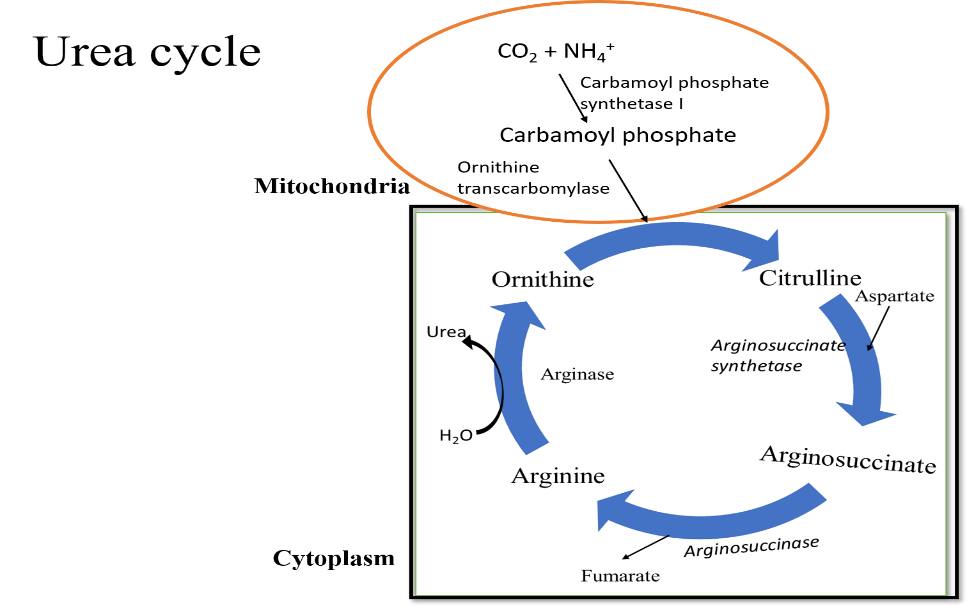
1. The ammonia combines with $C{ O }_{ 2 }$ and ${ H }_{ 2 }O$ to form carbamoyl phosphate.
2. Now, carbamoyl phosphate reacts with ornithine to form citrulline. This occurs in the matrix of mitochondria in the liver cells.
3. This citrulline produced now reacts with aspartate to form argininosuccinate.
4. Argininosuccinate breaks down to form fumarate & arginine. Later, fumarate produced is diverted towards Krebs Cycle.
5. Arginine is hydrolyzed by water to form urea & ornithine.
6. Ornithine is released and recycled. While urea is carried to the kidneys to be excreted through urine.
Note:
- The initial two steps of the ornithine cycle occur in the mitochondrial matrix.
- From the matrix, citrulline is released to the cytosol, where it condenses with aspartate to form argininosuccinate.
- Urea cycle defects cause hyperammonemia. Defects in the area could cause vomiting, coma, and convulsions in newborn babies.
- Krebs- Henseleit cycle is the other name of the ornithine cycle.
- Even a minute amount of excess ammonia can cause severe and irreversible damages.
- A dysfunctional urea (ornithine) cycle means an excessive amount of ammonia in the body, which can lead to cell toxicity and various disorders.
Complete step by step answer:
- Almost 80% of the nitrogen in mammals including humans is excreted is in the form of urea. Urea is produced through a series of reactions occurring in the cytosol and mitochondrial matrix of liver cells.
- Ammonia is a toxic product of nitrogen metabolism which must be removed from our blood. This is achieved via the ornithine cycle.
- The ornithine cycle starts with the metabolism of ammonia and $C{ O }_{ 2 }$. The main purpose of the ornithine cycle is to eliminate toxic ammonia from the body. Eventually, ammonia and carbon dioxide are the two waste products removed from the body.
So the correct answer is, ‘$C{ O }_{ 2 }$ and ammonia.’
Additional information:
1. The ammonia combines with $C{ O }_{ 2 }$ and ${ H }_{ 2 }O$ to form carbamoyl phosphate.
2. Now, carbamoyl phosphate reacts with ornithine to form citrulline. This occurs in the matrix of mitochondria in the liver cells.
3. This citrulline produced now reacts with aspartate to form argininosuccinate.
4. Argininosuccinate breaks down to form fumarate & arginine. Later, fumarate produced is diverted towards Krebs Cycle.
5. Arginine is hydrolyzed by water to form urea & ornithine.
6. Ornithine is released and recycled. While urea is carried to the kidneys to be excreted through urine.
Note:
- The initial two steps of the ornithine cycle occur in the mitochondrial matrix.
- From the matrix, citrulline is released to the cytosol, where it condenses with aspartate to form argininosuccinate.
- Urea cycle defects cause hyperammonemia. Defects in the area could cause vomiting, coma, and convulsions in newborn babies.
- Krebs- Henseleit cycle is the other name of the ornithine cycle.
- Even a minute amount of excess ammonia can cause severe and irreversible damages.
- A dysfunctional urea (ornithine) cycle means an excessive amount of ammonia in the body, which can lead to cell toxicity and various disorders.
Recently Updated Pages
If x a + bt + ct2 where x is in meters and t is in class 11 physics CBSE

A car covers the first half distance between two places class 11 physics CBSE
The resultant of two vectors overrightarrow P and overrightarrow class 11 physics CBSE
Find the value of cos 135 class 11 maths CBSE
A mass M is held in place by an applied force F and class 11 physics CBSE
A solution of glucose in water is labelled as 10 dfracwv class 11 chemistry CBSE
Trending doubts
Find the value of the expression given below sin 30circ class 11 maths CBSE
What is the maximum height of a projectile class 11 physics CBSE
Derive an expression for maximum height and range of class 11 physics CBSE
Describe various types of epithelial tissues with the class 11 biology CBSE
Lysosomes are known as suicidal bags of cell why class 11 biology CBSE
State and derive law of conservation of momentum class 11 physics CBSE