




The optically active molecule is:
A)
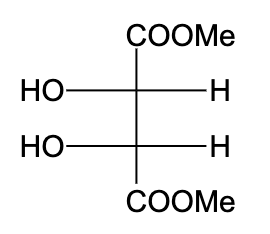
B)
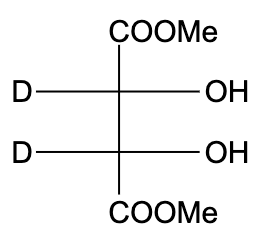
C)

D)

Answer
 Verified
607.8k+ views
Hint: Optical isomers are called enantiomers. They have identical chemical as well as physical properties. The Optical isomerism is associated with a plane of symmetry of the compound.
Complete step by step answer:
- Molecules which are optical isomers are known as enantiomers. They have identical chemical and physical properties. Only their effect on the plane of polarised light and reaction with the other chiral molecules are not the same.
- A chiral molecule that rotates through a plane of polarised light is said to be optically active. If the molecule rotates in a clockwise direction, we call that rotation a dextrorotatory rotation. However, if the light rotates counter-clockwise, we call that rotation as levorotatory.
- To identify the optically active molecule given in the question, we will consider the plane of symmetry of the compound. If there is an element of the plane of symmetry, the compound is optically inactive, if not found, and then it is optically active.
-In option (A), the compound is not optically active due to the presence of a plane of symmetry.

- In option (B), the compound is not optically active due to the presence of a plane of symmetry
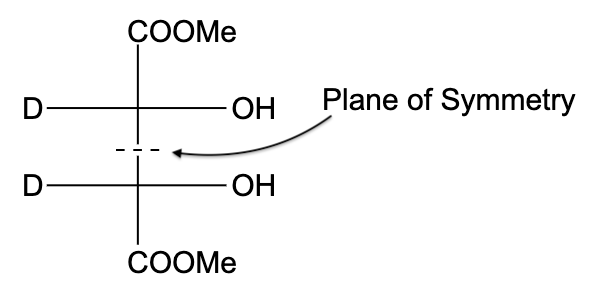
- In option (C), the compound is optically active, due to the presence of a plane of symmetry.
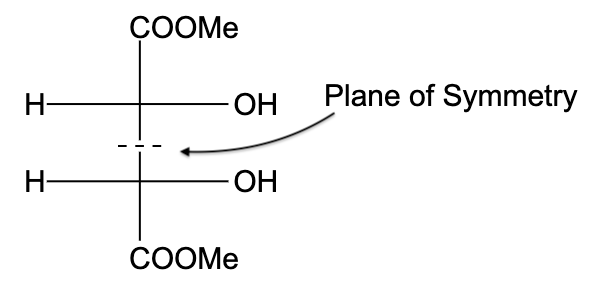
- In option (D), the compound is not optically active due to the presence of a plane of symmetry
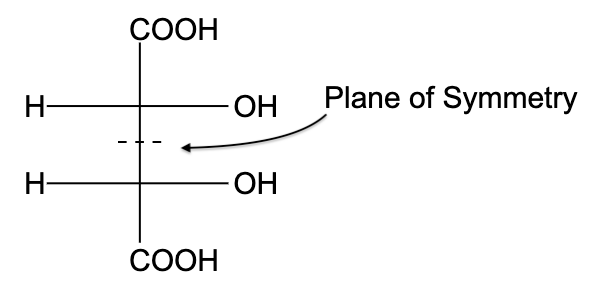
So, the correct answer is “Option C”.
Note: Chiral molecules are optically active. Therefore, when a beam of plane-polarized light passes through a chiral molecule, it interacts with the molecule in such a way that the angle of the plane of oscillation rotates.
Complete step by step answer:
- Molecules which are optical isomers are known as enantiomers. They have identical chemical and physical properties. Only their effect on the plane of polarised light and reaction with the other chiral molecules are not the same.
- A chiral molecule that rotates through a plane of polarised light is said to be optically active. If the molecule rotates in a clockwise direction, we call that rotation a dextrorotatory rotation. However, if the light rotates counter-clockwise, we call that rotation as levorotatory.
- To identify the optically active molecule given in the question, we will consider the plane of symmetry of the compound. If there is an element of the plane of symmetry, the compound is optically inactive, if not found, and then it is optically active.
-In option (A), the compound is not optically active due to the presence of a plane of symmetry.
- In option (B), the compound is not optically active due to the presence of a plane of symmetry
- In option (C), the compound is optically active, due to the presence of a plane of symmetry.
- In option (D), the compound is not optically active due to the presence of a plane of symmetry
So, the correct answer is “Option C”.
Note: Chiral molecules are optically active. Therefore, when a beam of plane-polarized light passes through a chiral molecule, it interacts with the molecule in such a way that the angle of the plane of oscillation rotates.
Recently Updated Pages
Master Class 12 Economics: Engaging Questions & Answers for Success

Master Class 12 Social Science: Engaging Questions & Answers for Success
Master Class 12 English: Engaging Questions & Answers for Success
Master Class 12 Maths: Engaging Questions & Answers for Success
Master Class 12 Physics: Engaging Questions & Answers for Success
Master Class 12 Biology: Engaging Questions & Answers for Success
Trending doubts
Draw a labelled sketch of the human eye class 12 physics CBSE
Which are the Top 10 Largest Countries of the World?
Draw ray diagrams each showing i myopic eye and ii class 12 physics CBSE
Which is the correct genotypic ratio of mendel dihybrid class 12 biology CBSE
Differentiate between homogeneous and heterogeneous class 12 chemistry CBSE
Which animal never drinks water in its entire life class 12 biology CBSE