




“The occurrence of one event excludes the occurrence of another event”. In a random experiment of probability theory, it is called
(A) Complementary event
(B) Impossible event
(C) Mutually exclusive event
(D) Certain event
Answer
 Verified
650.4k+ views
Hint: First of all, assume two events, event A and event B such that the occurrence of one event excludes the occurrence of another event. Then, draw the Venn diagram of the event. Now, compare with the Venn diagram of the mutually exclusive event and conclude the answer.
Complete step-by-step answer:
According to the question, we have two events and the occurrence of one event excludes the occurrence of another event.
Let us assume two events, event A and event B such that the occurrence of one event excludes the occurrence of another event.
It means that if event A is happening then event B cannot occur at the same and if event B is happening then event A cannot occur.
Let us understand and get the ideas of these both events, event A and event B by a Venn diagram.
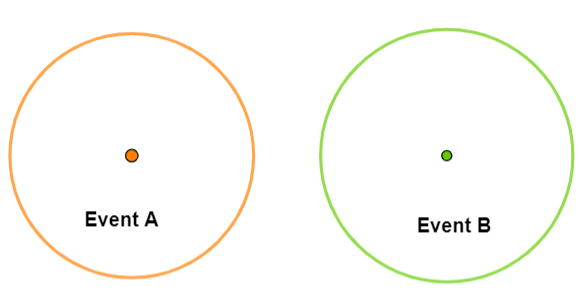
From the figure we can see that when the event A is happening then the event B is not occurring and also when the event B is happening then the event A is not occurring.
We also know the Venn diagram of mutually exclusive events. Drawing the Venn diagram of mutually exclusive events, we get
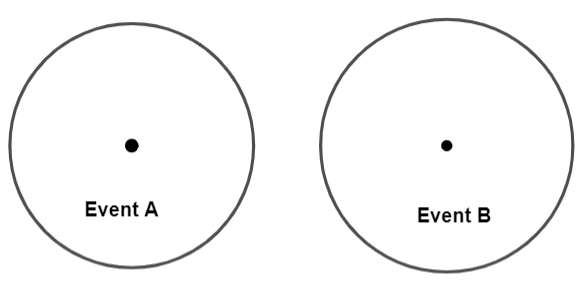
We can see that the Venn diagram of event A and event B is the same as of mutually exclusive events.
Therefore, the occurrence of one event excludes the occurrence of another event is mutually exclusive events.
Hence, the correct option is option (C).
Note: In this question, one can think that the occurrence of these events are independent and then conclude that these events are independent events. But this is wrong. These events are such that the occurrence of one event excludes the occurrence of another event. Independent events are those events whose probabilities do not affect one another.
Complete step-by-step answer:
According to the question, we have two events and the occurrence of one event excludes the occurrence of another event.
Let us assume two events, event A and event B such that the occurrence of one event excludes the occurrence of another event.
It means that if event A is happening then event B cannot occur at the same and if event B is happening then event A cannot occur.
Let us understand and get the ideas of these both events, event A and event B by a Venn diagram.
From the figure we can see that when the event A is happening then the event B is not occurring and also when the event B is happening then the event A is not occurring.
We also know the Venn diagram of mutually exclusive events. Drawing the Venn diagram of mutually exclusive events, we get
We can see that the Venn diagram of event A and event B is the same as of mutually exclusive events.
Therefore, the occurrence of one event excludes the occurrence of another event is mutually exclusive events.
Hence, the correct option is option (C).
Note: In this question, one can think that the occurrence of these events are independent and then conclude that these events are independent events. But this is wrong. These events are such that the occurrence of one event excludes the occurrence of another event. Independent events are those events whose probabilities do not affect one another.
Recently Updated Pages
Master Class 12 Economics: Engaging Questions & Answers for Success

Master Class 12 Biology: Engaging Questions & Answers for Success
Master Class 11 English: Engaging Questions & Answers for Success
Master Class 11 Physics: Engaging Questions & Answers for Success
Master Class 11 Computer Science: Engaging Questions & Answers for Success
Master Class 11 Chemistry: Engaging Questions & Answers for Success
Trending doubts
Draw a labelled sketch of the human eye class 12 physics CBSE
Why is the cell called the structural and functional class 12 biology CBSE
Draw ray diagrams each showing i myopic eye and ii class 12 physics CBSE
Which are the Top 10 Largest Countries of the World?
Differentiate between homogeneous and heterogeneous class 12 chemistry CBSE
Which is the correct genotypic ratio of mendel dihybrid class 12 biology CBSE