




The observations made by Swarali while doing the experiment are given below. Based on these, write answers to the questions.
Swarali found that the light ray travelling from the denser medium to rarer medium goes away from the normal. If the angle of incidence (i) is raised by Swarali, the angle of refraction (r) goes on increasing. However after a certain value of the angle of incidence the light ray is seen to return back into the denser medium.
Qns-
(i) What is the specific value of i called ?
(ii) What is the process of reflection of incident rays into a denser medium called ?
(iii) draw the diagrams of three observations made by Swarali.
Answer
 Verified
617.7k+ views
Hint: As the angle of incidence is increased the light gets reflected back in the denser medium. This kind of phenomenon is related to mirages observed in the desert or in communication through the ionosphere.
Complete answer:
(i) The specific value for angle of incidence at which the incident ray travels back into the denser medium is called critical angle.
It depends on the refractive index of the denser medium with respect to the rarer medium. The relation being:
$\mu = \tan \theta_c $.
where $\theta_c$ denotes the critical angle.
(ii) The phenomenon of reflection of incident rays back into the denser medium is called total internal reflection. As the light travels into a rarer medium from denser medium, reflection occurs at all angles i.e., a part of incident light is reflected back no matter what the incident angle is. But, after critical angle is reached, light does not pass into the rarer medium and is entirely reflected into the denser medium.
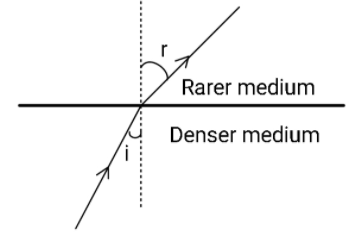
(iii) The first observation made by Swarali is that the light in traveling from denser to rarer medium goes away from the normal.
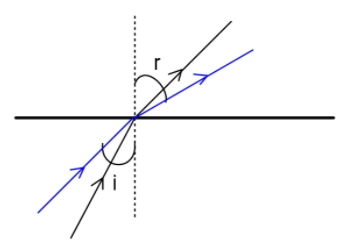
The second observation made by her is that angle of refraction r, increases on increasing angle of incidence, i.
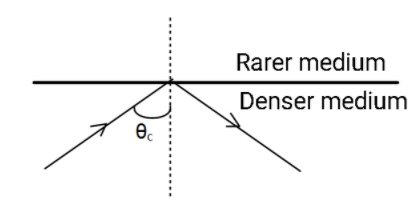
The final observation that she made was that at a critical angle there is no refraction in the rarer medium, the light instead travels back into the denser medium.
Note:
The value of critical angle can be simply determined by knowing the refractive index and taking tan$^{-1}$ of it. But here refractive index should not be the one with respect to air instead it should be the ratio for rarer medium refractive index with respect to air and denser medium index with respect to air medium. In other words, it should be the relative refractive index of rarer and denser medium.
Complete answer:
(i) The specific value for angle of incidence at which the incident ray travels back into the denser medium is called critical angle.
It depends on the refractive index of the denser medium with respect to the rarer medium. The relation being:
$\mu = \tan \theta_c $.
where $\theta_c$ denotes the critical angle.
(ii) The phenomenon of reflection of incident rays back into the denser medium is called total internal reflection. As the light travels into a rarer medium from denser medium, reflection occurs at all angles i.e., a part of incident light is reflected back no matter what the incident angle is. But, after critical angle is reached, light does not pass into the rarer medium and is entirely reflected into the denser medium.
(iii) The first observation made by Swarali is that the light in traveling from denser to rarer medium goes away from the normal.
The second observation made by her is that angle of refraction r, increases on increasing angle of incidence, i.
The final observation that she made was that at a critical angle there is no refraction in the rarer medium, the light instead travels back into the denser medium.
Note:
The value of critical angle can be simply determined by knowing the refractive index and taking tan$^{-1}$ of it. But here refractive index should not be the one with respect to air instead it should be the ratio for rarer medium refractive index with respect to air and denser medium index with respect to air medium. In other words, it should be the relative refractive index of rarer and denser medium.
Recently Updated Pages
Master Class 12 Economics: Engaging Questions & Answers for Success

Master Class 12 English: Engaging Questions & Answers for Success
Master Class 12 Social Science: Engaging Questions & Answers for Success
Master Class 12 Maths: Engaging Questions & Answers for Success
Master Class 12 Physics: Engaging Questions & Answers for Success
Master Class 9 General Knowledge: Engaging Questions & Answers for Success
Trending doubts
Which are the Top 10 Largest Countries of the World?
Draw a labelled sketch of the human eye class 12 physics CBSE
Differentiate between homogeneous and heterogeneous class 12 chemistry CBSE
Why is the cell called the structural and functional class 12 biology CBSE
Draw ray diagrams each showing i myopic eye and ii class 12 physics CBSE
Which is the correct genotypic ratio of mendel dihybrid class 12 biology CBSE