



The number of three digit numbers having no digits as $5$ is
$
{\text{A}}{\text{. 252}} \\
{\text{B}}{\text{. 225}} \\
{\text{C}}{\text{. 648}} \\
{\text{D}}{\text{. none of these}} \\
$
Answer
 Verified
640.8k+ views
Hint: This problem is based on the principle of fundamental counting which states that if there are n ways of doing something, and m ways of doing another thing after that, then there are $m \times n$ ways to perform both of these actions.
Complete step-by-step answer:
We know that
A three digit number has three places Ones, tenths and hundredths. Each place can be filled with any number between \[0{\text{ to 9}}\] .
For a three digit number without$5$ , hundreds place can be filled with any number except $0{\text{ and 5}}{\text{.}}$
Therefore the number of digits that can be placed at the hundredth’s place is $8$ .
Number 5 cannot be used as mentioned in the question.
So, number of digits that can be placed in tenth’s place is $9.$
And, number of digits that can be placed in one’s place is $9.$
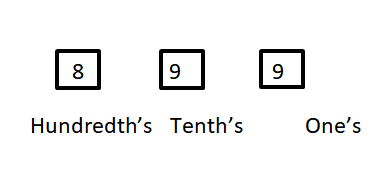
So, from the principle of fundamental counting number of three digit numbers having no digits as $5$ is
$
= 8 \times 9 \times 9 \\
= 648 \\
$
Hence, the number of three digits numbers having no digits as \[5{\text{ is 648}}{\text{.}}\]
Note: This problem is based on fundamental counting principle and for similar problems like this we have to find the number of ways a task can be done. These types of problems exclude the way which is not required and count the others left. In a three digit number zero cannot be placed at the hundredth’s place because the number will no longer be a three digit number.
Complete step-by-step answer:
We know that
A three digit number has three places Ones, tenths and hundredths. Each place can be filled with any number between \[0{\text{ to 9}}\] .
For a three digit number without$5$ , hundreds place can be filled with any number except $0{\text{ and 5}}{\text{.}}$
Therefore the number of digits that can be placed at the hundredth’s place is $8$ .
Number 5 cannot be used as mentioned in the question.
So, number of digits that can be placed in tenth’s place is $9.$
And, number of digits that can be placed in one’s place is $9.$
So, from the principle of fundamental counting number of three digit numbers having no digits as $5$ is
$
= 8 \times 9 \times 9 \\
= 648 \\
$
Hence, the number of three digits numbers having no digits as \[5{\text{ is 648}}{\text{.}}\]
Note: This problem is based on fundamental counting principle and for similar problems like this we have to find the number of ways a task can be done. These types of problems exclude the way which is not required and count the others left. In a three digit number zero cannot be placed at the hundredth’s place because the number will no longer be a three digit number.

Recently Updated Pages
Three beakers labelled as A B and C each containing 25 mL of water were taken A small amount of NaOH anhydrous CuSO4 and NaCl were added to the beakers A B and C respectively It was observed that there was an increase in the temperature of the solutions contained in beakers A and B whereas in case of beaker C the temperature of the solution falls Which one of the following statements isarecorrect i In beakers A and B exothermic process has occurred ii In beakers A and B endothermic process has occurred iii In beaker C exothermic process has occurred iv In beaker C endothermic process has occurred

Master Class 7 Social Science: Engaging Questions & Answers for Success
Master Class 7 Science: Engaging Questions & Answers for Success
Master Class 7 Maths: Engaging Questions & Answers for Success
Class 7 Question and Answer - Your Ultimate Solutions Guide
Master Class 9 Social Science: Engaging Questions & Answers for Success
Three beakers labelled as A B and C each containing 25 mL of water were taken A small amount of NaOH anhydrous CuSO4 and NaCl were added to the beakers A B and C respectively It was observed that there was an increase in the temperature of the solutions contained in beakers A and B whereas in case of beaker C the temperature of the solution falls Which one of the following statements isarecorrect i In beakers A and B exothermic process has occurred ii In beakers A and B endothermic process has occurred iii In beaker C exothermic process has occurred iv In beaker C endothermic process has occurred
Master Class 7 Social Science: Engaging Questions & Answers for Success
Master Class 7 Science: Engaging Questions & Answers for Success
Trending doubts
How many thousands make a crore class 7 maths CBSE
When phenolphthalein is added toNaOH the colour of class 7 chemistry CBSE
The HCF of 24721284 and a third number N is 12 If their class 7 maths CBSE
Find HCF and LCM of 510 and 92 by applying the prime class 7 maths CBSE
AIM To prepare stained temporary mount of onion peel class 7 biology CBSE
How many 5digit numbers are there in all class 7 maths CBSE