




What will be the number of histone molecules in a chromatin fibre having $50$ nucleosomes?
A. $400$
B. $450$
C. $500$
D. $1000$
Answer
 Verified
475.2k+ views
Hint: Nucleosome is a DNA coiled around a core of histone proteins. It looks like a thread wrapped around a spool. It is the fundamental subunit of chromatin. It is constituted by less than two turns of DNA. It serves as the basic structural unit of packaging of DNA in eukaryotic organisms. It acts as a scaffold as a means to the formation of higher order chromatin structure and also in regulatory control of expression of genes.
Complete answer:
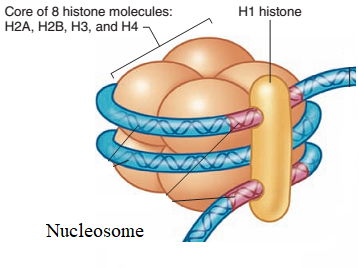
Fig.: Arrangement of Histones
Histones are classified into two types, namely, linker histones and core histones. There are eight subunits (histone octamer) present in the core histones. A pair of H$2$A, H$2$B, H$3$ and H$4$ are included. In addition, one linker histone H$1$ is also involved in the formation of nucleosomes. So, there are eight core histones and one linker histone and so, 9 should be taken for multiplication with nucleosomes. Therefore, the number of histone molecules in a chromatin fiber containing $50$ nucleosomes will be $50x9 = 450$
The linker histone binds to the nucleosome at the exit and entry sites of DNA, thereby locking DNA in a spot, resulting in the formation of higher order structures. Core histones play structural support in assembling chromatin and compaction through the formation of nucleosomes. It binds to the linker DNA, while linker histones form the core of the nucleosome.
Option B$450$: The total number of required histones form $50$ nucleosomes is $450$
Option B is correct
Additional Information:
Option A$400$: $400$is not the number obtained in the calculation
Hence, Option A is not correct
Option C $500$: The answer obtained from the estimation is $450$
So, Option C is not correct
Option D $1000$: This option is not probable.
Option D is not correct
Hence Option B is the correct answer.
Note:
Histone is a protein, which offers structural support to the chromosomes. Few variants of histones are involved in gene expression. They are particularly basic proteins, occur in the arginine and lysine residues, which are present in the eukaryotic cell nucleus. They possess positive charges, which aid them to associate with the negatively charged DNA molecules via electrostatic interactions.
Complete answer:
Fig.: Arrangement of Histones
Histones are classified into two types, namely, linker histones and core histones. There are eight subunits (histone octamer) present in the core histones. A pair of H$2$A, H$2$B, H$3$ and H$4$ are included. In addition, one linker histone H$1$ is also involved in the formation of nucleosomes. So, there are eight core histones and one linker histone and so, 9 should be taken for multiplication with nucleosomes. Therefore, the number of histone molecules in a chromatin fiber containing $50$ nucleosomes will be $50x9 = 450$
The linker histone binds to the nucleosome at the exit and entry sites of DNA, thereby locking DNA in a spot, resulting in the formation of higher order structures. Core histones play structural support in assembling chromatin and compaction through the formation of nucleosomes. It binds to the linker DNA, while linker histones form the core of the nucleosome.
Option B$450$: The total number of required histones form $50$ nucleosomes is $450$
Option B is correct
Additional Information:
Option A$400$: $400$is not the number obtained in the calculation
Hence, Option A is not correct
Option C $500$: The answer obtained from the estimation is $450$
So, Option C is not correct
Option D $1000$: This option is not probable.
Option D is not correct
Hence Option B is the correct answer.
Note:
Histone is a protein, which offers structural support to the chromosomes. Few variants of histones are involved in gene expression. They are particularly basic proteins, occur in the arginine and lysine residues, which are present in the eukaryotic cell nucleus. They possess positive charges, which aid them to associate with the negatively charged DNA molecules via electrostatic interactions.
Recently Updated Pages
Master Class 12 Economics: Engaging Questions & Answers for Success

Master Class 12 Physics: Engaging Questions & Answers for Success
Master Class 12 English: Engaging Questions & Answers for Success
Master Class 12 Social Science: Engaging Questions & Answers for Success
Master Class 12 Maths: Engaging Questions & Answers for Success
Master Class 12 Business Studies: Engaging Questions & Answers for Success
Trending doubts
Which are the Top 10 Largest Countries of the World?
What are the major means of transport Explain each class 12 social science CBSE
Draw a labelled sketch of the human eye class 12 physics CBSE
Why cannot DNA pass through cell membranes class 12 biology CBSE
Differentiate between insitu conservation and exsitu class 12 biology CBSE
Draw a neat and well labeled diagram of TS of ovary class 12 biology CBSE