




The number of benzylic hydrogen atoms in ethyl benzene is:
(A) 3
(B) 5
(C) 2
(D) 7
Answer
 Verified
593.7k+ views
Hint: Draw the expanded structure of ethyl benzene. This structure should display hydrogen atoms as well. Now determine the number of hydrogen atoms present in the aromatic ring. Count the hydrogen atoms that are directly attached to the aromatic ring i.e. benzene.
Complete step by step answer:
As suggested in the hint we will draw the expanded structure of the organic compound ethyl benzene.
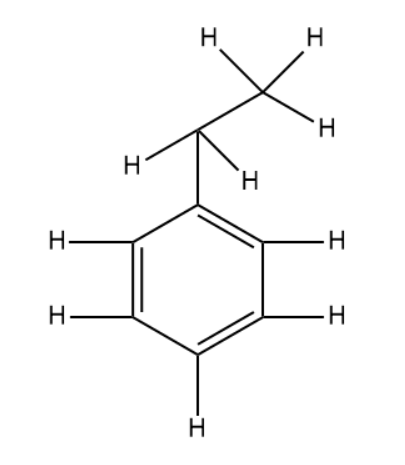
Benzylic hydrogen refers to the hydrogen atoms that are directly attached to the aromatic system i.e benzene in this case.
The total number of benzylic hydrogen atoms are 5.
So, the correct answer is “Option B”.
Additional Information:
Benzene is an aromatic compound as it has resonance and obeys the Debye Huckel rule. Benzene does not undergo addition reactions. This is because, upon addition the aromaticity of the system ceases to exist which is highly unstable and infeasible. This is the reaction benzene and most aromatic systems undergo substitution reactions. In this type of reaction, the incoming atom or group is replaced by the benzylic hydrogen atom.
Note: It is important to know that although there are more than 5 hydrogen atoms seen in the diagram they are not counted as benzylic hydrogen atoms. This is because they are attached to the carbon atom which is not part of the benzene ring. Instead it is considered as a substituted group and is thus not counted in calculation performed above.
Complete step by step answer:
As suggested in the hint we will draw the expanded structure of the organic compound ethyl benzene.
Benzylic hydrogen refers to the hydrogen atoms that are directly attached to the aromatic system i.e benzene in this case.
The total number of benzylic hydrogen atoms are 5.
So, the correct answer is “Option B”.
Additional Information:
Benzene is an aromatic compound as it has resonance and obeys the Debye Huckel rule. Benzene does not undergo addition reactions. This is because, upon addition the aromaticity of the system ceases to exist which is highly unstable and infeasible. This is the reaction benzene and most aromatic systems undergo substitution reactions. In this type of reaction, the incoming atom or group is replaced by the benzylic hydrogen atom.
Note: It is important to know that although there are more than 5 hydrogen atoms seen in the diagram they are not counted as benzylic hydrogen atoms. This is because they are attached to the carbon atom which is not part of the benzene ring. Instead it is considered as a substituted group and is thus not counted in calculation performed above.
Recently Updated Pages
Three beakers labelled as A B and C each containing 25 mL of water were taken A small amount of NaOH anhydrous CuSO4 and NaCl were added to the beakers A B and C respectively It was observed that there was an increase in the temperature of the solutions contained in beakers A and B whereas in case of beaker C the temperature of the solution falls Which one of the following statements isarecorrect i In beakers A and B exothermic process has occurred ii In beakers A and B endothermic process has occurred iii In beaker C exothermic process has occurred iv In beaker C endothermic process has occurred

Master Class 12 Social Science: Engaging Questions & Answers for Success
Master Class 12 Physics: Engaging Questions & Answers for Success
Master Class 12 Maths: Engaging Questions & Answers for Success
Master Class 12 Economics: Engaging Questions & Answers for Success
Master Class 12 Chemistry: Engaging Questions & Answers for Success
Three beakers labelled as A B and C each containing 25 mL of water were taken A small amount of NaOH anhydrous CuSO4 and NaCl were added to the beakers A B and C respectively It was observed that there was an increase in the temperature of the solutions contained in beakers A and B whereas in case of beaker C the temperature of the solution falls Which one of the following statements isarecorrect i In beakers A and B exothermic process has occurred ii In beakers A and B endothermic process has occurred iii In beaker C exothermic process has occurred iv In beaker C endothermic process has occurred
Master Class 12 Social Science: Engaging Questions & Answers for Success
Master Class 12 Physics: Engaging Questions & Answers for Success
Trending doubts
Which are the Top 10 Largest Countries of the World?
Draw a labelled sketch of the human eye class 12 physics CBSE
Explain the structure of megasporangium class 12 biology CBSE
What are the major means of transport Explain each class 12 social science CBSE
Differentiate between homogeneous and heterogeneous class 12 chemistry CBSE
Sulphuric acid is known as the king of acids State class 12 chemistry CBSE