



The number of balls of radius 1 cm that can be made from a solid sphere of radius 4 cm is
A.64
B.16
C.12
D.4
Answer
 Verified
615k+ views
Hint: First of all we need to calculate the volume of both the spheres are of radius 1 cm and radius 4 cm. Using the formula of volume \[v = \dfrac{{4\pi }}{3}{r^3}\] . Hence, on calculating the volumes of both spheres and on taking the ratio of bigger solid sphere to smaller solid sphere hence, total number of balls can be obtained.
Complete step-by-step answer:
As the given information, the radius of the spheres are of radius 1 cm and radius 4 cm.
Diagram:
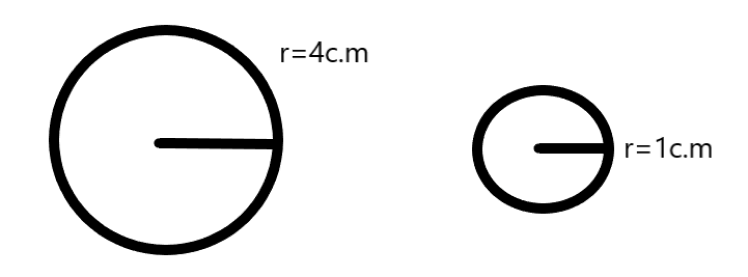
Volume of a sphere is given by \[v = \dfrac{{4\pi }}{3}{r^3}\]
Let \[{r_1}\]is radius of bigger sphere so \[{r_1} = 4\,cm\]
And \[{r_2}\]is radius of smaller sphere so \[{r_2} = 1c.m\]
Hence, now for calculating the numbers of balls we take the ratios of volume of the bigger sphere to the smaller sphere.
\[n = \dfrac{{\dfrac{{4\pi }}{3}{r_1}^3}}{{\dfrac{{4\pi }}{3}{r_2}^3}}\]
On cancelling out common terms, we get,
\[n = \dfrac{{{r_1}^3}}{{{r_2}^3}}\]
Now, substituting the values of radius, \[{r_1} = 4cm\] and \[{r_2} = 1cm\], we get,
\[n = \dfrac{{{4^3}}}{{{1^3}}}\]
On simplification we get,
\[n = 64\]
Hence, the number of balls of radius 1 cm that can be made from a solid sphere of radius 4 cm is \[64\].
Hence, option (A) is the correct answer.
Note: You can think that if we scoop out spheres from a big sphere there would be waste portion, and hence the number of balls can be less than 64, but here we are not considering that case, and we will use the extra part and reform it to make balls.
A sphere is a geometrical object in three-dimensional space that is the surface of a ball. Like a circle in a two-dimensional space, a sphere is defined mathematically as the set of points that are all at the same distance r from a given point in a three-dimensional space.
Complete step-by-step answer:
As the given information, the radius of the spheres are of radius 1 cm and radius 4 cm.
Diagram:
Volume of a sphere is given by \[v = \dfrac{{4\pi }}{3}{r^3}\]
Let \[{r_1}\]is radius of bigger sphere so \[{r_1} = 4\,cm\]
And \[{r_2}\]is radius of smaller sphere so \[{r_2} = 1c.m\]
Hence, now for calculating the numbers of balls we take the ratios of volume of the bigger sphere to the smaller sphere.
\[n = \dfrac{{\dfrac{{4\pi }}{3}{r_1}^3}}{{\dfrac{{4\pi }}{3}{r_2}^3}}\]
On cancelling out common terms, we get,
\[n = \dfrac{{{r_1}^3}}{{{r_2}^3}}\]
Now, substituting the values of radius, \[{r_1} = 4cm\] and \[{r_2} = 1cm\], we get,
\[n = \dfrac{{{4^3}}}{{{1^3}}}\]
On simplification we get,
\[n = 64\]
Hence, the number of balls of radius 1 cm that can be made from a solid sphere of radius 4 cm is \[64\].
Hence, option (A) is the correct answer.
Note: You can think that if we scoop out spheres from a big sphere there would be waste portion, and hence the number of balls can be less than 64, but here we are not considering that case, and we will use the extra part and reform it to make balls.
A sphere is a geometrical object in three-dimensional space that is the surface of a ball. Like a circle in a two-dimensional space, a sphere is defined mathematically as the set of points that are all at the same distance r from a given point in a three-dimensional space.
Recently Updated Pages
Master Class 12 Business Studies: Engaging Questions & Answers for Success

Master Class 12 Biology: Engaging Questions & Answers for Success
Master Class 12 Chemistry: Engaging Questions & Answers for Success
Class 12 Question and Answer - Your Ultimate Solutions Guide
Master Class 11 Social Science: Engaging Questions & Answers for Success
Master Class 11 English: Engaging Questions & Answers for Success
Trending doubts
Find the sum of series 1 + 2 + 3 + 4 + 5 + + 100 class 9 maths CBSE
Fill the blanks with the suitable prepositions 1 The class 9 english CBSE
Difference Between Plant Cell and Animal Cell
How many hours before the closure of election must class 9 social science CBSE
What is pollution? How many types of pollution? Define it
Name 10 Living and Non living things class 9 biology CBSE