




The number electric field lines of force emerging out of a closed surface is 1000, and then the charge enclosed by the surface is:
$\begin{align}
& (A)8.854\times {{10}^{-9}}C \\
& (B)8.854\times {{10}^{-4}}C \\
& (C)8.854\times {{10}^{-1}}C \\
& (D)8.854C \\
\end{align}$
Answer
 Verified
583.5k+ views
Hint: The number of electric field lines of force emerging out of a closed surface represents the flux and we need to find the charge enclosed. The Gauss law of electrostatics relates the amount of charge enclosed with flux, so it is ideal to use the Gauss law in this case.
Formula used:
$\phi =\dfrac{q}{{{\varepsilon }_{0}}}$
Where q is the enclosed charge
Complete step by step answer:
The Gauss law in electrostatics states that the total flux out of a closed surface is equal to the charge enclosed divided by the permittivity of free space.
$\phi =\dfrac{q}{{{\varepsilon }_{0}}}$
$q$ is the enclosed charge
$\phi $ is the electric flux
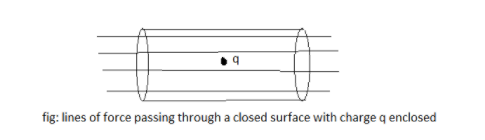
Given,
No of lines emerging out of the closed surface=1000
To find: The charge enclosed by the closed surface
According to the Gauss law of electrostatics, the electric flux and charge are related as follows:
$\phi =\dfrac{q}{{{\varepsilon }_{0}}}$
Here, electric flux is given by the number of lines emerging out of the closed surface, which is equal to 1000
Plugging the value of $\phi $ and ${{\varepsilon }_{0}}$ which is a constant, we have
$\begin{align}
& \Rightarrow \phi =\dfrac{q}{{{\varepsilon }_{0}}} \\
& \Rightarrow 1000=\dfrac{q}{8.8419\times {{10}^{-12}}} \\
& \Rightarrow q=8.8419\times {{10}^{-9}}C \\
\end{align}$
The enclosed charge can thus be given as $(A)8.854\times {{10}^{-9}}C$
Additional Information:
By the definition of electric flux, it is clear that it is given by the number of field lines emerging out of a closed surface. Electric flux is a property of electric fields. It describes the influence of electric field lines over a given surface. The relation called the Gauss’s law is only valid for closed Gaussian surfaces and cannot be applied elsewhere.
Note:
Gauss law of electrostatics is one of the four Maxwell equations. In this problem, it is applied to calculate the electric charge when the number of field lines emerging out of a closed surface is given. Conversely, it can also be applied to calculate the flux or the number of field lines coming out of a closed surface when the total charge enclosed by the closed surface is given.
Formula used:
$\phi =\dfrac{q}{{{\varepsilon }_{0}}}$
Where q is the enclosed charge
Complete step by step answer:
The Gauss law in electrostatics states that the total flux out of a closed surface is equal to the charge enclosed divided by the permittivity of free space.
$\phi =\dfrac{q}{{{\varepsilon }_{0}}}$
$q$ is the enclosed charge
$\phi $ is the electric flux
Given,
No of lines emerging out of the closed surface=1000
To find: The charge enclosed by the closed surface
According to the Gauss law of electrostatics, the electric flux and charge are related as follows:
$\phi =\dfrac{q}{{{\varepsilon }_{0}}}$
Here, electric flux is given by the number of lines emerging out of the closed surface, which is equal to 1000
Plugging the value of $\phi $ and ${{\varepsilon }_{0}}$ which is a constant, we have
$\begin{align}
& \Rightarrow \phi =\dfrac{q}{{{\varepsilon }_{0}}} \\
& \Rightarrow 1000=\dfrac{q}{8.8419\times {{10}^{-12}}} \\
& \Rightarrow q=8.8419\times {{10}^{-9}}C \\
\end{align}$
The enclosed charge can thus be given as $(A)8.854\times {{10}^{-9}}C$
Additional Information:
By the definition of electric flux, it is clear that it is given by the number of field lines emerging out of a closed surface. Electric flux is a property of electric fields. It describes the influence of electric field lines over a given surface. The relation called the Gauss’s law is only valid for closed Gaussian surfaces and cannot be applied elsewhere.
Note:
Gauss law of electrostatics is one of the four Maxwell equations. In this problem, it is applied to calculate the electric charge when the number of field lines emerging out of a closed surface is given. Conversely, it can also be applied to calculate the flux or the number of field lines coming out of a closed surface when the total charge enclosed by the closed surface is given.
Recently Updated Pages
Master Class 12 Economics: Engaging Questions & Answers for Success

Master Class 12 Physics: Engaging Questions & Answers for Success
Master Class 12 English: Engaging Questions & Answers for Success
Master Class 12 Social Science: Engaging Questions & Answers for Success
Master Class 12 Maths: Engaging Questions & Answers for Success
Master Class 12 Business Studies: Engaging Questions & Answers for Success
Trending doubts
Which are the Top 10 Largest Countries of the World?
What are the major means of transport Explain each class 12 social science CBSE
Draw a labelled sketch of the human eye class 12 physics CBSE
Why cannot DNA pass through cell membranes class 12 biology CBSE
Differentiate between insitu conservation and exsitu class 12 biology CBSE
Draw a neat and well labeled diagram of TS of ovary class 12 biology CBSE