




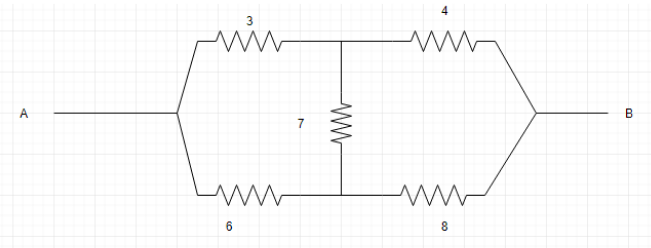
the net resistance of the circuit b/w a and b is?
A. $8/3 \Omega$
B. $14/3\Omega $
C. $16/3 \Omega$
D.$22/3 \Omega$
Answer
 Verified
572.7k+ views
Hint: While doing such problems we first check whether the given circuit satisfies the Wheatstone bridge condition or not. If the condition of the Wheatstone bridge is not satisfied then we have to make use of Kirchhoff’s law by making loops and then dividing current and applying Ohm’s law for each individual resistor.
Complete step by step answer:
We first of all check the condition of Wheatstone bridge:
$\dfrac{3}{6}=\dfrac{4}{8} \\
\Rightarrow \dfrac{1}{2}=\dfrac{1}{2} $
Thus, this is a balanced Wheatstone bridge and so, no current flows through the 7 Ω resistor.So, the resistance of 3 Ω and 4 Ω are in series and their equivalent resistance is 7 Ω. Similarly, resistance 6 Ω and 8 Ω are in series and their equivalent resistance is 14 ΩThus, 7 Ω and 14 Ω are in parallel and their equivalent resistance can be given by:
\[R=\dfrac{7\times 14}{7+14}\\
\therefore R =\dfrac{14}{3}\Omega \]
So, the correct option is B.
Note:Resistors are said to be connected in parallel when both of their terminals are connected to each terminal of the other resistor. There is more than one path available to the current. They are also known as current dividers. If one of the components in the parallel circuit gets fused, it does not affect the performance of other componentsIn the parallel combination the voltage across both of the resistors will always be the same but the current will get divided.
Complete step by step answer:
We first of all check the condition of Wheatstone bridge:
$\dfrac{3}{6}=\dfrac{4}{8} \\
\Rightarrow \dfrac{1}{2}=\dfrac{1}{2} $
Thus, this is a balanced Wheatstone bridge and so, no current flows through the 7 Ω resistor.So, the resistance of 3 Ω and 4 Ω are in series and their equivalent resistance is 7 Ω. Similarly, resistance 6 Ω and 8 Ω are in series and their equivalent resistance is 14 ΩThus, 7 Ω and 14 Ω are in parallel and their equivalent resistance can be given by:
\[R=\dfrac{7\times 14}{7+14}\\
\therefore R =\dfrac{14}{3}\Omega \]
So, the correct option is B.
Note:Resistors are said to be connected in parallel when both of their terminals are connected to each terminal of the other resistor. There is more than one path available to the current. They are also known as current dividers. If one of the components in the parallel circuit gets fused, it does not affect the performance of other componentsIn the parallel combination the voltage across both of the resistors will always be the same but the current will get divided.
Recently Updated Pages
Basicity of sulphurous acid and sulphuric acid are

Master Class 12 English: Engaging Questions & Answers for Success
Master Class 12 Social Science: Engaging Questions & Answers for Success
Master Class 12 Maths: Engaging Questions & Answers for Success
Master Class 12 Economics: Engaging Questions & Answers for Success
Master Class 12 Physics: Engaging Questions & Answers for Success
Trending doubts
Which country did Danny Casey play for class 12 english CBSE
Give 10 examples of unisexual and bisexual flowers
Coming together federation is practiced in A India class 12 social science CBSE
Write the formula to find the shortest distance between class 12 maths CBSE
Find the foot of the perpendicular from point232to class 12 maths CBSE
How was the Civil Disobedience Movement different from class 12 social science CBSE