




The nature of X-rays spectrum is
(A) Continuous
(B) Line
(C) Continuous and line
(D) None of these
Answer
 Verified
635.4k+ views
Hint: For answering this question, we need to recall the experiment of the generation of the X-rays inside a vacuum tube. We have to analyse the interactions taking place between the electrons and the target atom. The type of the interaction will decide the nature of the X-rays spectrum, linear or continuous.
Complete step by step solution:
The electrons are subjected to an accelerating potential which gives the electrons high energy. These high energy electrons are made to interact with the target atom in an X-ray tube. The electrons get penetrated inside the X-ray tube due to this high energy. There is Coulomb’s interaction for each electron to the corresponding target atom. This interaction makes the electrons lose their energy. When they lose their energy, two kinds of X-rays are produced
(i) When the electrons lose their entire energy in a single interaction, the X-rays of continuous spectrum are generated. In this case the attacking electrons are scattered elastically by the target atom. So the electrons get decelerated and as we know that when a charged particle accelerates, it emits radiation. So, it emits a continuous X-ray spectrum.
(ii) It also happens that the attacking electrons knock out the inner shell electrons from the target atom, thereby creating a vacancy. The atom rearranges its electronic configuration to fill this vacancy. For this, an electron inside the atom makes a transition from the higher energy level to the lower energy level. Thus, the characteristic X-rays are emitted which have a linear spectrum.
Hence, the correct answer is option C, continuous and line.
Note:
We can answer this question by directly looking at the graph of the intensity variation of the X-rays with the wavelength.
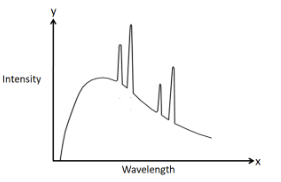
As we can clearly see in the graph, there exists a continuous region which represents the continuous spectrum and also there exists discrete lines which represent the characteristic spectrum.
Complete step by step solution:
The electrons are subjected to an accelerating potential which gives the electrons high energy. These high energy electrons are made to interact with the target atom in an X-ray tube. The electrons get penetrated inside the X-ray tube due to this high energy. There is Coulomb’s interaction for each electron to the corresponding target atom. This interaction makes the electrons lose their energy. When they lose their energy, two kinds of X-rays are produced
(i) When the electrons lose their entire energy in a single interaction, the X-rays of continuous spectrum are generated. In this case the attacking electrons are scattered elastically by the target atom. So the electrons get decelerated and as we know that when a charged particle accelerates, it emits radiation. So, it emits a continuous X-ray spectrum.
(ii) It also happens that the attacking electrons knock out the inner shell electrons from the target atom, thereby creating a vacancy. The atom rearranges its electronic configuration to fill this vacancy. For this, an electron inside the atom makes a transition from the higher energy level to the lower energy level. Thus, the characteristic X-rays are emitted which have a linear spectrum.
Hence, the correct answer is option C, continuous and line.
Note:
We can answer this question by directly looking at the graph of the intensity variation of the X-rays with the wavelength.
As we can clearly see in the graph, there exists a continuous region which represents the continuous spectrum and also there exists discrete lines which represent the characteristic spectrum.
Recently Updated Pages
Which of the following graphs shows the variation of class 12 physics CBSE

Draw a labelled diagram of the human male reproductive class 12 biology CBSE
Describe the experiment to compare the emf of two cells class 12 physics CBSE
What is standard hydrogen electrode
What is conventional current and electric current class 12 physics CBSE
2Bromopentane is treated with an alcoholic KOH solution class 12 chemistry CBSE
Trending doubts
Draw a labelled sketch of the human eye class 12 physics CBSE
Which are the Top 10 Largest Countries of the World?
Differentiate between homogeneous and heterogeneous class 12 chemistry CBSE
Draw ray diagrams each showing i myopic eye and ii class 12 physics CBSE
Which is the correct genotypic ratio of mendel dihybrid class 12 biology CBSE
What is the Full Form of PVC, PET, HDPE, LDPE, PP and PS ?