




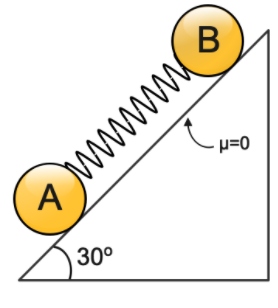
The natural forces to move the sphere A and B on a \[30^\circ \] smooth incline are 25 N and 5N.The spring constant is $100{\text{ }}N{m^{ - 1}}$ .Find the elongation in the spring ($g = 10{\text{ }}m{s^{ - 2}}$)
Answer
 Verified
570k+ views
Hint: In order to solve the question, we will first make the free body diagram of the figure given in the question then we will find the natural forces applied on the balls while moving on the incline plane after then we will find the acceleration to check the elongation of both spheres.
Formula Used:
$F = ma$
F refers to force
M refers to mass
A refers to acceleration
Complete step by step solution:
In the question we are given to sphere on an inclined plane connected to each other and on both of the sphere force is applied and we have to find the elongation in the spring
it is also given that the natural forces are only applied on the sphere to move which means only gravitation force is applied and it is also mentioned that value of $g = 10{\text{ }}m{s^{ - 2}}$
it is also given in the diagram that coefficient of friction is zero which means the surface of the incline plane is frictionless
angle of inclination of inclined plane = \[30^\circ \]
force applied on spring A = 25 N
force applied on spring B = 5 N
spring constant is $100{\text{ }}N{m^{ - 1}}$
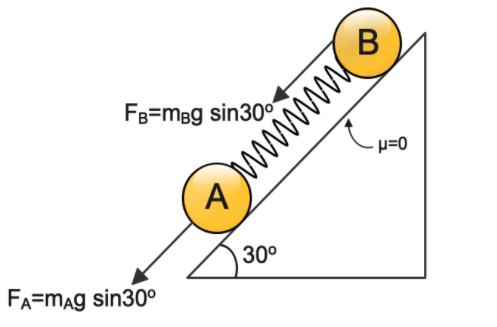
This is free body diagram of the spheres on which gravitational force is applied
On both the spheres A and B due same inclination same force is applied gravitational force on the downward direction and in the direction of falling force is applied
According to FDB
Sphere A
${F_A} = {M_A}g\sin 30^\circ $
force applied on spring A = 25 N
$25N = {M_A}g\sin 30^\circ $
Acceleration applied is \[g\sin 30^\circ \] on Sphere A
Sphere B
${F_B} = {M_B}g\sin 30^\circ $
force applied on spring A = 5 N
$5N = {M_B}g\sin 30^\circ $
Acceleration applied is \[g\sin 30^\circ \] on Sphere B
As we can see that the both spheres have the same acceleration so both of them are sliding freely, that’s why there will be no elongation
Note: Many of the people will be confused by the extra values and the variable given in the question for example spring constant is given in the question but it has no use as well as forces also does play any part in the calculation it only factorizes that the mass of both spheres are different but both of them are moving with the same acceleration.
Formula Used:
$F = ma$
F refers to force
M refers to mass
A refers to acceleration
Complete step by step solution:
In the question we are given to sphere on an inclined plane connected to each other and on both of the sphere force is applied and we have to find the elongation in the spring
it is also given that the natural forces are only applied on the sphere to move which means only gravitation force is applied and it is also mentioned that value of $g = 10{\text{ }}m{s^{ - 2}}$
it is also given in the diagram that coefficient of friction is zero which means the surface of the incline plane is frictionless
angle of inclination of inclined plane = \[30^\circ \]
force applied on spring A = 25 N
force applied on spring B = 5 N
spring constant is $100{\text{ }}N{m^{ - 1}}$
This is free body diagram of the spheres on which gravitational force is applied
On both the spheres A and B due same inclination same force is applied gravitational force on the downward direction and in the direction of falling force is applied
According to FDB
Sphere A
${F_A} = {M_A}g\sin 30^\circ $
force applied on spring A = 25 N
$25N = {M_A}g\sin 30^\circ $
Acceleration applied is \[g\sin 30^\circ \] on Sphere A
Sphere B
${F_B} = {M_B}g\sin 30^\circ $
force applied on spring A = 5 N
$5N = {M_B}g\sin 30^\circ $
Acceleration applied is \[g\sin 30^\circ \] on Sphere B
As we can see that the both spheres have the same acceleration so both of them are sliding freely, that’s why there will be no elongation
Note: Many of the people will be confused by the extra values and the variable given in the question for example spring constant is given in the question but it has no use as well as forces also does play any part in the calculation it only factorizes that the mass of both spheres are different but both of them are moving with the same acceleration.
Recently Updated Pages
If x a + bt + ct2 where x is in meters and t is in class 11 physics CBSE

A car covers the first half distance between two places class 11 physics CBSE
The resultant of two vectors overrightarrow P and overrightarrow class 11 physics CBSE
Find the value of cos 135 class 11 maths CBSE
A mass M is held in place by an applied force F and class 11 physics CBSE
A solution of glucose in water is labelled as 10 dfracwv class 11 chemistry CBSE
Trending doubts
One Metric ton is equal to kg A 10000 B 1000 C 100 class 11 physics CBSE
Find the value of the expression given below sin 30circ class 11 maths CBSE
What do you mean by retardation What is its SI uni class 11 physics CBSE
Draw a diagram of nephron and explain its structur class 11 biology CBSE
10 examples of friction in our daily life
Difference between physical and chemical change class 11 chemistry CBSE