




The most suitable material for making the core of an electromagnet is
A) Tin
B) Zinc
C) Soft iron
D) Steel
Answer
 Verified
621k+ views
Hint: An electromagnet is a type of a magnet in which a magnetic field is produced by an electric current. Electromagnets usually consist of wire wound into a coil. A current through the wire creates a magnetic field. We need a material that adds on the strength and forgets magnetism when power is turned off. Tin can’t do that nor steel because they don’t lose all magnetism after power off.
Complete step by step answer:
It is very important to know the basic principle on which electromagnet works. Below there is a diagram for a clear understanding and working of it.
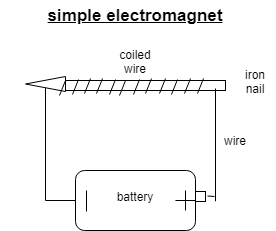
Working of an electromagnet:
An electromagnet works on the principle of magnetism. The difference is that the electricity is provided to the coil to increase the strength of the magnetism. The material should be used of that quality which retains the magnetic property easily and loses it after the power off.
The copper coil wounded on the nail makes stronger magnetism in the presence of electricity. Here it is provided by a battery.
The soft iron core is used to make electromagnets as it gains and loses magnetism quickly depending upon the presence of existence magnetic fields as compared to other items given in the options. The armature is also made of soft iron which can induce magnetism rapidly. No matter what direction is the current flow.
It can create a concentrated field that is as much as 50,000 times more intense than an air core. Iron is desirable to make magnetic cores, as it can withstand high levels of the magnetic field without saturating. It is also used because unlike hard iron, it does not remain magnetized when the field is removed, which is often important in applications where the magnetic field is required to be repeatedly switched.
Hence soft iron is used to make electromagnets because of its properties in retaining and losing magnetism. So, option C is correct.
Note:
Electromagnets are very widely used in electric and electromechanical devices including:
- Motors and generators
- Transformers
- Pickups
- Relays
- Electric bells and buzzers
- Loudspeakers and headphones
- Actuators such as valves
- Magnetic recording and data storage equipment: tape, recorders, VCRs, hard disks, etc.
Complete step by step answer:
It is very important to know the basic principle on which electromagnet works. Below there is a diagram for a clear understanding and working of it.
Working of an electromagnet:
An electromagnet works on the principle of magnetism. The difference is that the electricity is provided to the coil to increase the strength of the magnetism. The material should be used of that quality which retains the magnetic property easily and loses it after the power off.
The copper coil wounded on the nail makes stronger magnetism in the presence of electricity. Here it is provided by a battery.
The soft iron core is used to make electromagnets as it gains and loses magnetism quickly depending upon the presence of existence magnetic fields as compared to other items given in the options. The armature is also made of soft iron which can induce magnetism rapidly. No matter what direction is the current flow.
It can create a concentrated field that is as much as 50,000 times more intense than an air core. Iron is desirable to make magnetic cores, as it can withstand high levels of the magnetic field without saturating. It is also used because unlike hard iron, it does not remain magnetized when the field is removed, which is often important in applications where the magnetic field is required to be repeatedly switched.
Hence soft iron is used to make electromagnets because of its properties in retaining and losing magnetism. So, option C is correct.
Note:
Electromagnets are very widely used in electric and electromechanical devices including:
- Motors and generators
- Transformers
- Pickups
- Relays
- Electric bells and buzzers
- Loudspeakers and headphones
- Actuators such as valves
- Magnetic recording and data storage equipment: tape, recorders, VCRs, hard disks, etc.
Recently Updated Pages
Master Class 12 Economics: Engaging Questions & Answers for Success

Master Class 12 English: Engaging Questions & Answers for Success
Master Class 12 Social Science: Engaging Questions & Answers for Success
Master Class 12 Maths: Engaging Questions & Answers for Success
Master Class 12 Physics: Engaging Questions & Answers for Success
Master Class 9 General Knowledge: Engaging Questions & Answers for Success
Trending doubts
Which are the Top 10 Largest Countries of the World?
Draw a labelled sketch of the human eye class 12 physics CBSE
Differentiate between homogeneous and heterogeneous class 12 chemistry CBSE
Why is the cell called the structural and functional class 12 biology CBSE
Draw ray diagrams each showing i myopic eye and ii class 12 physics CBSE
Which is the correct genotypic ratio of mendel dihybrid class 12 biology CBSE