




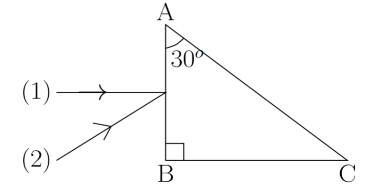
The minimum value of refractive index of the material of the prism for which the ray (1) undergoes total internal reflection on the face \[AC\] is:
A. \[22\]
B. \[2\]
C. \[5\]
D. \[\sqrt 2 \]
Answer
 Verified
558.6k+ views
Hint: Refractive Index is a value calculated from the ratio of the speed of light in a vacuum to that in a second medium of greater density. We know that if the angle between two lines is the same as the angle between their perpendiculars and one of right angles, the prism is always \[{90^o}\]. The angle of incidence should be minimum for total internal reflection (i.e., \[\theta \geqslant {i_c}\]). Using Snell's law we find the minimum value of the refractive index.
Complete step by step answer:
Snell's Law states that the ratio of the sine of the angles of incidence and reflection is equal to the ratio of the refractive index of the materials at the interface.
i.e., \[{n_1}\sin {\theta _1} = {n_2}\sin {\theta _2}\]
where \[{n_1}\]and \[{n_2}\] are refractive indices of first and second materials respectively. \[{\theta _1}\]and \[{\theta _2}\] be the angle of incidence and angle of reflection respectively.
Since the given first medium is air with angle of incidence is \[{90^o}\]. Let \[\mu \] be the refractive index and \[{i_c}\]be the angle of reflection of the material of the prism. Then by Snell’s law we get
\[1 = \mu \sin {i_c}\]--(2)
Since the angle between two lines is same as the angle between their perpendiculars so the given figures can be as follows
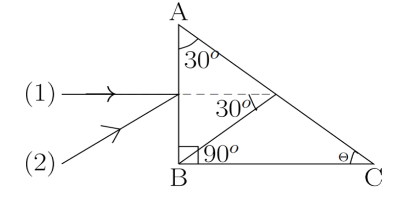
Let \[ABC\] is a right angled prism. A ray (1) is incident on the face \[AB\] along the normal. Now the condition is, ray (1) undergoes total internal reflection on the face \[AC\]. Since, ray (1) falls on \[AC\] at an angle of incidence \[{30^o}\].
So, from the condition of total internal reflection, we have
\[{30^o} \geqslant {i_c}\]--(3)
Taking sine in the expression (3), we get
\[\sin {30^o} \geqslant \sin {i_c}\]
\[ \Rightarrow \]\[\dfrac{1}{2} \geqslant \sin {i_c}\]
\[ \Rightarrow \]\[\dfrac{1}{2} \geqslant \dfrac{1}{\mu }\]
\[\therefore \mu \geqslant 2\]
Therefore, the minimum value of \[\mu \] is \[2\].
Hence the correct option is B.
Note: We know that the minimum angle for total internal reflection is the critical angle. The angle of the right-angled prism is \[{90^o}\]. Then the maximum value of the \[\theta \] is calculated corresponding to the minimum value of the angle of incidence. Total internal reflection occurs when light passes through denser medium to the lighter medium.
Complete step by step answer:
Snell's Law states that the ratio of the sine of the angles of incidence and reflection is equal to the ratio of the refractive index of the materials at the interface.
i.e., \[{n_1}\sin {\theta _1} = {n_2}\sin {\theta _2}\]
where \[{n_1}\]and \[{n_2}\] are refractive indices of first and second materials respectively. \[{\theta _1}\]and \[{\theta _2}\] be the angle of incidence and angle of reflection respectively.
Since the given first medium is air with angle of incidence is \[{90^o}\]. Let \[\mu \] be the refractive index and \[{i_c}\]be the angle of reflection of the material of the prism. Then by Snell’s law we get
\[1 = \mu \sin {i_c}\]--(2)
Since the angle between two lines is same as the angle between their perpendiculars so the given figures can be as follows
Let \[ABC\] is a right angled prism. A ray (1) is incident on the face \[AB\] along the normal. Now the condition is, ray (1) undergoes total internal reflection on the face \[AC\]. Since, ray (1) falls on \[AC\] at an angle of incidence \[{30^o}\].
So, from the condition of total internal reflection, we have
\[{30^o} \geqslant {i_c}\]--(3)
Taking sine in the expression (3), we get
\[\sin {30^o} \geqslant \sin {i_c}\]
\[ \Rightarrow \]\[\dfrac{1}{2} \geqslant \sin {i_c}\]
\[ \Rightarrow \]\[\dfrac{1}{2} \geqslant \dfrac{1}{\mu }\]
\[\therefore \mu \geqslant 2\]
Therefore, the minimum value of \[\mu \] is \[2\].
Hence the correct option is B.
Note: We know that the minimum angle for total internal reflection is the critical angle. The angle of the right-angled prism is \[{90^o}\]. Then the maximum value of the \[\theta \] is calculated corresponding to the minimum value of the angle of incidence. Total internal reflection occurs when light passes through denser medium to the lighter medium.
Recently Updated Pages
Basicity of sulphurous acid and sulphuric acid are

Master Class 12 Economics: Engaging Questions & Answers for Success
Master Class 12 Biology: Engaging Questions & Answers for Success
Master Class 11 English: Engaging Questions & Answers for Success
Master Class 11 Physics: Engaging Questions & Answers for Success
Master Class 11 Computer Science: Engaging Questions & Answers for Success
Trending doubts
Draw a labelled sketch of the human eye class 12 physics CBSE
The chemical formula of tear gas is A CO Cl 2 B C 10 class 12 chemistry CBSE
Draw ray diagrams each showing i myopic eye and ii class 12 physics CBSE
Which are the Top 10 Largest Countries of the World?
Differentiate between homogeneous and heterogeneous class 12 chemistry CBSE
Which is the correct genotypic ratio of mendel dihybrid class 12 biology CBSE