




The minimum distance between an object and its real image formed by a convex lens is:
(A) $ \dfrac{2}{3}f $
(B) $ 2f $
(C) $ \dfrac{5}{2}f $
(D) $ 4f $
Answer
 Verified
564.3k+ views
Hint :To solve this type of problem. We should know about the Convex lens and the characteristics of the image formed by it.
Convex lens:- This type of lens is thick at middle and thin at upper and lower edge of the lens. This converges the ray of light passing through it. Hence it is converging in nature.
Focus point: The point on the principal axis of the lens at which all parallel rays of light coming from infinity get converged.
By using lens formula:
$ \dfrac{1}{f} = \dfrac{1}{v} - \dfrac{1}{u} $
Complete Step By Step Answer:
Let’s draw a ray diagram as per given below.
Let $ I $ is the real image of an object which is placed at $ O $ . Let $ d $ be the distance between them. If the distance of the image from the center of the lens is $ x $ then the distance between object and center of lens will be, $ (d - x) $ .
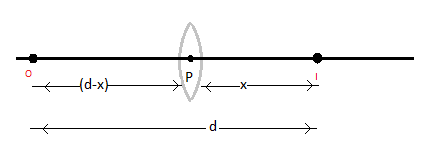
As we know, sign convention for convex lenses.
Thus, $ u = - (d - x) $ and $ v = + x $
$ \dfrac{1}{f} = \dfrac{1}{x} - \dfrac{1}{{ - (d - x)}} $
$ \Rightarrow \dfrac{1}{f} = \dfrac{1}{x} + \dfrac{1}{{(d - x)}} $
$ \Rightarrow {x^2} - xd - fd = 0 $
For a real image, the value of $ x $ must be a real number, for roots of equation will be real when,
$ {d^2} \geqslant 4fd $
$ d \geqslant 4f $
Hence, from the above equation we get the minimum distance between an object and its real image formed by a convex lens is $ d = 4f $ .
So, the correct option will be (d).
Note :
We can solve this problem by using a ray diagram. If u have good knowledge of trigonometry then u can easily solve it. Concave lens is a diverging lens and Convex lens will be a converging lens. This lens is formed by joining two spherical surfaces. If one side of the spherical surface is painted then this will act as a concave and convex mirror which we use in our daily life like a vehicle side mirror, dental appliances, solar cooker etc. They can enlarge and diminish the image of objects.
Convex lens:- This type of lens is thick at middle and thin at upper and lower edge of the lens. This converges the ray of light passing through it. Hence it is converging in nature.
Focus point: The point on the principal axis of the lens at which all parallel rays of light coming from infinity get converged.
By using lens formula:
$ \dfrac{1}{f} = \dfrac{1}{v} - \dfrac{1}{u} $
Complete Step By Step Answer:
Let’s draw a ray diagram as per given below.
Let $ I $ is the real image of an object which is placed at $ O $ . Let $ d $ be the distance between them. If the distance of the image from the center of the lens is $ x $ then the distance between object and center of lens will be, $ (d - x) $ .
As we know, sign convention for convex lenses.
Thus, $ u = - (d - x) $ and $ v = + x $
$ \dfrac{1}{f} = \dfrac{1}{x} - \dfrac{1}{{ - (d - x)}} $
$ \Rightarrow \dfrac{1}{f} = \dfrac{1}{x} + \dfrac{1}{{(d - x)}} $
$ \Rightarrow {x^2} - xd - fd = 0 $
For a real image, the value of $ x $ must be a real number, for roots of equation will be real when,
$ {d^2} \geqslant 4fd $
$ d \geqslant 4f $
Hence, from the above equation we get the minimum distance between an object and its real image formed by a convex lens is $ d = 4f $ .
So, the correct option will be (d).
Note :
We can solve this problem by using a ray diagram. If u have good knowledge of trigonometry then u can easily solve it. Concave lens is a diverging lens and Convex lens will be a converging lens. This lens is formed by joining two spherical surfaces. If one side of the spherical surface is painted then this will act as a concave and convex mirror which we use in our daily life like a vehicle side mirror, dental appliances, solar cooker etc. They can enlarge and diminish the image of objects.
Recently Updated Pages
Master Class 12 Business Studies: Engaging Questions & Answers for Success

Master Class 12 Biology: Engaging Questions & Answers for Success
Master Class 12 Chemistry: Engaging Questions & Answers for Success
Class 12 Question and Answer - Your Ultimate Solutions Guide
Master Class 11 Social Science: Engaging Questions & Answers for Success
Master Class 11 English: Engaging Questions & Answers for Success
Trending doubts
Which is more stable and why class 12 chemistry CBSE
Which are the Top 10 Largest Countries of the World?
Draw a labelled sketch of the human eye class 12 physics CBSE
Differentiate between homogeneous and heterogeneous class 12 chemistry CBSE
What are the major means of transport Explain each class 12 social science CBSE
Sulphuric acid is known as the king of acids State class 12 chemistry CBSE