




The mid-point of the line joining the points $\left( { - 10.8} \right){\text{ and }}\left( { - 6,12} \right)$ divides the line joining the points $\left( {4, - 2} \right){\text{ and }}\left( { - 2,4} \right)$ in the ratio:
$\left( 1 \right)1:2{\text{ internally}}$
$\left( 2 \right)1:2{\text{ externally}}$
$\left( 3 \right)2:1{\text{ internally}}$
$\left( 4 \right)2:1{\text{ externally}}$
$\left( 5 \right)2:3{\text{ externally}}$
Answer
 Verified
538.2k+ views
Hint: We must be familiar with the concept of section formula for internal and external division for a segment in order to solve this question. The section formula helps us to find the co-ordinates of the point dividing the segment if the section ratio in which the point divides the given line segment is known. The section formula is of two types and these types depend on the point which divides the line segment means it can be present internally or externally. We must also know how to write the equation of a line segment via the point slope form. In order to solve this question we will proceed with first finding the equation for both line segments, then we will use these equations to find the co-ordinates of the mid-point and then with the help of section formula we will find the section ratio which has been asked in this question.
Complete step by step answer:
$\left( 1 \right)$ Section formula for internal division:
If $C$ is the point which divides the line segment $AB$ internally (means the point $c$ is present on the line segment) in the ratio $m:n$ , then the co-ordinates of point $C$ are given by;
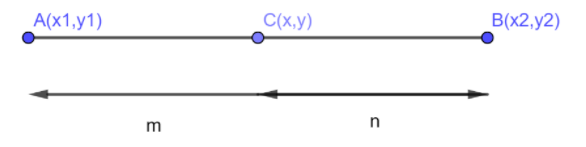
$ \Rightarrow C\left( {x,y} \right) = \left( {\dfrac{{m{x_2} + n{x_1}}}{{m + n}},\dfrac{{m{y_2} + n{y_1}}}{{m + n}}} \right)$
$\left( 2 \right)$ Section formula for external division:
If $C$ is the point which divides the line segment $AB$ externally (means the point $c$ lies outside the line segment) in the ratio $m:n$ , then the co-ordinates of point $C$ are given by;
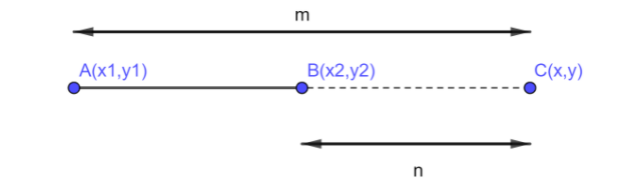
$ \Rightarrow C\left( {x,y} \right) = \left( {\dfrac{{m{x_2} - n{x_1}}}{{m - n}},\dfrac{{m{y_2} - n{y_1}}}{{m - n}}} \right)$
Now, according to the question let us draw the scenario given to us;
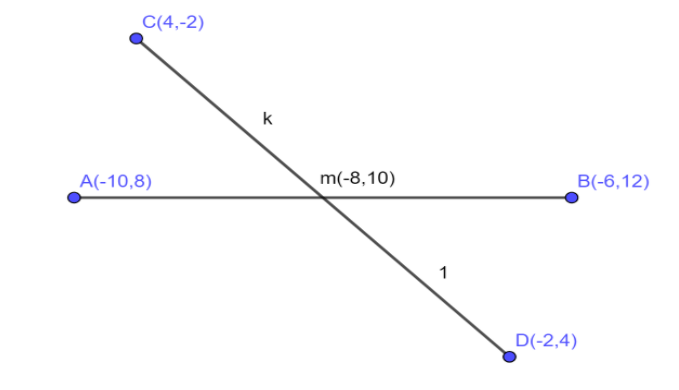
Firstly, we will find the equation of the line ${\text{AB}}$ by the point slope form of equations;
$ \Rightarrow y - {y_1} = \dfrac{{{y_2} - {y_1}}}{{{x_2} - {x_1}}}\left( {x - {x_1}} \right)$
The line segment $\left( {{\text{AB}}} \right){\text{ has points }}\left( { - 10,8} \right){\text{ and }}\left( { - 6,12} \right){\text{ as }}\left( {{x_1},{y_1}} \right){\text{ and }}\left( {{x_2},{y_2}} \right)$ respectively;
$\therefore y - 8 = \dfrac{{12 - 8}}{{ - 6 + 10}}\left( {x + 10} \right)$
Further simplifying the above equation,
$ \Rightarrow y - 8 = x + 10$
Therefore we get the equation of the line segment ${\text{AB}}$ as;
$ \Rightarrow x - y + 18 = 0{\text{ }}......\left( 1 \right)$
Now, we will find the equation of the line ${\text{CD}}$ by the point slope form of equations;
The line segment $\left( {{\text{CD}}} \right){\text{ has points }}\left( {4, - 2} \right){\text{ and }}\left( { - 2,4} \right){\text{ as }}\left( {{x_1},{y_1}} \right){\text{ and }}\left( {{x_2},{y_2}} \right)$ respectively;
$\therefore y + 2 = \dfrac{{4 + 2}}{{ - 2 - 4}}\left( {x - 4} \right)$
Further simplifying the above equation,
$ \Rightarrow y + 2 = - x + 4$
Therefore we get the equation of the line segment ${\text{CD}}$ as;
$ \Rightarrow x + y - 2 = 0{\text{ }}......\left( 2 \right)$
Solving equation $\left( 1 \right)$ and equation $\left( 2 \right)$ to find the values of $x{\text{ and y}}$ ;
Adding equations $\left( 1 \right)$ and equation $\left( 2 \right)$ , we get;
$ \Rightarrow x - y + 18 + x + y - 2 = 0$
$ \Rightarrow 2x + 16 = 0$
$\therefore x = - 8$
Put the Value of $x{\text{ in equation }}\left( 2 \right)$ , we get;
$ \Rightarrow - 8 + y - 2 = 0$
$\therefore y = 10$
Since we have the value of mid-point $\left( {x,y} \right) = \left( { - 8,10} \right)$ , now we can use the section formula to find out the section ratio;
So, let $\left( { - 8,10} \right)$ divide the joining of $\left( {4, - 2} \right){\text{ and }}\left( { - 2,4} \right)$ in the ratio ${\text{k : 1}}$ ;
Using section formula we have ;
$ \Rightarrow - 8 = \dfrac{{ - 2k + 4}}{{k + 1}}{\text{ }}......\left( 3 \right)$
And also, $10 = \dfrac{{4k - 2}}{{k + 1}}{\text{ }}......\left( 4 \right)$
Using any of the above equation, we can find the value of $k$ ;
Using equation $\left( 3 \right)$ , we have;
$ \Rightarrow - 8k - 8 = - 2k + 4$
$ \Rightarrow - 6k = 12$
Therefore, $k = - 2$ .
Here, the value of $k$ is negative which means that this is a case of external division .
Therefore, the correct answer for this question is option $\left( 4 \right)$ , i.e. $2:1{\text{ externally}}{\text{.}}$

Note: Significance of negative section ratio: The negative ratio tells us that the point dividing the line segment ${\text{CD}}$ i.e. ${\text{m}}$ , actually lies outside the line segment means this is a case of external division. We can also notice this via the given points of the line segment ${\text{CD}}$ , the given points are $\left( {4, - 2} \right){\text{ and }}\left( { - 2,4} \right)$ and we have calculated the co-ordinates of the point ${\text{m}}\left( {x,y} \right) = \left( { - 8,10} \right)$ , therefore the point ${\text{m}}$ definitely lies outside the line segment ${\text{CD}}$. Figure $\left( 4 \right)$ gives us more clarity on this graphically.
Complete step by step answer:
$\left( 1 \right)$ Section formula for internal division:
If $C$ is the point which divides the line segment $AB$ internally (means the point $c$ is present on the line segment) in the ratio $m:n$ , then the co-ordinates of point $C$ are given by;
$ \Rightarrow C\left( {x,y} \right) = \left( {\dfrac{{m{x_2} + n{x_1}}}{{m + n}},\dfrac{{m{y_2} + n{y_1}}}{{m + n}}} \right)$
$\left( 2 \right)$ Section formula for external division:
If $C$ is the point which divides the line segment $AB$ externally (means the point $c$ lies outside the line segment) in the ratio $m:n$ , then the co-ordinates of point $C$ are given by;
$ \Rightarrow C\left( {x,y} \right) = \left( {\dfrac{{m{x_2} - n{x_1}}}{{m - n}},\dfrac{{m{y_2} - n{y_1}}}{{m - n}}} \right)$
Now, according to the question let us draw the scenario given to us;
Firstly, we will find the equation of the line ${\text{AB}}$ by the point slope form of equations;
$ \Rightarrow y - {y_1} = \dfrac{{{y_2} - {y_1}}}{{{x_2} - {x_1}}}\left( {x - {x_1}} \right)$
The line segment $\left( {{\text{AB}}} \right){\text{ has points }}\left( { - 10,8} \right){\text{ and }}\left( { - 6,12} \right){\text{ as }}\left( {{x_1},{y_1}} \right){\text{ and }}\left( {{x_2},{y_2}} \right)$ respectively;
$\therefore y - 8 = \dfrac{{12 - 8}}{{ - 6 + 10}}\left( {x + 10} \right)$
Further simplifying the above equation,
$ \Rightarrow y - 8 = x + 10$
Therefore we get the equation of the line segment ${\text{AB}}$ as;
$ \Rightarrow x - y + 18 = 0{\text{ }}......\left( 1 \right)$
Now, we will find the equation of the line ${\text{CD}}$ by the point slope form of equations;
The line segment $\left( {{\text{CD}}} \right){\text{ has points }}\left( {4, - 2} \right){\text{ and }}\left( { - 2,4} \right){\text{ as }}\left( {{x_1},{y_1}} \right){\text{ and }}\left( {{x_2},{y_2}} \right)$ respectively;
$\therefore y + 2 = \dfrac{{4 + 2}}{{ - 2 - 4}}\left( {x - 4} \right)$
Further simplifying the above equation,
$ \Rightarrow y + 2 = - x + 4$
Therefore we get the equation of the line segment ${\text{CD}}$ as;
$ \Rightarrow x + y - 2 = 0{\text{ }}......\left( 2 \right)$
Solving equation $\left( 1 \right)$ and equation $\left( 2 \right)$ to find the values of $x{\text{ and y}}$ ;
Adding equations $\left( 1 \right)$ and equation $\left( 2 \right)$ , we get;
$ \Rightarrow x - y + 18 + x + y - 2 = 0$
$ \Rightarrow 2x + 16 = 0$
$\therefore x = - 8$
Put the Value of $x{\text{ in equation }}\left( 2 \right)$ , we get;
$ \Rightarrow - 8 + y - 2 = 0$
$\therefore y = 10$
Since we have the value of mid-point $\left( {x,y} \right) = \left( { - 8,10} \right)$ , now we can use the section formula to find out the section ratio;
So, let $\left( { - 8,10} \right)$ divide the joining of $\left( {4, - 2} \right){\text{ and }}\left( { - 2,4} \right)$ in the ratio ${\text{k : 1}}$ ;
Using section formula we have ;
$ \Rightarrow - 8 = \dfrac{{ - 2k + 4}}{{k + 1}}{\text{ }}......\left( 3 \right)$
And also, $10 = \dfrac{{4k - 2}}{{k + 1}}{\text{ }}......\left( 4 \right)$
Using any of the above equation, we can find the value of $k$ ;
Using equation $\left( 3 \right)$ , we have;
$ \Rightarrow - 8k - 8 = - 2k + 4$
$ \Rightarrow - 6k = 12$
Therefore, $k = - 2$ .
Here, the value of $k$ is negative which means that this is a case of external division .
Therefore, the correct answer for this question is option $\left( 4 \right)$ , i.e. $2:1{\text{ externally}}{\text{.}}$
Note: Significance of negative section ratio: The negative ratio tells us that the point dividing the line segment ${\text{CD}}$ i.e. ${\text{m}}$ , actually lies outside the line segment means this is a case of external division. We can also notice this via the given points of the line segment ${\text{CD}}$ , the given points are $\left( {4, - 2} \right){\text{ and }}\left( { - 2,4} \right)$ and we have calculated the co-ordinates of the point ${\text{m}}\left( {x,y} \right) = \left( { - 8,10} \right)$ , therefore the point ${\text{m}}$ definitely lies outside the line segment ${\text{CD}}$. Figure $\left( 4 \right)$ gives us more clarity on this graphically.
Recently Updated Pages
Master Class 11 Social Science: Engaging Questions & Answers for Success

Master Class 11 Chemistry: Engaging Questions & Answers for Success
Master Class 9 General Knowledge: Engaging Questions & Answers for Success
Master Class 9 Maths: Engaging Questions & Answers for Success
Master Class 9 Science: Engaging Questions & Answers for Success
Master Class 9 English: Engaging Questions & Answers for Success
Trending doubts
One Metric ton is equal to kg A 10000 B 1000 C 100 class 11 physics CBSE
Difference Between Prokaryotic Cells and Eukaryotic Cells
Two of the body parts which do not appear in MRI are class 11 biology CBSE
1 ton equals to A 100 kg B 1000 kg C 10 kg D 10000 class 11 physics CBSE
Explain zero factorial class 11 maths CBSE
10 examples of friction in our daily life