




The microscopic pollen grains of the past are obtained as fossils.
Mention the characteristics of pollen grains that make it happen.
A. Intine is made up of sporopollenin
B. The exine is made up of sporopollenin
C. Both intine and exine are made up of sporopollenin
D. None of the above
Answer
 Verified
617.1k+ views
Hint: The pollen grains have two layers: intine and exine.
The fossils are evidence of a long period of time.
So, the most resistant, hard, and thick portion of the pollen grain will help to obtained fossil
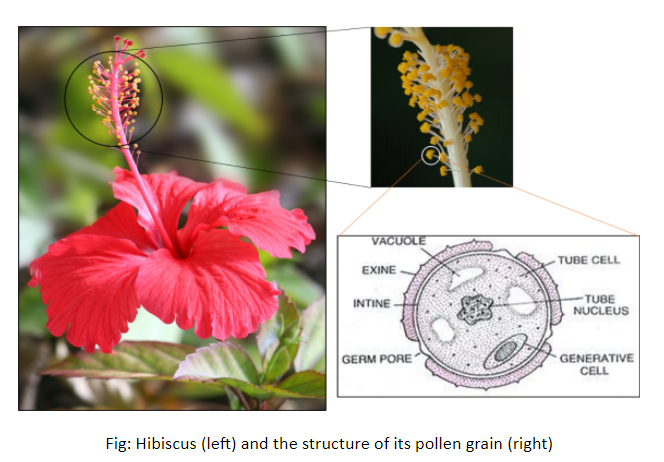
Complete answer: The wall of a pollen grain consists of two layers – the outer portion is called exine and the inner portion is called intine.
1. The exine is the hard outer layer that is made up of sporopollenin.
2. Sporopollenin is one of the most commonly known resistant organic material.
It can survive in a harsh environment like high temperature, strong acid, or alkali and is not degraded by enzymes. Due to the presence of sporopollenin, pollen grains are well conserved as fossils.
3. In many organisms, the exine is thin or absent. These can have thickened intine that has a deposition of callose within it. Sporopollenin is absent in germ pores or germinal furrows.
4. Sporopollenin is more resistant than intine and it is chemically very stable.
It is usually well preserved in soils and sediments. Thus, it can remain as it is for millions of years.
So, the correct answer is “Option A”.
Note: Pollen are often defined as a powdery substance that consists of pollen grains which are the male microgametophytes. This helps to produce male gamete cells or sperm cells of seed plants. The sporopollenin of pollen grains protects the gametophytes during their movement from the stamens to the pistil of flowering plants, or from the male cone to the feminine cone of coniferous plants.
The fossils are evidence of a long period of time.
So, the most resistant, hard, and thick portion of the pollen grain will help to obtained fossil
Complete answer: The wall of a pollen grain consists of two layers – the outer portion is called exine and the inner portion is called intine.
1. The exine is the hard outer layer that is made up of sporopollenin.
2. Sporopollenin is one of the most commonly known resistant organic material.
It can survive in a harsh environment like high temperature, strong acid, or alkali and is not degraded by enzymes. Due to the presence of sporopollenin, pollen grains are well conserved as fossils.
3. In many organisms, the exine is thin or absent. These can have thickened intine that has a deposition of callose within it. Sporopollenin is absent in germ pores or germinal furrows.
4. Sporopollenin is more resistant than intine and it is chemically very stable.
It is usually well preserved in soils and sediments. Thus, it can remain as it is for millions of years.
So, the correct answer is “Option A”.
Note: Pollen are often defined as a powdery substance that consists of pollen grains which are the male microgametophytes. This helps to produce male gamete cells or sperm cells of seed plants. The sporopollenin of pollen grains protects the gametophytes during their movement from the stamens to the pistil of flowering plants, or from the male cone to the feminine cone of coniferous plants.
Recently Updated Pages
Master Class 12 Economics: Engaging Questions & Answers for Success

Master Class 12 English: Engaging Questions & Answers for Success
Master Class 12 Social Science: Engaging Questions & Answers for Success
Master Class 12 Maths: Engaging Questions & Answers for Success
Master Class 12 Physics: Engaging Questions & Answers for Success
Master Class 9 General Knowledge: Engaging Questions & Answers for Success
Trending doubts
Which are the Top 10 Largest Countries of the World?
Draw a labelled sketch of the human eye class 12 physics CBSE
Differentiate between homogeneous and heterogeneous class 12 chemistry CBSE
Sulphuric acid is known as the king of acids State class 12 chemistry CBSE
Why is the cell called the structural and functional class 12 biology CBSE
Draw ray diagrams each showing i myopic eye and ii class 12 physics CBSE